Useche Sergio, Alonso Francisco, Montoro Luis, Garrigós Leandro
DATS (Development and Advising in Traffic Safety) Research Group - INTRAS (Research Institute on Traffic and Road Safety), Universitat de Valencia, Valencia, Valencian Community, Spain
DATS (Development and Advising in Traffic Safety) Research Group - INTRAS (Research Institute on Traffic and Road Safety), Universitat de Valencia, Valencia, Valencian Community, Spain.
BMJ Open. 2019 Nov 25;9(11):e035007. doi: 10.1136/bmjopen-2019-035007.
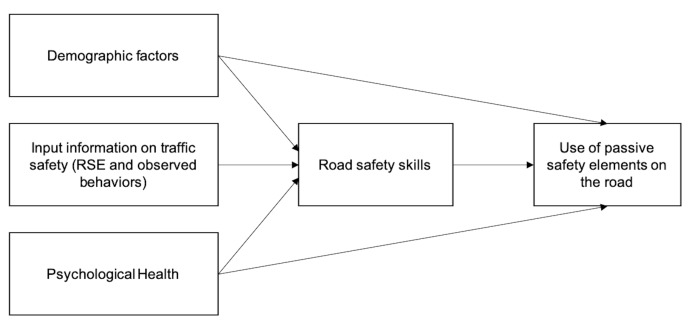
This study had two objectives: first, to test the effects of sociodemographic variables, and the effects of three key road safety skills (knowledge-risk perception-attitudes) on the use of passive safety elements (PSEs) among teenagers; and second, to assess the differential impact of the study variables on PSEs use from a gender-based perspective.
This cross-sectional study was framed in the paradigm of primary care, and it involved students from several educational centres in Spain. A sample of 827 Spanish teenagers (52.4% females and 47.6% males) with a mean age of M=14.41-7 (12-19) years was used.
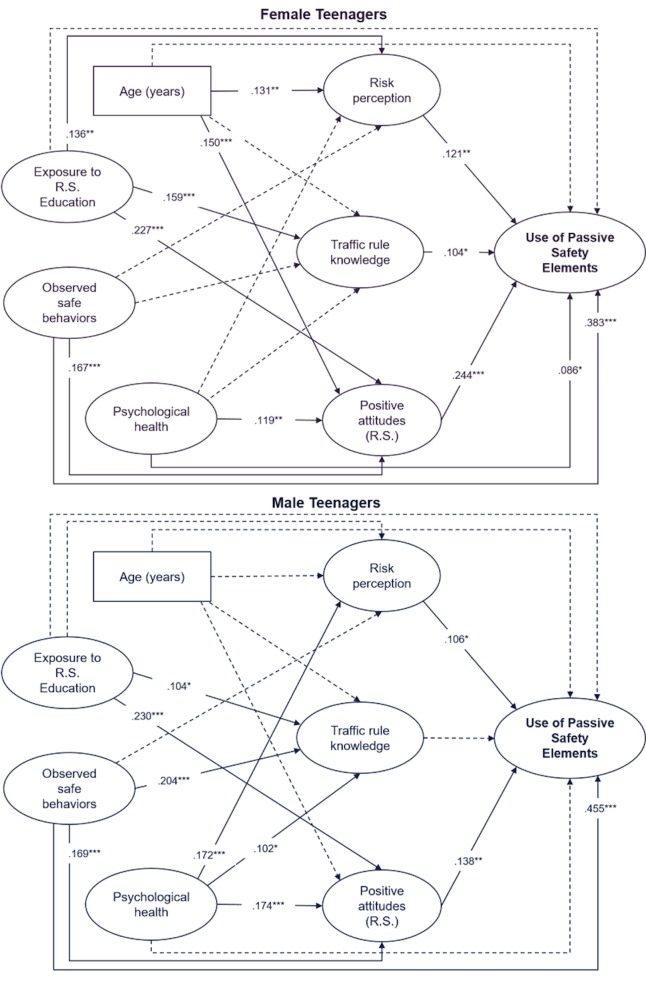
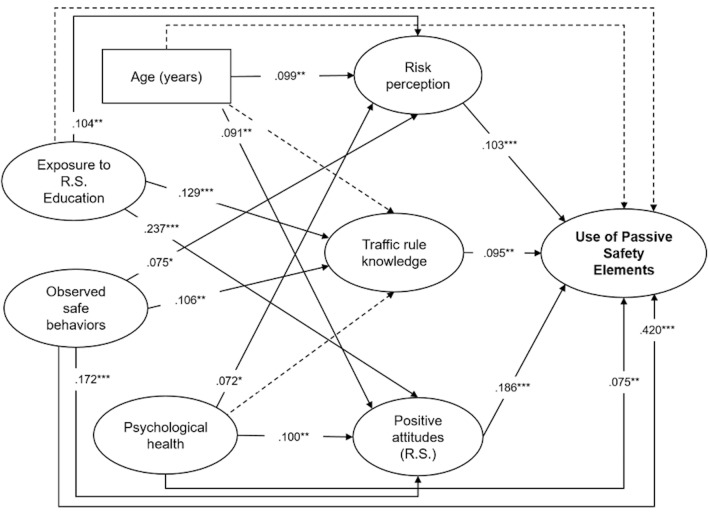
Through SEM modelling, we found that the use of PSEs is largely explained by psychosocial variables through the mediation of three road safety skills: risk perception (β=0.103), rule knowledge (β=0.095) and attitudes towards road safety (β=0.186). Furthermore, multigroup analyses showed that, although most variables explain the use of PSEs among teenagers in a similar way, key gender-based differences exist in this regard.
Road safety skills have a significant effect on the use of PSEs among Spanish teenagers, and gender explains some differences in the mechanisms which predict them. Also, in the study we discuss the need for strengthening school-based interventions aimed at helping this vulnerable group of road users acquire and develop positive behavioural competences.
本研究有两个目的:第一,测试社会人口统计学变量以及三种关键道路安全技能(知识 - 风险感知 - 态度)对青少年使用被动安全元件(PSE)的影响;第二,从基于性别的角度评估研究变量对PSE使用的差异影响。
本横断面研究以初级保健模式为框架,涉及西班牙多个教育中心的学生。使用了827名西班牙青少年样本(女性占52.4%,男性占47.6%),平均年龄M = 14.41 - 7(12 - 19)岁。
通过结构方程模型(SEM)建模,我们发现PSE的使用很大程度上由社会心理变量通过三种道路安全技能的中介作用来解释:风险感知(β = 0.103)、规则知识(β = 0.095)和对道路安全的态度(β = 0.186)。此外,多组分析表明,尽管大多数变量以类似方式解释青少年对PSE的使用,但在这方面存在基于性别的关键差异。
道路安全技能对西班牙青少年使用PSE有显著影响,性别解释了预测这些技能的机制中的一些差异。此外,在本研究中我们讨论了加强以学校为基础的干预措施的必要性,旨在帮助这一易受伤害的道路使用者群体获得并发展积极的行为能力。