
大黄酚通过调节SIRT1/HMGB1/NF-κB信号通路减轻糖尿病小鼠的心肌损伤。
Chrysophanol alleviates myocardial injury in diabetic mice by regulating the SIRT1/HMGB1/NF-κB signaling pathway.
作者信息
Xue Peng, Zhao Jing, Zheng Aibin, Li Lin, Chen Huaqin, Tu Wenjuan, Zhang Ning, Yu Zhangbin, Wang Qiuwei, Gu Meng
机构信息
Department of Pediatrics, Changzhou Children's Hospital of Nantong Medical University, Changzhou, Jiangsu 213003, P.R. China.
Department of Pediatrics, Nanjing Maternity and Child Health Care Hospital of Nanjing Medical University, Nangjing, Jiangsu 210004, P.R. China.
出版信息
Exp Ther Med. 2019 Dec;18(6):4406-4412. doi: 10.3892/etm.2019.8083. Epub 2019 Oct 7.
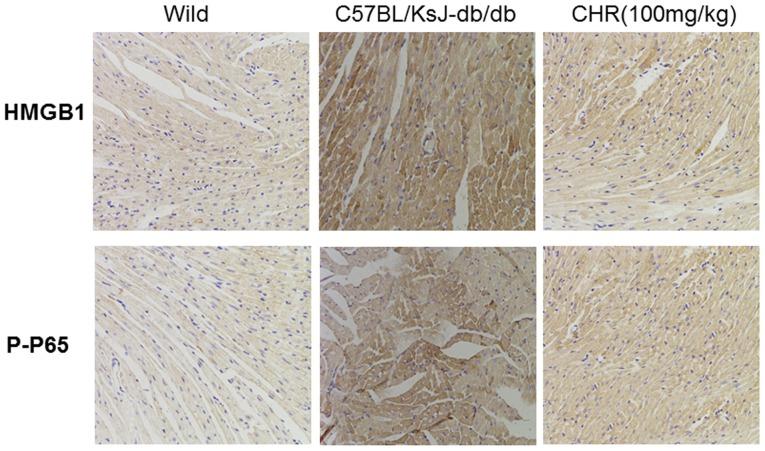
Myocardial injury induced by diabetes has become an increasing health problem. Chrysophanol (CHR) has been widely studied as a potential treatment for many diseases due to its anti-inflammatory effects, but has not been investigated in regard to diabetes-induced myocardial injury. The present study evaluated the myocardial protective effects of CHR in C57BL/KsJ- diabetic mice. C57BL/KsJ- and C57BLKS/J mice were treated with vehicle, metformin (100 mg/kg/day) or CHR (50 or 100 mg/kg/day) for 28 days. An oral glucose tolerance test was performed to detect blood glucose levels. Blood lipids, triglycerides, total cholesterol, myocardial function-associated enzymes, namely creatine kinase (CK) and lactate dehydrogenase (LDH), and insulin levels were analyzed. TNF-α, interleukin (IL)-1β and IL-6 inflammatory cytokine levels in serum and myocardial tissues were determined by ELISA. Expression of silent information regulator l (SIRT1) and high mobility group box 1/NF-κB pathway-associated proteins in myocardial tissues were measured by western blot analysis and immunohistochemistry. CHR treatment at both concentrations markedly decreased blood lipid and serum insulin levels, and inhibited the myocardial enzymes CK and LDH. CHR also significantly ameliorated the cardiac pathological changes in diabetic mice. The inflammatory cytokine levels that were increased in C57BL/KsJ-/ diabetic mice were downregulated by CHR treatment. CHR also increased SIRT1 protein expression and inhibited activation of the HMGB1/NF-κB pathway. In conclusion, the present study indicates that CHR effectively protected against diabetic myocardial injury via regulation of SIRT1 and the HMGB1/NF-κB signaling pathway.
糖尿病所致的心肌损伤已成为一个日益严重的健康问题。由于其抗炎作用,大黄酚(CHR)作为多种疾病的潜在治疗药物已得到广泛研究,但尚未针对糖尿病诱导的心肌损伤进行研究。本研究评估了CHR对C57BL/KsJ糖尿病小鼠的心肌保护作用。将C57BL/KsJ和C57BLKS/J小鼠用赋形剂、二甲双胍(100mg/kg/天)或CHR(50或100mg/kg/天)处理28天。进行口服葡萄糖耐量试验以检测血糖水平。分析血脂、甘油三酯、总胆固醇、心肌功能相关酶,即肌酸激酶(CK)和乳酸脱氢酶(LDH)以及胰岛素水平。通过ELISA测定血清和心肌组织中TNF-α、白细胞介素(IL)-1β和IL-6炎症细胞因子水平。通过蛋白质印迹分析和免疫组织化学测量心肌组织中沉默信息调节因子1(SIRT1)和高迁移率族蛋白B1/NF-κB通路相关蛋白的表达。两种浓度的CHR处理均显著降低血脂和血清胰岛素水平,并抑制心肌酶CK和LDH。CHR还显著改善了糖尿病小鼠的心脏病理变化。CHR处理下调了C57BL/KsJ糖尿病小鼠中升高的炎症细胞因子水平。CHR还增加了SIRT1蛋白表达并抑制了HMGB1/NF-κB通路的激活。总之,本研究表明CHR通过调节SIRT1和HMGB1/NF-κB信号通路有效预防糖尿病心肌损伤。


 Zotero 插件