Wei Lanyi, Zhang Wenrui, Li Yueyang, Zhai Jinghui
Department of Clinical Pharmacy, The First Hospital of Jilin University, Changchun, Jilin, China.
Department of Pharmacy, Shanghai Jiao Tong University Affiliated Sixth People's Hospital, Shanghai, China.
Front Cell Dev Biol. 2022 Aug 19;10:986511. doi: 10.3389/fcell.2022.986511. eCollection 2022.
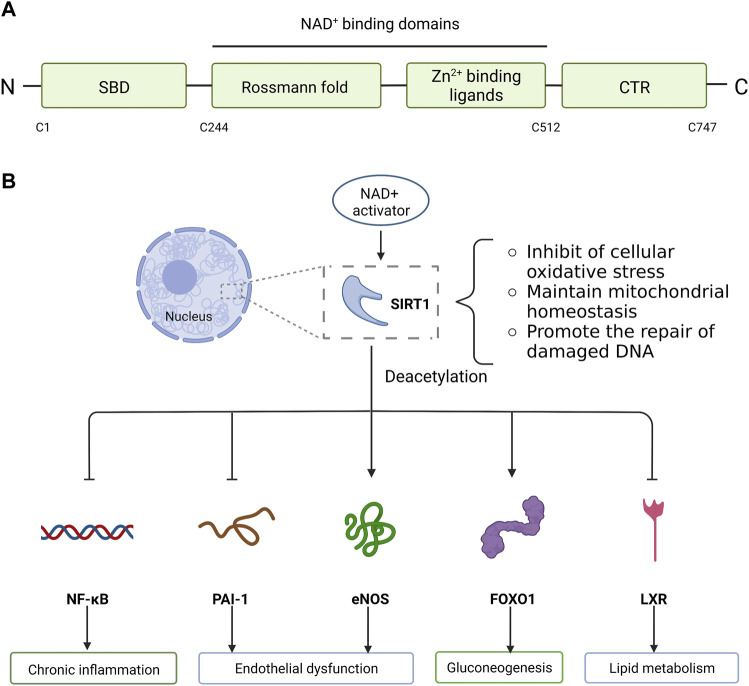
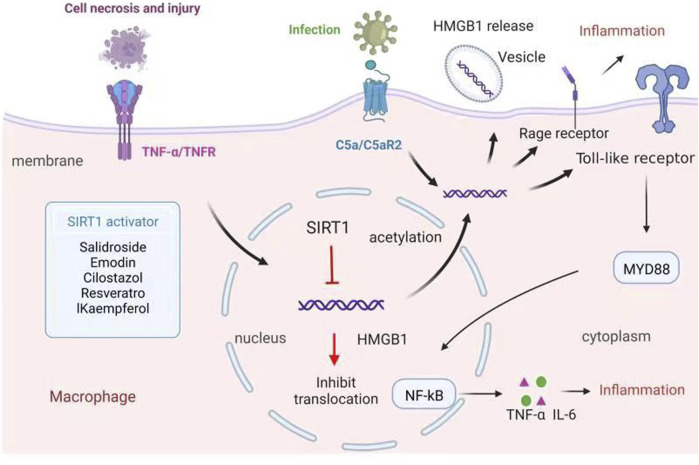
Inflammation is a common complication of many chronic diseases. It includes inflammation of the parenchyma and vascular systems. Sirtuin 1 (SIRT1) is a nicotinamide adenine dinucleotide (NAD)-dependent histone deacetylase, which can directly participate in the suppression of inflammation. It can also regulate the activity of other proteins. Among them, high mobility group box 1 (HMGB1) signaling can be inhibited by deacetylating four lysine residues (55, 88, 90, and 177) in quiescent endothelial cells. HMGB1 is a ubiquitous nuclear protein, once translocated outside the cell, which can interact with various target cell receptors including the receptor for advanced glycation end-products (RAGE), toll-like receptor (TLR) 2, and TLR4 and stimulates the release of pro-inflammatory cyto-/chemokines. And SIRT1 has been reported to inhibit the activity of HMGB1. Both are related to the occurrence and development of inflammation and associated diseases but show an antagonistic relationship in controlling inflammation. Therefore, in this review, we introduce how this signaling axis regulates the emergence of inflammation-related responses and tumor occurrence, providing a new experimental perspective for future inflammation research. In addition, it explores diverse upstream regulators and some natural/synthetic activators of SIRT1 as a possible treatment for inflammatory responses and tumor occurrence which may encourage the development of new anti-inflammatory drugs. Meanwhile, this review also introduces the potential molecular mechanism of the SIRT1-HMGB1 pathway to improve inflammation, suggesting that SIRT1 and HMGB1 proteins may be potential targets for treating inflammation.
炎症是许多慢性疾病的常见并发症。它包括实质和血管系统的炎症。沉默调节蛋白1(SIRT1)是一种烟酰胺腺嘌呤二核苷酸(NAD)依赖性组蛋白脱乙酰酶,可直接参与炎症抑制。它还可以调节其他蛋白质的活性。其中,通过使静止内皮细胞中的四个赖氨酸残基(55、88、90和177)去乙酰化,可抑制高迁移率族蛋白B1(HMGB1)信号传导。HMGB1是一种普遍存在的核蛋白,一旦转运到细胞外,它可以与包括晚期糖基化终产物受体(RAGE)、Toll样受体(TLR)2和TLR4在内的各种靶细胞受体相互作用,并刺激促炎细胞因子/趋化因子的释放。并且据报道SIRT1可抑制HMGB1的活性。两者均与炎症及相关疾病的发生和发展有关,但在控制炎症方面呈拮抗关系。因此,在本综述中,我们介绍了该信号轴如何调节炎症相关反应的出现和肿瘤发生,为未来的炎症研究提供了新的实验视角。此外,它还探索了SIRT1的多种上游调节因子以及一些天然/合成激活剂,作为炎症反应和肿瘤发生的可能治疗方法,这可能会促进新型抗炎药物的开发。同时,本综述还介绍了SIRT1 - HMGB1途径改善炎症的潜在分子机制,表明SIRT1和HMGB1蛋白可能是治疗炎症的潜在靶点。