Institute of Digestive Disease and Department of Medicine and Therapeutics, State Key Laboratory of Digestive Disease, Li Ka Shing Institute of Health Sciences, CUHK Shenzhen Research Institute, The Chinese University of Hong Kong, Shatin, Hong Kong
Institute of Digestive Disease and Department of Medicine and Therapeutics, State Key Laboratory of Digestive Disease, Li Ka Shing Institute of Health Sciences, CUHK Shenzhen Research Institute, The Chinese University of Hong Kong, Shatin, Hong Kong.
Gut. 2020 Jul;69(7):1248-1257. doi: 10.1136/gutjnl-2019-318532. Epub 2019 Nov 27.
There is a need for early detection of colorectal cancer (CRC) at precancerous-stage adenoma. Here, we identified novel faecal bacterial markers for diagnosing adenoma.
This study included 1012 subjects (274 CRC, 353 adenoma and 385 controls) from two independent Asian groups. Candidate markers were identified by metagenomics and validated by targeted quantitative PCR.
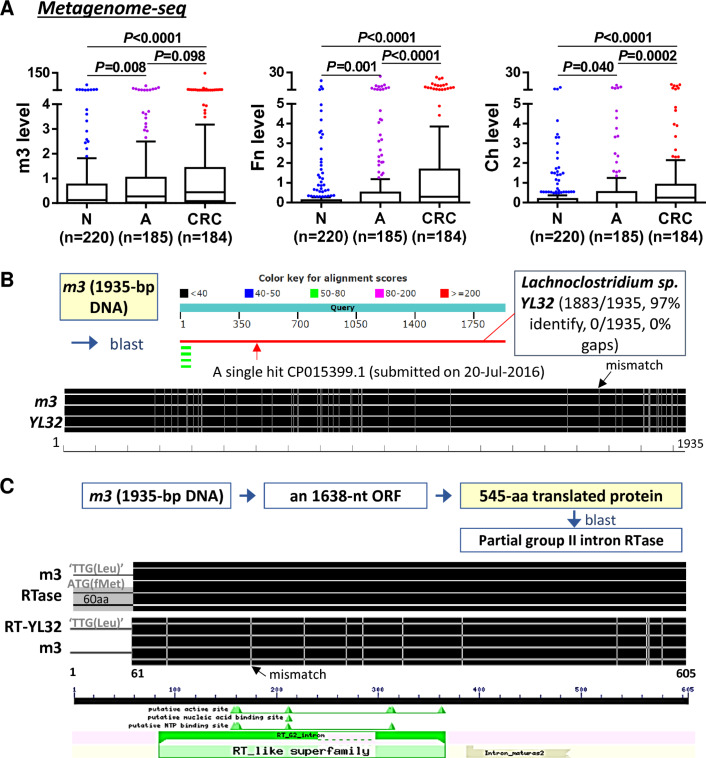
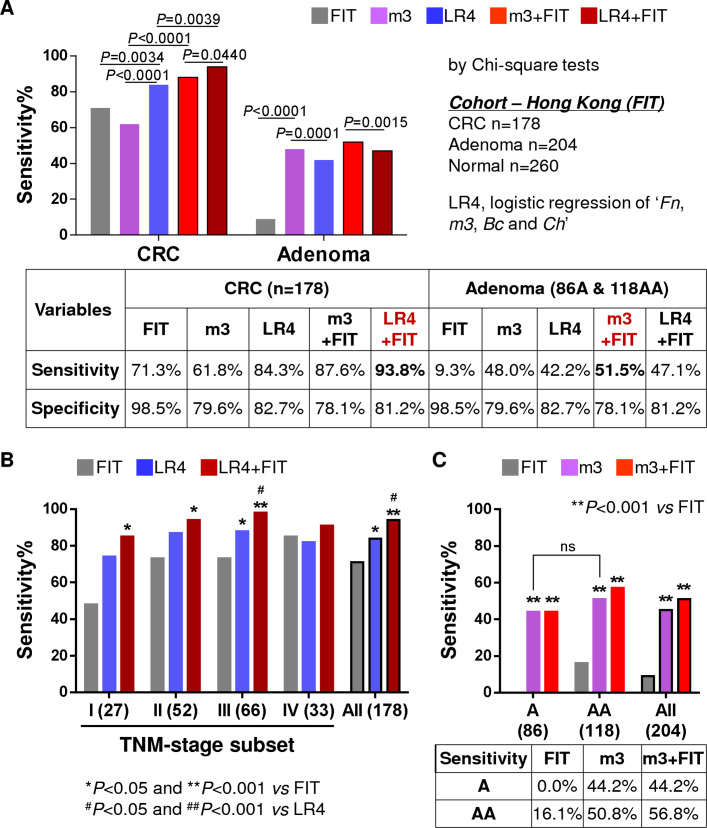
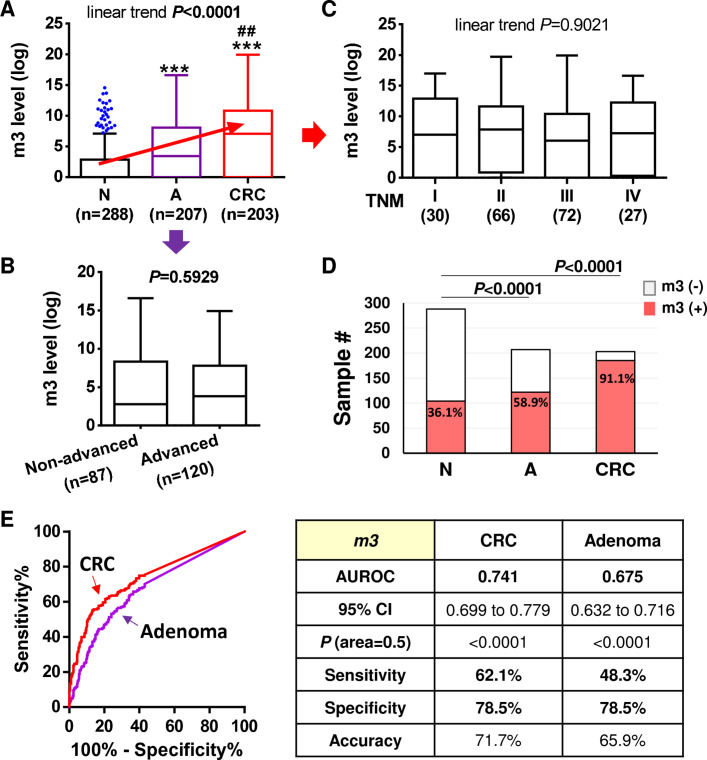
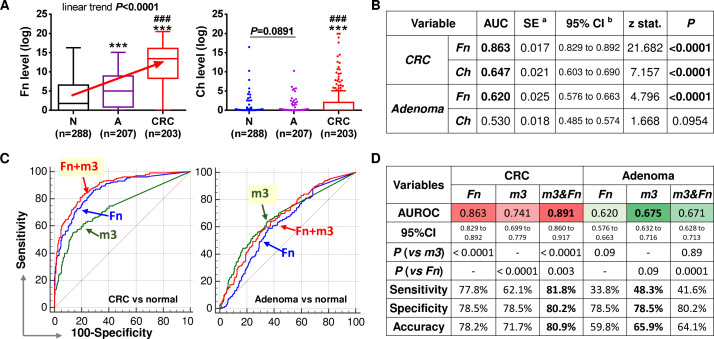
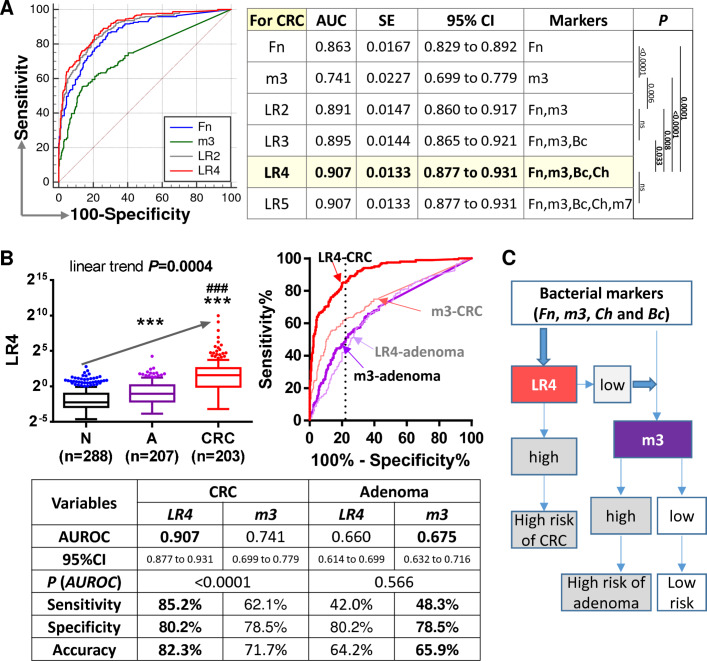
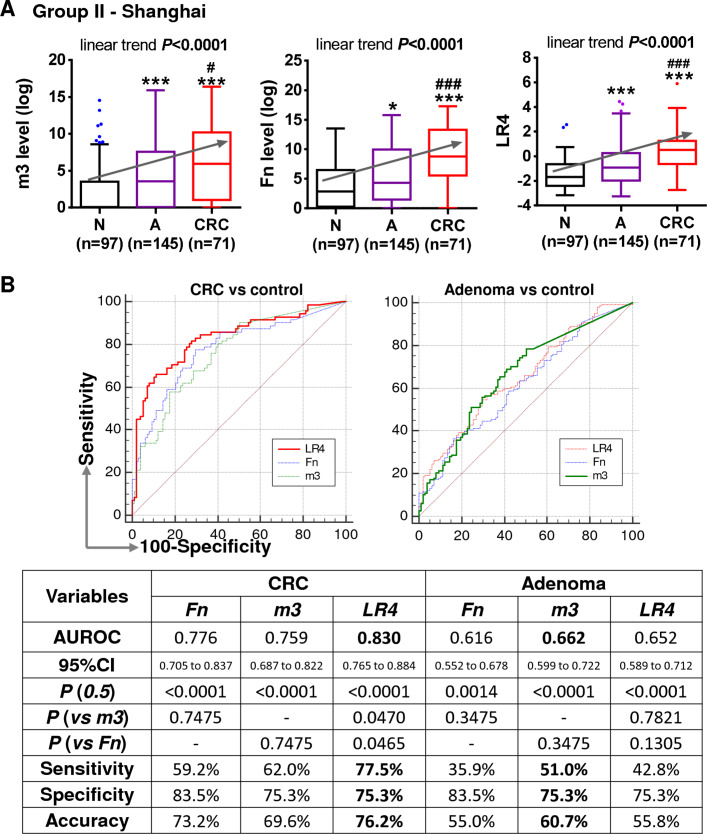
Metagenomic analysis identified '' from a sp., () and () to be significantly enriched in adenoma. Faecal and were significantly increased from normal to adenoma to CRC (p<0.0001, linear trend by one-way ANOVA) in group I (n=698), which was further confirmed in group II (n=313; p<0.0001). Faecal may perform better than in distinguishing adenoma from controls (areas under the receiver operating characteristic curve (AUROCs) =0.675 vs =0.620, p=0.09), while performed better in diagnosing CRC (AUROCs =0.862 vs =0.741, p<0.0001). At 78.5% specificity, and showed sensitivities of 48.3% and 33.8% for adenoma, and 62.1% and 77.8% for CRC, respectively. In a subgroup tested with faecal immunochemical test (FIT; n=642), performed better than FIT in detecting adenoma (sensitivities for non-advanced and advanced adenomas of 44.2% and 50.8% by (specificity=79.6%) vs 0% and 16.1% by FIT (specificity=98.5%)). Combining with FIT improved sensitivity of for advanced adenoma to 56.8%. The combination of with , , and FIT performed best for diagnosing CRC (specificity=81.2% and sensitivity=93.8%).
This study identifies a novel bacterial marker for the non-invasive diagnosis of colorectal adenoma.
需要在癌前腺瘤阶段早期发现结直肠癌(CRC)。在这里,我们确定了用于诊断腺瘤的新型粪便细菌标志物。
这项研究包括来自两个独立亚洲人群的 1012 名受试者(274 例 CRC、353 例腺瘤和 385 例对照)。通过宏基因组学鉴定候选标志物,并通过靶向定量 PCR 进行验证。
宏基因组分析确定 种属、 和 在腺瘤中明显富集。在 I 组(n=698)中,从正常到腺瘤到 CRC,粪便 和 显著增加(p<0.0001,单因素方差分析的线性趋势),在 II 组(n=313)中也得到了进一步证实(p<0.0001)。粪便 可能比 在区分腺瘤与对照组方面表现更好(受试者工作特征曲线下面积(AUROCs)=0.675 vs =0.620,p=0.09),而 在诊断 CRC 方面表现更好(AUROCs =0.862 vs =0.741,p<0.0001)。在特异性为 78.5%时, 和 对腺瘤的敏感性分别为 48.3%和 33.8%,对 CRC 的敏感性分别为 62.1%和 77.8%。在用粪便免疫化学试验(FIT;n=642)检测的亚组中, 在检测腺瘤方面优于 FIT(非高级和高级腺瘤的敏感性分别为 44.2%和 50.8%,特异性为 79.6%,而 FIT 的敏感性分别为 0%和 16.1%,特异性为 98.5%)。 与 FIT 结合可将 检测高级腺瘤的敏感性提高到 56.8%。 与 、 、 和 FIT 联合使用对诊断 CRC 效果最佳(特异性=81.2%和敏感性=93.8%)。
本研究确定了一种新型的粪便细菌标志物 ,可用于非侵入性诊断结直肠腺瘤。