Institute of Digestive Disease and Department of Medicine and Therapeutics, State Key Laboratory of Digestive Disease, Li Ka Shing Institute of Health Sciences, CUHK Shenzhen Research Institute, The Chinese University of Hong Kong, Hong Kong, China.
Department of Microbiology, Faculty of Medicine, The Chinese University of Hong Kong, Hong Kong, China.
J Gastroenterol Hepatol. 2021 Apr;36(4):1035-1043. doi: 10.1111/jgh.15171. Epub 2020 Jul 15.
We have previously shown that fecal microbial markers might be useful for non-invasive diagnosis of colorectal cancer (CRC) and adenoma. Here, we assessed the application of microbial DNA markers, as compared with and in combination with fecal immunochemical test (FIT), in detecting CRC and adenoma in symptomatic patients and asymptomatic subjects.
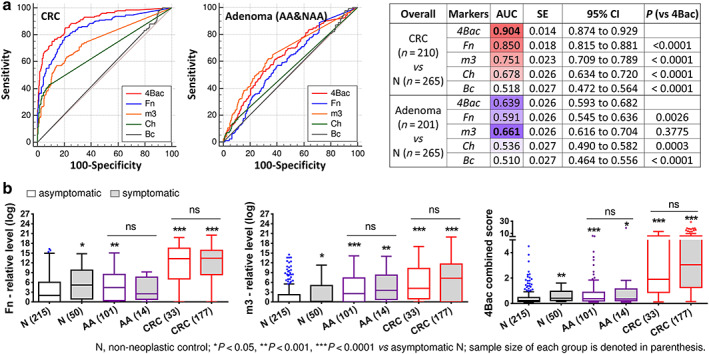
We recruited 676 subjects [210 CRC, 115 advanced adenoma (AA), 86 non-advanced adenoma, and 265 non-neoplastic controls], including 241 symptomatic and 435 asymptomatic subjects. Fecal abundances of Fusobacterium nucleatum, a Lachnoclostridium sp. m3, Bacteroides clarus, and Clostridium hathewayi were quantified by quantitative PCR. Combining score of the four microbial markers (4Bac) and diagnostic prediction were determined using our previously established scoring model and cutoff values and FIT with a cutoff of 100 ng Hb/mL.
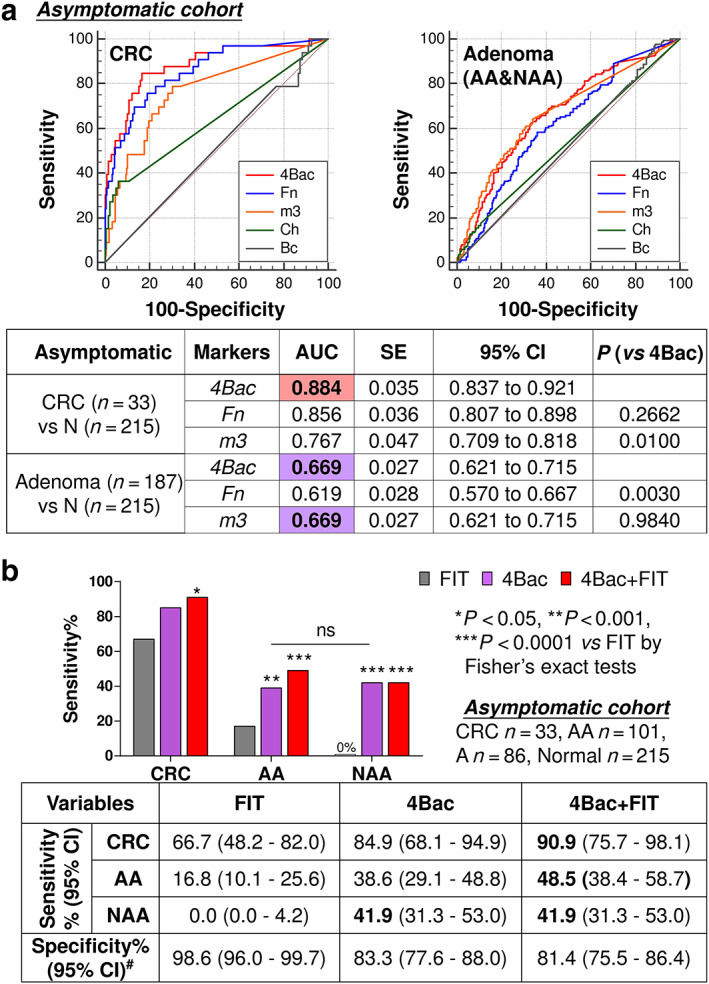
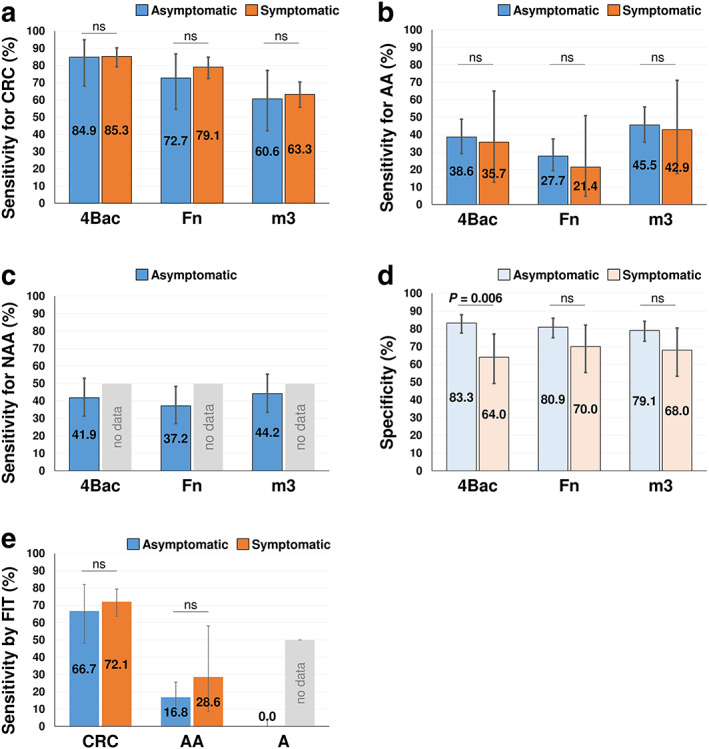
4Bac detected similar percentages of CRC [85.3% (95%CI: 79.2-90.2%) vs 84.9% (68.1-94.9%)] and AA [35.7% (12.8-64.9%) vs 38.6% (29.1-48.8%)], while FIT detected more CRC [72.1% (63.7-79.4%) vs 66.7% (48.2-82.0%)] and AA [28.6% (8.4-58.1%) vs 16.8% (10.1-25.6%)], in symptomatic vs asymptomatic subjects, respectively. Focusing on the asymptomatic cohort, 4Bac was more sensitive for diagnosing CRC and AA than FIT (P < 0.001), with lower specificity [83.3% (77.6-88.0%) vs 98.6% (96.0-99.7%)]. FIT failed to detect any non-advanced adenoma [0% (0.0-4.2%)] compared with 4Bac [41.9% (31.3-53.0%), P < 0.0001]. Combining 4Bac with FIT improved sensitivities for CRC [90.9% (75.7-98.1%)] and AA [48.5% (38.4-58.7%)] detection.
Quantitation of fecal microbial DNA markers may serve as a new test, stand alone, or in combination with FIT for screening colorectal neoplasm in asymptomatic subjects.
我们之前的研究表明,粪便微生物标志物可能有助于结直肠癌(CRC)和腺瘤的非侵入性诊断。在此,我们评估了微生物 DNA 标志物在有症状和无症状患者中检测 CRC 和腺瘤的应用,以及与粪便免疫化学检测(FIT)的比较和联合应用。
我们招募了 676 名受试者[210 例 CRC、115 例高级别腺瘤(AA)、86 例非高级别腺瘤和 265 例非肿瘤对照],包括 241 例有症状和 435 例无症状受试者。采用实时定量 PCR 定量检测粪便中具核梭杆菌、lachnoclostridium sp. m3、Bacteroides clarus 和 Clostridium hathewayi 的丰度。使用我们之前建立的评分模型和临界值,以及 FIT(临界值为 100ng Hb/mL),确定 4 种微生物标志物的组合评分(4Bac)和诊断预测。
4Bac 检测 CRC 的百分比相似[85.3%(95%CI:79.2-90.2%)与 84.9%(68.1-94.9%)]和 AA [35.7%(12.8-64.9%)与 38.6%(29.1-48.8%)],而 FIT 检测 CRC 的百分比更高[72.1%(63.7-79.4%)与 66.7%(48.2-82.0%)]和 AA [28.6%(8.4-58.1%)与 16.8%(10.1-25.6%)],分别在有症状和无症状受试者中。在无症状队列中,4Bac 诊断 CRC 和 AA 的敏感性优于 FIT(P<0.001),特异性较低[83.3%(77.6-88.0%)与 98.6%(96.0-99.7%)]。FIT 未能检测到任何非高级别腺瘤[0%(0.0-4.2%)],而 4Bac 则检测到 41.9%(31.3-53.0%),差异有统计学意义(P<0.0001)。4Bac 联合 FIT 可提高 CRC [90.9%(75.7-98.1%)]和 AA [48.5%(38.4-58.7%)]的检测敏感性。
粪便微生物 DNA 标志物的定量分析可能成为一种新的检测方法,单独使用或与 FIT 联合使用,可用于无症状受试者的结直肠肿瘤筛查。