Aouhab Z, Hong H, Felicelli C, Tarplin S, Ostrowski R A
Loyola University Medical Center Maywood Illinois.
ACR Open Rheumatol. 2019 Oct 18;1(9):593-599. doi: 10.1002/acr2.11084. eCollection 2019 Nov.
Hydroxychloroquine (HCQ) is an antimalarial drug that is recommended as a safe, daily prophylactic intervention for individuals with systemic lupus erythematosus (SLE) based on previous studies that showed an association of HCQ use with reductions in flares compared with placebo. Our study aims to determine whether the discontinuation of HCQ leads to relapse of disease and whether the duration of HCQ use impacts the success of its eventual discontinuation.
A retrospective chart review was performed on the medical records of patients diagnosed with SLE between July 1, 2006, and June 30, 2016. The data gathered included demographic factors, diagnostic symptoms, laboratory values, and SLE medications. Additionally, HCQ usage and discontinuation rates were collected as well as the timing and prevalence of flares during and after HCQ usage. Patients who were diagnosed with SLE but never used HCQ were excluded from the study. The occurrence of flares, clinical characteristics, and duration of treatment with HCQ were compared between the group that continued HCQ and the group that discontinued HCQ.
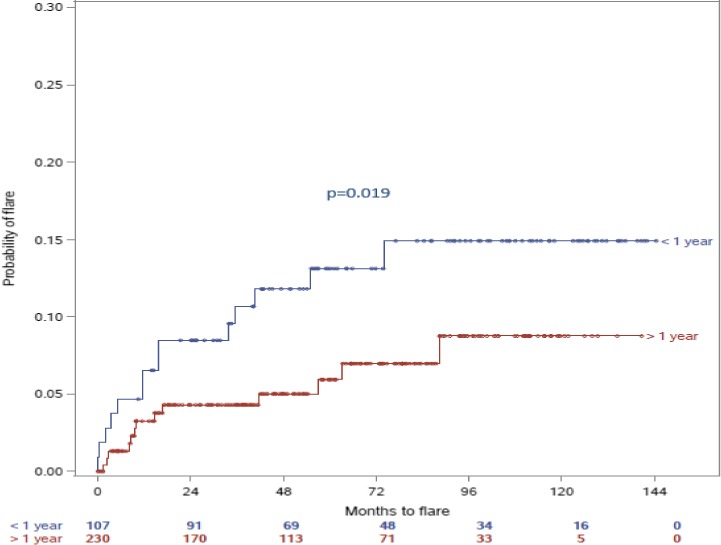
Of the 509 patients who met inclusion criteria, 66.2% (n = 337) continued HCQ throughout the duration of their treatment (median duration of HCQ treatment was 8.0 years), whereas 33.8% (n = 172) did not (median duration of HCQ treatment was 1.9 years). Patients who received HCQ for less than 1 year before discontinuation (median duration of HCQ treatment was 2.5 months) were more likely to experience SLE flares compared with those who continued HCQ for more than 1 year (13.1% vs 5.7%, = 0.019). Patients who experienced a flare while on HCQ were more likely to have arthritis, oral ulcers, leukopenia, and thrombocytopenia.
With over 500 patient charts reviewed, this is the largest study comparing outcomes for patients on HCQ with those who discontinued it. Patients who discontinue HCQ after being on it for less than 1 year are at greater risk for flares compared with those who take HCQ for longer than 1 year. These findings should be used to guide treatment, educate patients on the role of continued treatment with HCQ, and ultimately reduce morbidity and mortality.
羟氯喹(HCQ)是一种抗疟药物,基于先前的研究表明与安慰剂相比,使用HCQ可减少疾病发作,因此被推荐为系统性红斑狼疮(SLE)患者安全的每日预防性干预药物。我们的研究旨在确定停用HCQ是否会导致疾病复发,以及使用HCQ的持续时间是否会影响最终停用它的成功率。
对2006年7月1日至2016年6月30日期间诊断为SLE的患者的病历进行回顾性图表审查。收集的数据包括人口统计学因素、诊断症状、实验室值和SLE药物。此外,还收集了HCQ的使用和停用率以及HCQ使用期间和之后疾病发作的时间和发生率。被诊断为SLE但从未使用过HCQ的患者被排除在研究之外。比较继续使用HCQ的组和停用HCQ的组之间疾病发作的发生情况、临床特征和HCQ治疗持续时间。
在符合纳入标准的509例患者中,66.2%(n = 337)在整个治疗期间继续使用HCQ(HCQ治疗的中位持续时间为8.0年),而33.8%(n = 172)未继续使用(HCQ治疗的中位持续时间为1.9年)。与继续使用HCQ超过1年的患者相比,在停用前使用HCQ少于1年的患者(HCQ治疗的中位持续时间为2.5个月)更有可能经历SLE发作(13.1%对5.7%,P = 0.019)。在使用HCQ期间经历发作的患者更有可能患有关节炎、口腔溃疡、白细胞减少症和血小板减少症。
通过审查500多份患者病历,这是比较使用HCQ的患者与停用HCQ的患者结局的最大规模研究。与使用HCQ超过1年的患者相比,使用HCQ少于1年就停用的患者发作风险更大。这些发现应用于指导治疗、向患者宣传继续使用HCQ的作用,并最终降低发病率和死亡率。