State Key Laboratory of Developmental Biology of Freshwater Fish, Hunan Normal University, Changsha, 410081, Hunan, People's Republic of China.
College of Life Sciences, Hunan Normal University, Changsha, 410081, Hunan, People's Republic of China.
BMC Genet. 2019 Nov 28;20(1):87. doi: 10.1186/s12863-019-0784-2.
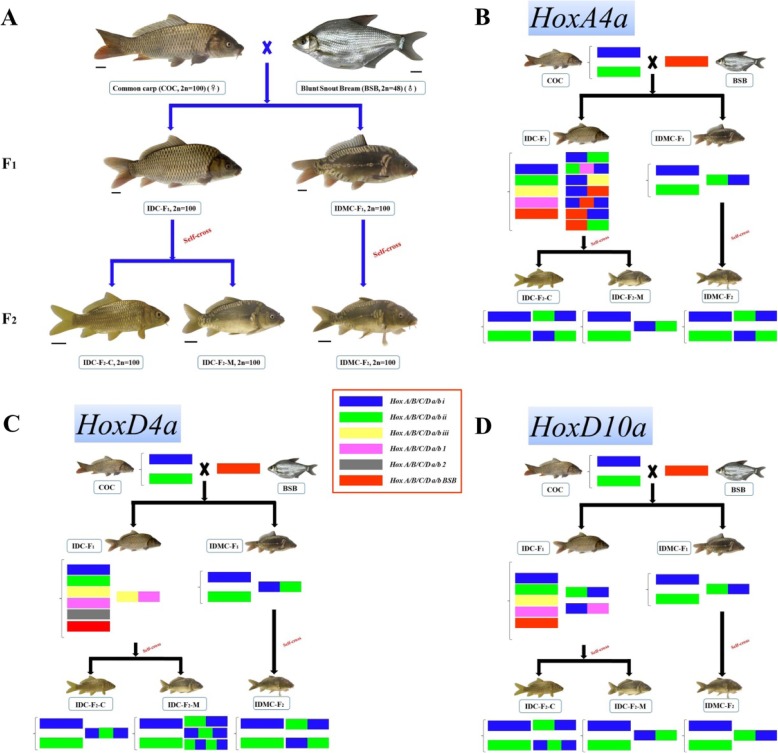
Distant hybridization can generate changes in phenotypes and genotypes that lead to the formation of new hybrid lineages with genetic variation. In this study, the establishment of two bisexual fertile carp lineages, including the improved diploid common carp (IDC) lineage and the improved diploid scattered mirror carp (IDMC) lineage, from the interspecific hybridization of common carp (Cyprinus carpio, 2n = 100) (♀) × blunt snout bream (Megalobrama amblycephala, 2n = 48) (♂), provided a good platform to investigate the genetic relationship between the parents and their hybrid progenies.
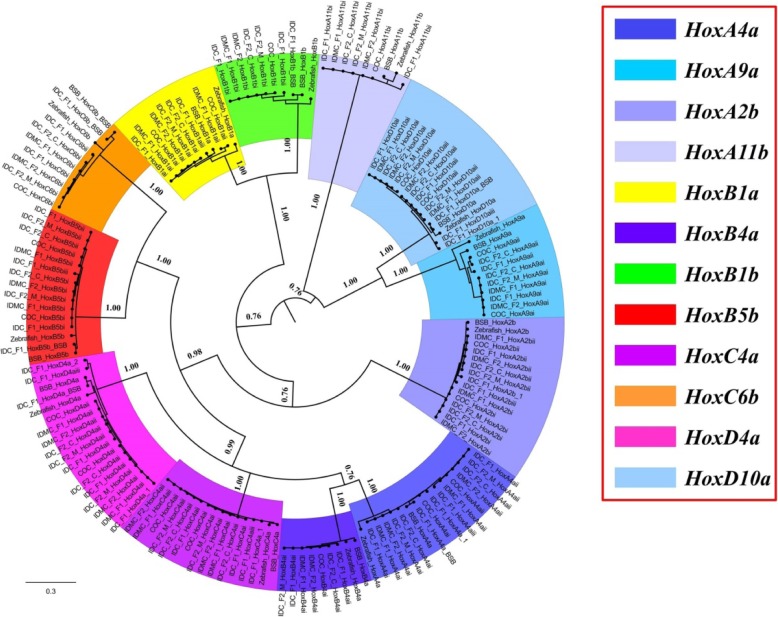
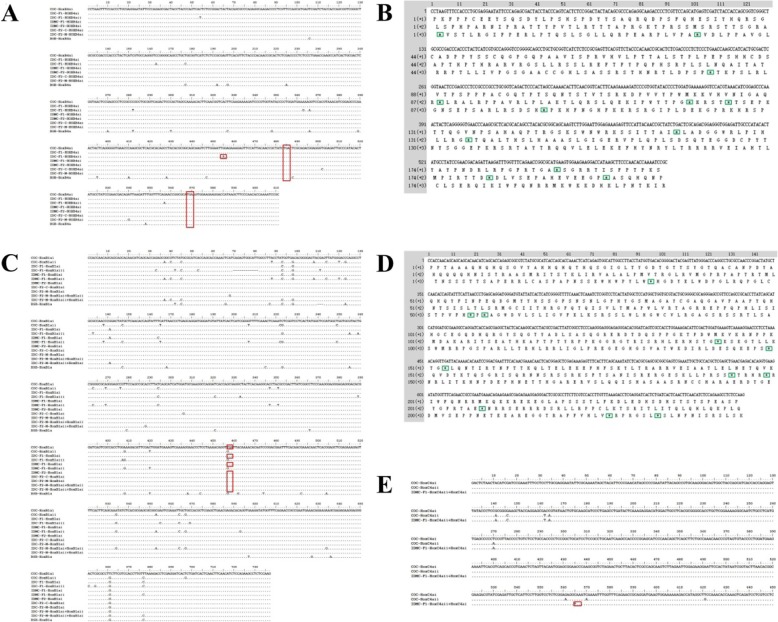
In this study, we investigated the genetic variation of 12 Hox genes in the two types of improved carp lineages derived from common carp (♀) × blunt snout bream (♂). Hox gene clusters were abundant in the first generation of IDC, but most were not stably inherited in the second generation. In contrast, we did not find obvious mutations in Hox genes in the first generation of IDMC, and almost all the Hox gene clusters were stably inherited from the first generation to the second generation of IDMC. Interestingly, we found obvious recombinant clusters of Hox genes in both improved carp lineages, and partially recombinant clusters of Hox genes were stably inherited from the first generation to the second generation in both types of improved carp lineages. On the other hand, some Hox genes were gradually becoming pseudogenes, and some genes were completely pseudogenised in IDC or IDMC.
Our results provided important evidence that distant hybridization produces rapid genomic DNA changes that may or may not be stably inherited, providing novel insights into the function of hybridization in the establishment of improved lineages used as new fish resources for aquaculture.
远缘杂交可以产生表型和基因型的变化,从而导致具有遗传变异的新杂交谱系的形成。在这项研究中,通过鲤鱼(Cyprinus carpio,2n=100)(♀)× 圆口铜鱼(Megalobrama amblycephala,2n=48)(♂)的种间杂交,建立了两个两性可育的鲤鱼谱系,包括改良二倍体鲤鱼(IDC)谱系和改良二倍体散鳞镜鲤(IDMC)谱系,为研究父母与其杂交后代之间的遗传关系提供了良好的平台。
本研究调查了 12 个 Hox 基因在两种改良鲤鱼谱系中的遗传变异,这些改良鲤鱼谱系是由鲤鱼(♀)× 圆口铜鱼(♂)杂交产生的。IDC 的第一代中 Hox 基因簇丰富,但在第二代中大多数不能稳定遗传。相比之下,在 IDMC 的第一代中,我们没有发现 Hox 基因明显突变,几乎所有的 Hox 基因簇都从第一代稳定遗传到 IDMC 的第二代。有趣的是,我们在两种改良鲤鱼谱系中都发现了明显的 Hox 基因重组簇,部分重组 Hox 基因簇在两种改良鲤鱼谱系中从第一代稳定遗传到第二代。另一方面,一些 Hox 基因逐渐成为假基因,在 IDC 或 IDMC 中,一些基因完全失活。
我们的结果提供了重要证据,表明远缘杂交产生了快速的基因组 DNA 变化,这些变化可能稳定遗传,也可能不稳定遗传,为杂交在改良谱系的建立中的作用提供了新的见解,这些改良谱系可用作水产养殖的新鱼类资源。