Department of Biomedical Engineering, Tufts University, Medford, MA, 02155, USA.
Department of Bioengineering, Stanford University, Stanford, CA, 94305, USA.
Sci Rep. 2019 Nov 29;9(1):17874. doi: 10.1038/s41598-019-54248-1.
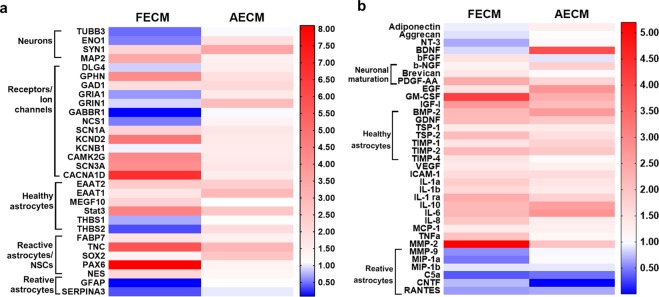
Brain extracellular matrix (ECM) is often overlooked in vitro brain tissue models, despite its instructive roles during development. Using developmental stage-sourced brain ECM in reproducible 3D bioengineered culture systems, we demonstrate enhanced functional differentiation of human induced neural stem cells (hiNSCs) into healthy neurons and astrocytes. Particularly, fetal brain tissue-derived ECM supported long-term maintenance of differentiated neurons, demonstrated by morphology, gene expression and secretome profiling. Astrocytes were evident within the second month of differentiation, and reactive astrogliosis was inhibited in brain ECM-enriched cultures when compared to unsupplemented cultures. Functional maturation of the differentiated hiNSCs within fetal ECM-enriched cultures was confirmed by calcium signaling and spectral/cluster analysis. Additionally, the study identified native biochemical cues in decellularized ECM with notable comparisons between fetal and adult brain-derived ECMs. The development of novel brain-specific biomaterials for generating mature in vitro brain models provides an important path forward for interrogation of neuron-glia interactions.
脑细胞外基质(ECM)在体外脑组织模型中经常被忽视,尽管它在发育过程中具有指导作用。我们使用源自发育阶段的脑 ECM 在可重复的 3D 生物工程培养系统中,证明了人类诱导多能干细胞(hiPSC)向健康神经元和星形胶质细胞的功能分化得到增强。特别是,胎儿脑组织来源的 ECM 支持分化神经元的长期维持,这通过形态、基因表达和分泌组分析得到证实。星形胶质细胞在分化后的第二个月内出现,与未补充培养物相比,富含 ECM 的培养物中抑制了反应性星形胶质增生。在富含胎儿 ECM 的培养物中,分化的 hiPSC 的功能成熟通过钙信号和光谱/聚类分析得到证实。此外,该研究还确定了去细胞 ECM 中的天然生化线索,其中胎儿和成人脑组织衍生的 ECM 之间有显著的比较。开发新型的大脑特异性生物材料来生成成熟的体外大脑模型为研究神经元-胶质细胞相互作用提供了一个重要的途径。