Leonard M. Miller Professor of Psychiatry and Behavioral Sciences, University of Miami, Miller School of Medicine, Miami, FL, USA.
Medical Affairs, Sumitomo Dainippon Pharma Co., Ltd, Tokyo, Japan.
Neuropsychopharmacol Rep. 2020 Mar;40(1):63-72. doi: 10.1002/npr2.12089. Epub 2019 Dec 1.
To report the efficacy and safety of blonanserin in patients with schizophrenia compared with risperidone in a Japanese multicenter, randomized, double-blind study based on post hoc sensitivity analysis in addition to the previous results reported by Miura and discuss the current approaches for schizophrenia treatment.
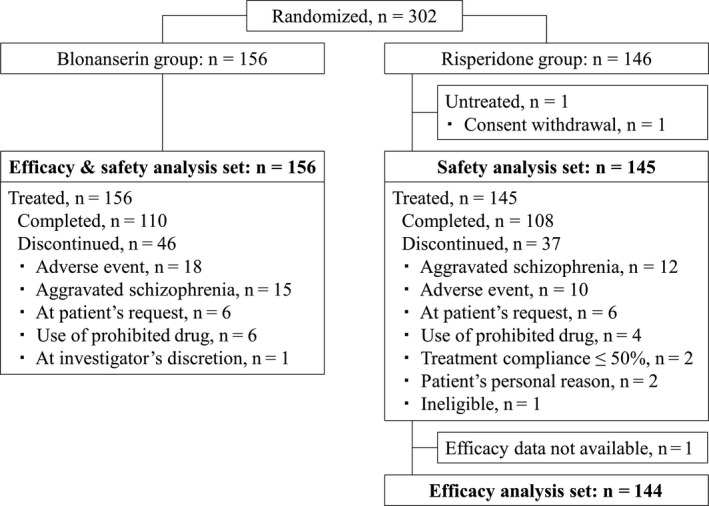
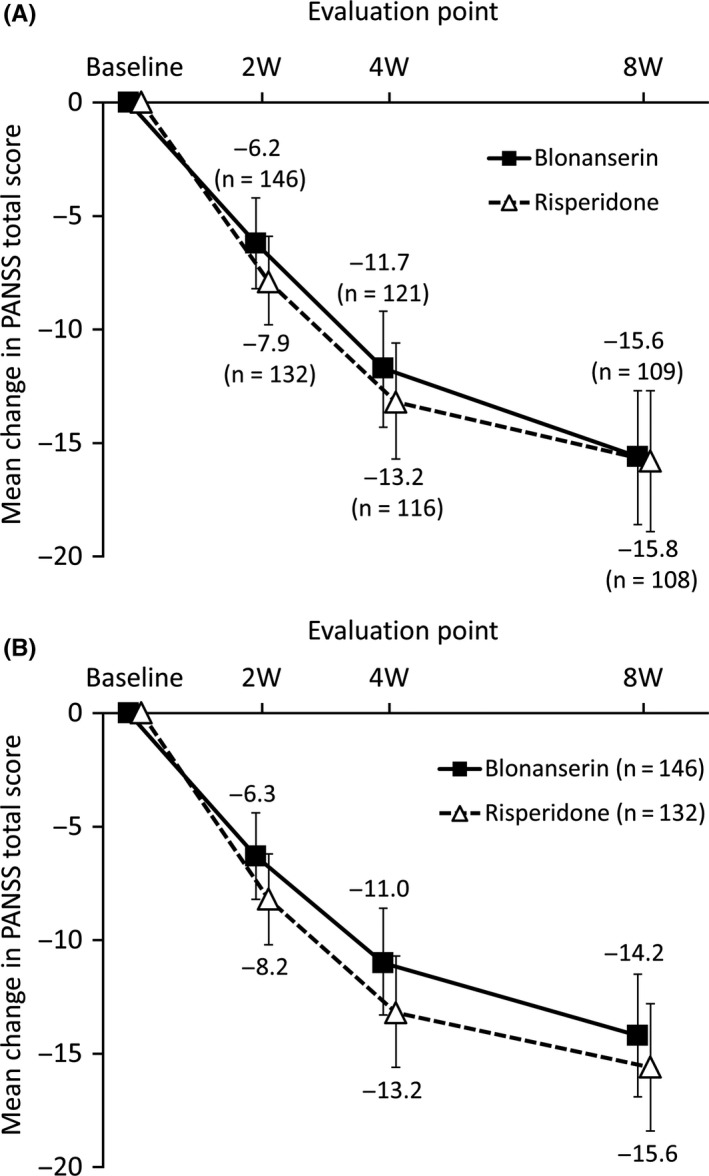
Of 302 patients randomized, 156 received blonanserin (8-24 mg/d) and 145 received risperidone (2-6 mg/d) for 8 weeks. Efficacy variables included the Positive and Negative Syndrome Scale (PANSS) total score for the primary outcome, PANSS subscale, Brief Psychiatric Rating Scale (BPRS), and Clinical Global Impression-Improvement (CGI-I) for secondary outcomes. Safety variables included treatment-emergent adverse events, Drug Induced Extrapyramidal Symptoms Scale scores, laboratory data, vital signs, electrocardiogram, etc RESULTS: Blonanserin was not inferior to risperidone in the change in PANSS total score at a non-inferior margin of -7 (intergroup difference, -0.46; 95% CI, -4.40 to 3.48). Post hoc analyses wholly supported the primary result. No major difference was found in the changes in BPRS scores and the improvement rate on CGI-I between the drugs. The incidence of adverse events was similar in the two drugs. Blonanserin was associated with a lower risk of prolactin increase, weight gain, and orthostatic hypotension compared with risperidone. However, blonanserin was associated with a higher incidence of akathisia and excitability compared with risperidone. Most of the adverse events were mild to moderate in severity with no specific events of predominant high severity in the both drugs.
Blonanserin exerted the similar efficacy to risperidone in both positive and negative symptoms in schizophrenia with a lower risk of prolactin increase, weight gain, and orthostatic hypotension compared with risperidone. Blonanserin will serve as a favorable treatment option for schizophrenia in daily clinical practice.
报告布南色林治疗精神分裂症的疗效和安全性,与利培酮相比,本研究基于 Miura 等人之前报告的结果进行了事后敏感性分析,是一项日本多中心、随机、双盲研究。并讨论目前治疗精神分裂症的方法。
302 例患者随机分组,156 例患者接受布南色林(8-24mg/d)治疗,145 例患者接受利培酮(2-6mg/d)治疗,疗程 8 周。主要疗效变量为阳性和阴性症状量表(PANSS)总分,次要疗效变量为 PANSS 各分量表、简明精神病评定量表(BPRS)和临床总体印象-改善(CGI-I)评分。安全性变量包括治疗中出现的不良事件、药物引起的锥体外系症状量表评分、实验室数据、生命体征、心电图等。
布南色林在 PANSS 总分变化方面不劣于利培酮,非劣效性边界为-7(组间差异,-0.46;95%置信区间,-4.40 至 3.48)。事后分析完全支持主要结果。两种药物的 BPRS 评分变化和 CGI-I 改善率无显著差异。两种药物的不良事件发生率相似。与利培酮相比,布南色林引起催乳素升高、体重增加和体位性低血压的风险较低。然而,布南色林引起静坐不能和激越的发生率高于利培酮。大多数不良事件的严重程度为轻度至中度,两种药物均无特定的高严重度不良事件。
布南色林在精神分裂症的阳性和阴性症状方面与利培酮疗效相当,与利培酮相比,布南色林引起催乳素升高、体重增加和体位性低血压的风险较低。布南色林将成为精神分裂症日常临床实践中的一种有利治疗选择。