Department of Gynecologic Oncology, Affiliated Cancer Hospital of Zhengzhou University (Henan Cancer Hospital), Zhengzhou, China.
J Gynecol Oncol. 2020 Jan;31(1):e2. doi: 10.3802/jgo.2020.31.e2. Epub 2019 Jun 25.
To observe the safety and short-term efficacy of apatinib in the treatment of recurrent, metastatic cervical cancer in patients who have already received more than two kinds of comprehensive treatment.
Forty-eight patients with recurrent or metastatic cervical cancer after radiotherapy or surgery who received apatinib between June 2016 and June 2017 were involved in this study. These patients experienced progression after first-line or second-line chemotherapy. There were 38 patients with cervical squamous cell carcinoma, 8 with adenocarcinoma, and 2 with adenosquamous carcinoma. Progression-free survival (PFS), overall survival (OS), and treatment-related adverse events (AEs) were reviewed and evaluated.
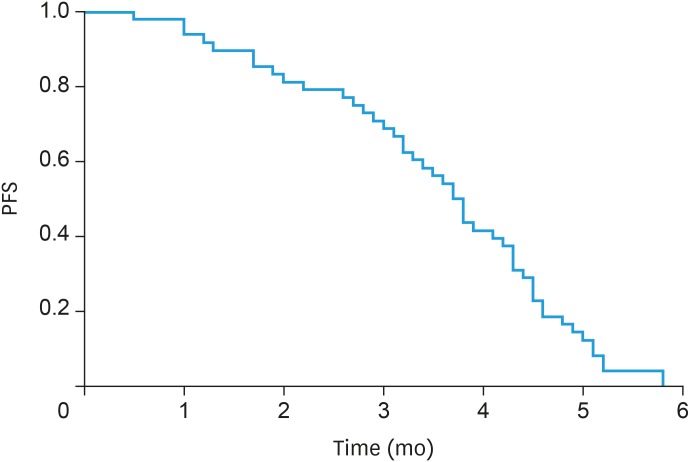
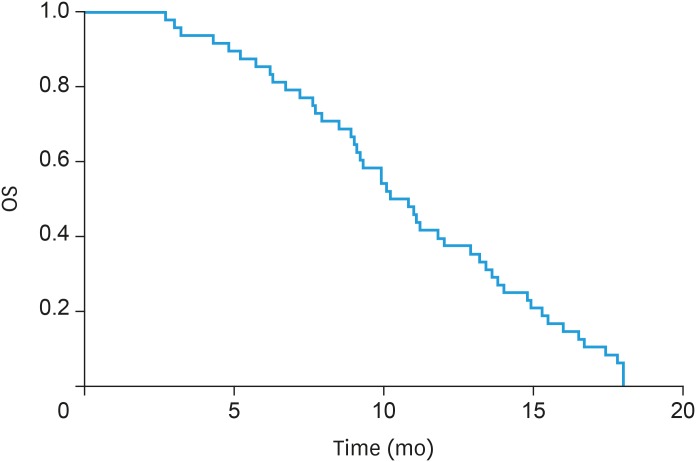
All patients had complete follow-up records, and the median follow-up time was 14.5 months (5.5-20.5 months). Among the 48 patients, 14.58% achieved a partial response and 52.08% achieved stable disease. The overall response rate and disease control rate were 14.58% and 66.67%, respectively. The median time that the 48 patients received oral apatinib was 8.2 months. The median PFS was 4.6 months (95% confidence interval [CI]=3.31-5.26) and OS was 13.9 months (95% CI=8.37-17.96). The main apatinib-related adverse reactions were leukopenia (37.5%), neutropenia (41.67%), hemorrhage (37.5%), hypertension (33.33%), proteinuria (12.5%), fatigue (37.5%), and hand-foot syndrome (27.08%). Most of them were grade 1-2, and no drug-related death occurred.
Apatinib can improve the disease control rate of recurrent and metastatic cervical cancer when chemotherapy has failed, and the treatment is well tolerated. This represents that apatinib may be a new treatment option for metastatic cervical cancer patients.
观察阿帕替尼治疗接受过两种以上综合治疗的复发转移性宫颈癌患者的安全性和短期疗效。
本研究纳入 2016 年 6 月至 2017 年 6 月期间接受阿帕替尼治疗的 48 例复发或转移性宫颈癌患者。这些患者在接受一线或二线化疗后发生进展,其中宫颈鳞癌 38 例,腺癌 8 例,腺鳞癌 2 例。回顾并评估无进展生存期(PFS)、总生存期(OS)和治疗相关不良事件(AEs)。
所有患者均有完整的随访记录,中位随访时间为 14.5 个月(5.5-20.5 个月)。48 例患者中,部分缓解率为 14.58%,疾病稳定率为 52.08%。总缓解率和疾病控制率分别为 14.58%和 66.67%。48 例患者接受阿帕替尼口服中位时间为 8.2 个月。中位 PFS 为 4.6 个月(95%CI=3.31-5.26),OS 为 13.9 个月(95%CI=8.37-17.96)。阿帕替尼相关的主要不良反应为白细胞减少(37.5%)、中性粒细胞减少(41.67%)、出血(37.5%)、高血压(33.33%)、蛋白尿(12.5%)、乏力(37.5%)和手足综合征(27.08%)。大多数为 1-2 级,无药物相关死亡。
阿帕替尼治疗化疗失败的复发转移性宫颈癌可提高疾病控制率,且治疗耐受性良好。这表明阿帕替尼可能成为转移性宫颈癌患者的一种新的治疗选择。