Masson Walter, Lobo Martín, Molinero Graciela, Rossi Emiliano
Cardiology Service, Hospital Italiano de Buenos Aires, Buenos Aires, Argentina; Council of Epidemiology and Cardiovascular Prevention, Sociedad Argentina de Cardiología, Buenos Aires, Argentina.
Council of Epidemiology and Cardiovascular Prevention, Sociedad Argentina de Cardiología, Buenos Aires, Argentina.
An Bras Dermatol. 2019 Nov-Dec;94(6):691-697. doi: 10.1016/j.abd.2019.03.001. Epub 2019 Oct 24.
Different strategies have been proposed for the cardiovascular risk management of patients with psoriasis.
To estimate the cardiovascular risk and evaluate two cardiovascular prevention strategies in patients with psoriasis, analyzing which proportion of patients would be candidates to receive statin therapy.
A retrospective cohort was selected from a secondary database. All patients >18 years with psoriasis without cardiovascular disease or lipid-lowering treatment were included. The atherosclerotic cardiovascular disease calculator (2018 American College of Cardiology/American Heart Association guidelines) and the Systematic Coronary Risk Evaluation risk calculator (2016 European Society of Cardiology/European Society of Atherosclerosis guidelines) were calculated. The SCORE risk value was adjusted by a multiplication factor of 1.5. The recommendations for the indication of statins suggested by both guidelines were analyzed.
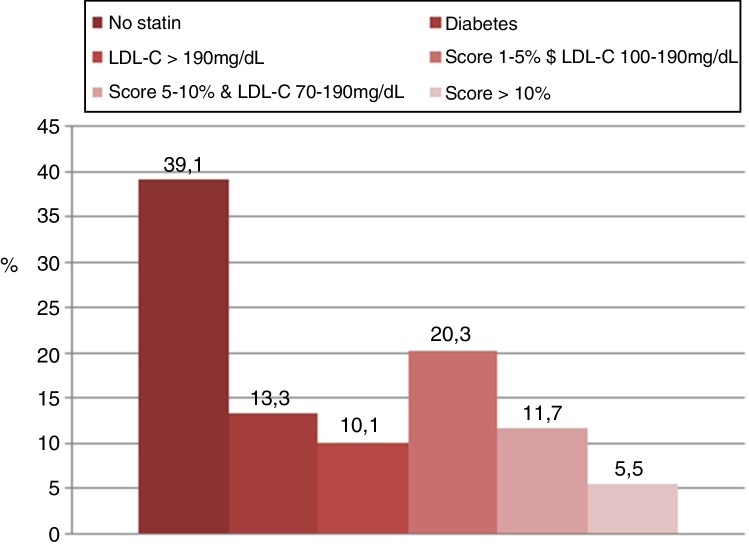
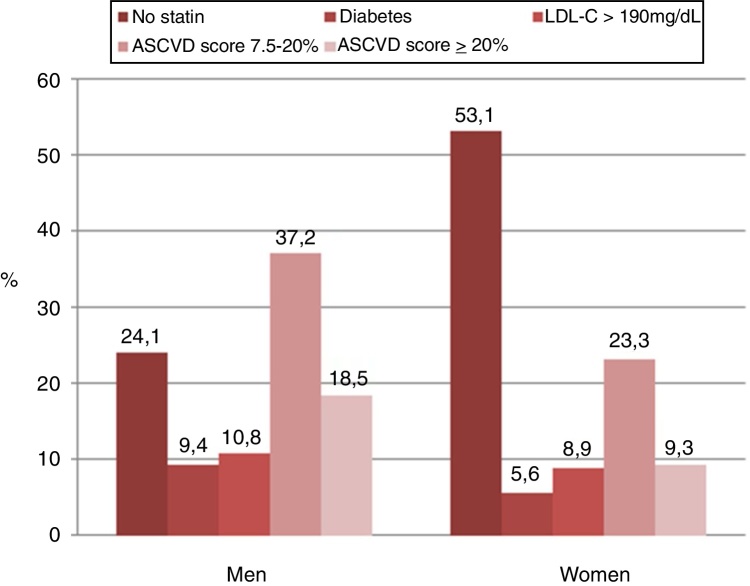
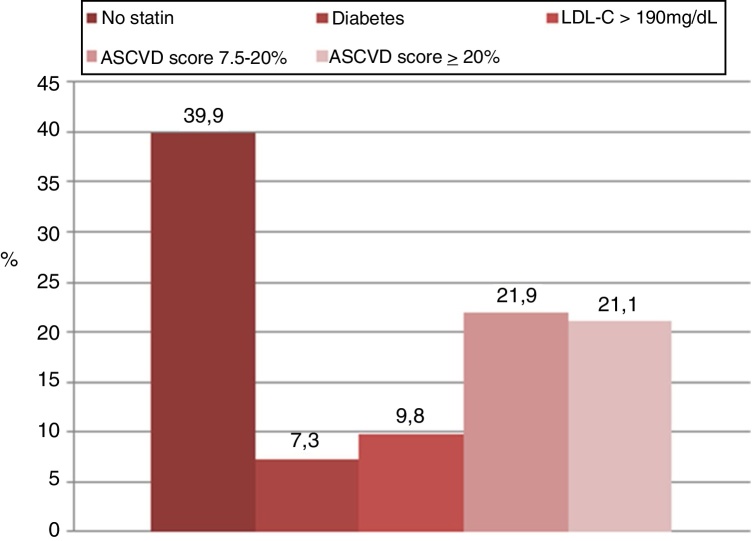
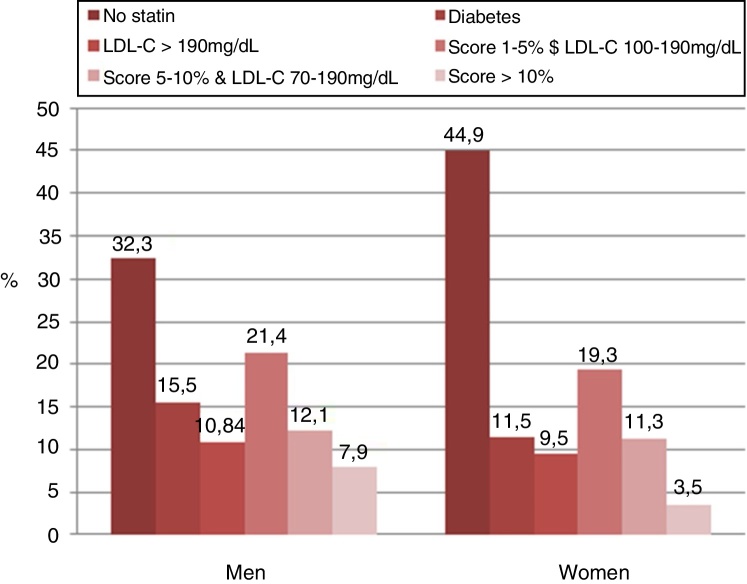
A total of 892 patients (mean age 59.9±16.5 years, 54.5% women) were included. The median atherosclerotic cardiovascular disease calculator and Systematic Coronary Risk Evaluation values were 13.4% (IQR 6.1-27.0%) and 1.9% (IQR 0.4-5.2), respectively. According to the atherosclerotic cardiovascular disease calculator, 20.1%, 11.0%, 32.9%, and 36.4% of the population was classified at low, borderline, moderate, or high risk. Applying the Systematic Coronary Risk Evaluation, 26.5%, 42.9%, 20.8%, and 9.8% of patients were stratified as having low, moderate, high, or very high risk, respectively. The proportion of subjects with statin indication was similar using both strategies: 60.1% and 60.9% for the 2018 American College of Cardiology/American Heart Association and 2016 European Society of Cardiology/European Society of Atherosclerosis guidelines, respectively.
This was a secondary database study. Data on the severity of psoriasis and pharmacological treatments were not included in the analysis.
This population with psoriasis was mostly classified at moderate-high risk and the statin therapy indication was similar when applying the two strategies evaluated.
针对银屑病患者的心血管风险管理,已提出了不同的策略。
评估银屑病患者的心血管风险,并评价两种心血管预防策略,分析有多少比例的患者适合接受他汀类药物治疗。
从一个二级数据库中选取回顾性队列。纳入所有年龄大于18岁、患有银屑病且无心血管疾病或降脂治疗的患者。计算动脉粥样硬化性心血管疾病计算器(2018年美国心脏病学会/美国心脏协会指南)和系统性冠状动脉风险评估风险计算器(2016年欧洲心脏病学会/欧洲动脉粥样硬化学会指南)。SCORE风险值通过乘以1.5的系数进行调整。分析了两种指南所建议的他汀类药物适应症。
共纳入892例患者(平均年龄59.9±16.5岁,54.5%为女性)。动脉粥样硬化性心血管疾病计算器和系统性冠状动脉风险评估值的中位数分别为13.4%(四分位间距6.1 - 27.0%)和1.9%(四分位间距0.4 - 5.2)。根据动脉粥样硬化性心血管疾病计算器,20.1%、11.0%、32.9%和36.4%的人群被分类为低、临界、中或高风险。应用系统性冠状动脉风险评估,分别有26.5%、42.9%、20.8%和9.8%的患者被分层为低、中、高或极高风险。两种策略下他汀类药物适应症的受试者比例相似:2018年美国心脏病学会/美国心脏协会和2016年欧洲心脏病学会/欧洲动脉粥样硬化学会指南分别为60.1%和60.9%。
这是一项二级数据库研究。分析中未包括银屑病严重程度和药物治疗的数据。
该银屑病患者群体大多被分类为中高风险,应用所评估的两种策略时他汀类药物治疗适应症相似。