Department of Biological Sciences, Oakland University, Rochester, Michigan, United States of America.
PLoS One. 2019 Dec 2;14(12):e0225852. doi: 10.1371/journal.pone.0225852. eCollection 2019.
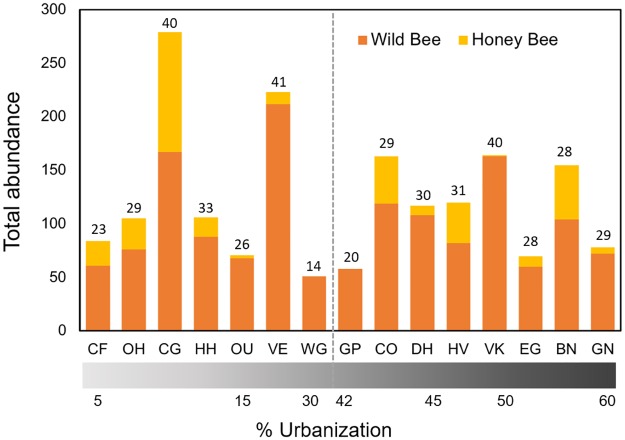
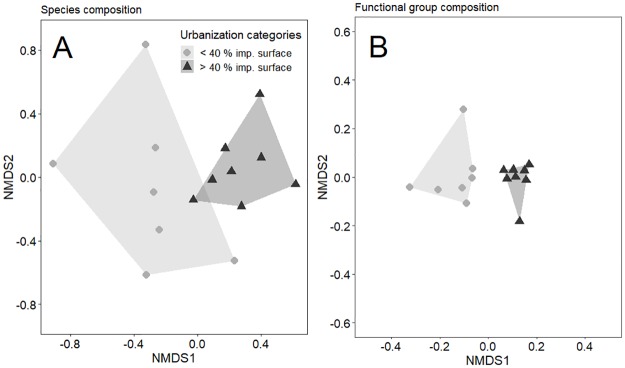
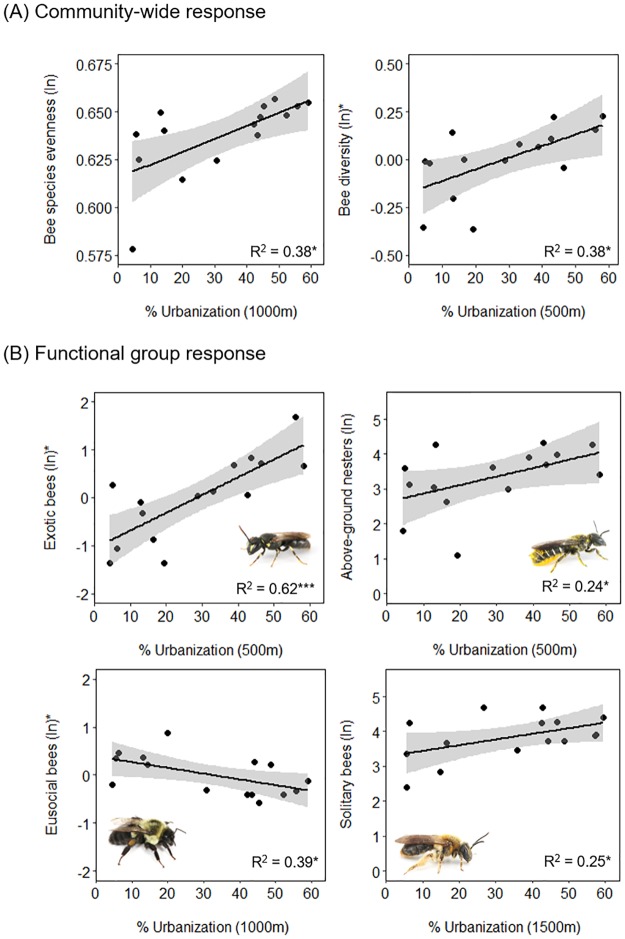
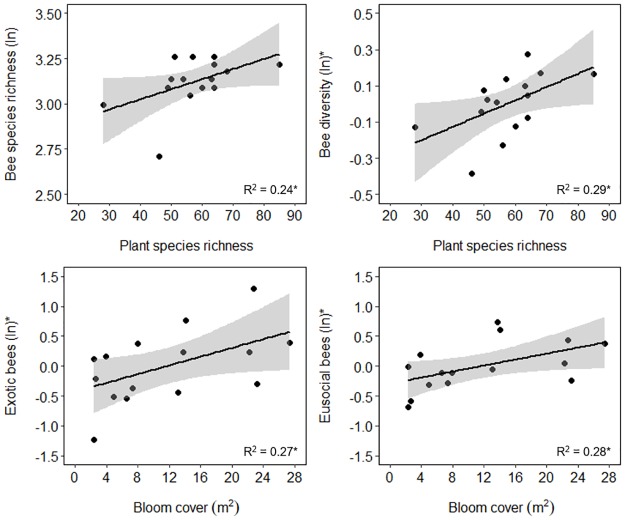
Wild bees are important pollinators in many ecosystems threatened by anthropogenic disturbance. Urban development can reduce and degrade natural habitat for bees and other pollinators. However, some researchers suggest that cities could also provide refuge for bees, given that agricultural intensification may pose a greater risk. In this study, we surveyed bee communities at 15 farms and gardens across an urban-rural gradient in southeastern Michigan, USA to evaluate the effect of urbanization on bees. We examined how floral resources, bee functional traits, temperature, farm size, and the spatial scale of analysis influence bee response to urbanization. We found that urbanization positively affected bee diversity and evenness but had no effect on total abundance or species richness. Additionally, urbanization altered bee community composition via differential effects on bee species and functional groups. More urbanized sites supported a greater number of exotic, above-ground nesting, and solitary bees, but fewer eusocial bees. Blooming plant species richness positively influenced bee species diversity and richness. Furthermore, the amount of available floral resources was positively associated with exotic and eusocial bee abundances. Across sites, nearly 70% of floral resources were provided by exotic plants, most of which are characterized as weedy but not invasive. Our study demonstrates that urbanization can benefit some bee species and negatively impact others. Notably, Bombus and Lasioglossum (Dialictus), were two important pollinator groups negatively affected by urbanization. Our study supports the idea that urban environments can provide valuable habitat for diverse bee communities, but demonstrates that some bees are vulnerable to urbanization. Finally, while our results indicate that increasing the abundance and richness of floral resources could partially compensate for negative effects of urbanization on bees, the effectiveness of such measures may be limited by other factors, such as urban warming.
野生蜜蜂在许多受到人为干扰的生态系统中是重要的传粉媒介。城市发展会减少和破坏蜜蜂和其他传粉媒介的自然栖息地。然而,一些研究人员认为,城市也可以为蜜蜂提供避难所,因为农业集约化可能带来更大的风险。在这项研究中,我们调查了美国密歇根州东南部 15 个农场和花园的蜜蜂群落,以评估城市化对蜜蜂的影响。我们研究了花卉资源、蜜蜂功能特征、温度、农场规模以及分析的空间尺度如何影响蜜蜂对城市化的反应。我们发现,城市化对蜜蜂多样性和均匀度有积极影响,但对总丰度或物种丰富度没有影响。此外,城市化通过对蜜蜂物种和功能群的不同影响改变了蜜蜂群落的组成。更城市化的地点支持更多的外来、地上筑巢和独居蜜蜂,但社会性蜜蜂较少。开花植物物种丰富度对蜜蜂物种多样性和丰富度有积极影响。此外,可用花卉资源的数量与外来和社会性蜜蜂的丰度呈正相关。在各个地点,近 70%的花卉资源由外来植物提供,其中大多数具有杂草特征但没有入侵性。我们的研究表明,城市化可以使一些蜜蜂受益,而使其他蜜蜂受到负面影响。值得注意的是,Bombus 和 Lasioglossum(Dialictus)是受到城市化负面影响的两个重要传粉媒介群体。我们的研究支持这样一种观点,即城市环境可以为多样化的蜜蜂群落提供有价值的栖息地,但也表明有些蜜蜂容易受到城市化的影响。最后,尽管我们的研究结果表明增加花卉资源的丰度和丰富度可以部分补偿城市化对蜜蜂的负面影响,但这些措施的有效性可能会受到其他因素的限制,如城市变暖。