Department of Obstetrics and Gynecology, Taipei Veterans General Hospital, Taipei 112, Taiwan.
Department of Obstetrics and Gynecology, National Yang-Ming University, Taipei 112, Taiwan.
Int J Environ Res Public Health. 2019 Nov 29;16(23):4794. doi: 10.3390/ijerph16234794.
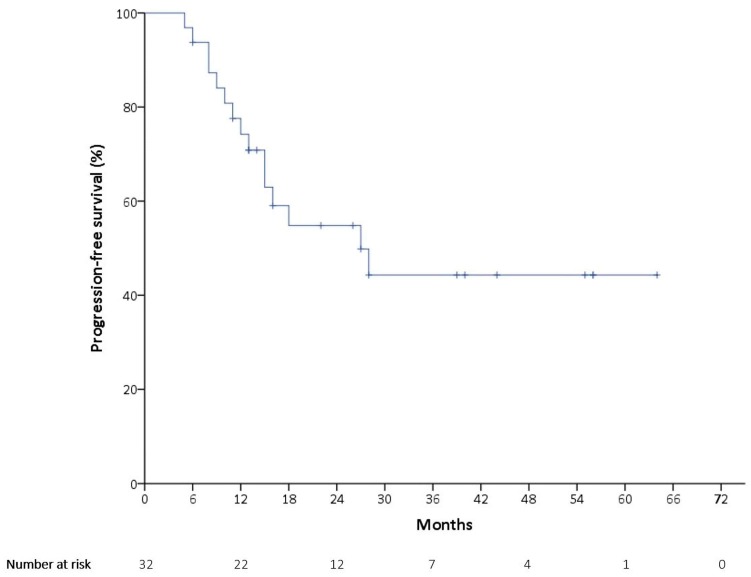
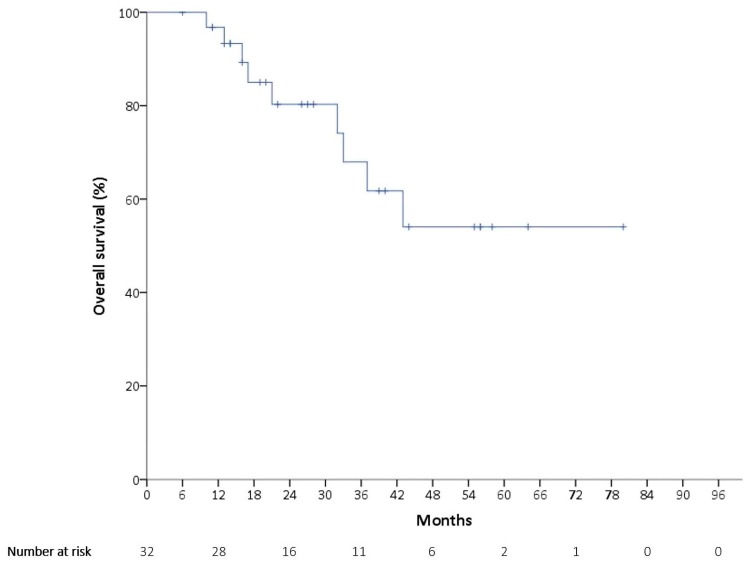
A combination of cytoreductive surgery, either primary (PCS) or interval (ICS), and chemotherapy with a platinum-paclitaxel regimen is the well-accepted treatment for advanced-stage epithelial ovarian cancer (EOC), fallopian tube cancer (FTC), and primary peritoneal serous carcinoma (PPSC), but it is still uncertain whether a combination of dose-dense weekly paclitaxel and low-dose triweekly cisplatin is useful in the management of these patients. Therefore, we retrospectively evaluated the outcomes of women with advanced-stage EOC, FTC, and PPSC treated with PCS and subsequent dose-dense weekly paclitaxel (80 mg/m) and low-dose triweekly cisplatin (20 mg/m). Between January 2011 and December 2017, 32 women with International Federation of Gynecology and Obstetrics (FIGO) stage IIIC-IV EOC, FTC, or PPSC were enrolled. Optimal PCS was achieved in 63.5% of patients. The mean and median progression-free survival was 36.5 and 27.0 months, respectively (95% confidence interval (CI): 26.8-46.2 and 11.3-42.7 months, respectively). The mean overall survival was 56.0 months (95% CI: 43.9-68.1 months), and the median overall survival could not be obtained. The most common all-grade adverse events (AEs) were anemia (96.9%), neutropenia (50%), peripheral neuropathy (28.1%), nausea and vomiting (34.4%), and thrombocytopenia (15.6%). These AEs were predominantly grade 1/2, and only a few patients were complicated by grade 3/4 neutropenia (21.9%) and anemia (6.3%). A multivariate analysis indicated that only suboptimal PCS was significantly correlated with a worse prognosis, resulting in an 11.6-fold increase in the odds of disease progression. In conclusion, our data suggest that dose-dense weekly paclitaxel (80 mg/m) combined with low-dose triweekly cisplatin (20 mg/m) is a potentially effective and highly tolerable front-line treatment in advanced EOC, FTC, and PPSC. Randomized trials comparing the outcome of this regimen to other standard therapies for FIGO stage IIIC-IV EOC, FTC, and PPSC are warranted.
细胞减灭术联合化疗(顺铂联合紫杉醇)是晚期上皮性卵巢癌(EOC)、输卵管癌(FTC)和原发性腹膜浆液性癌(PPSC)的标准治疗方法,其中细胞减灭术包括初次肿瘤细胞减灭术(PCS)和间隔性肿瘤细胞减灭术(ICS)。但是,目前仍不确定在这些患者的治疗中,每周给予高剂量紫杉醇联合低剂量顺铂方案是否有益。因此,我们回顾性评估了采用 PCS 联合随后每周给予高剂量紫杉醇(80mg/m)和低剂量顺铂(20mg/m)方案治疗的晚期 EOC、FTC 和 PPSC 患者的结局。2011 年 1 月至 2017 年 12 月,共纳入 32 例国际妇产科联盟(FIGO)分期为 III C-IV 期的 EOC、FTC 或 PPSC 患者。63.5%的患者达到了最佳的 PCS。无进展生存期的中位值和平均值分别为 27.0 个月(95%CI:11.3-42.7)和 36.5 个月(95%CI:26.8-46.2)。总生存期的中位值和平均值分别为 56.0 个月(95%CI:43.9-68.1)和 56.0 个月(95%CI:43.9-68.1)。最常见的所有级别不良反应(AE)为贫血(96.9%)、中性粒细胞减少(50%)、周围神经病变(28.1%)、恶心和呕吐(34.4%)以及血小板减少(15.6%)。这些 AE 主要为 1/2 级,仅有少数患者发生 3/4 级中性粒细胞减少(21.9%)和贫血(6.3%)。多因素分析表明,仅非最佳 PCS 与预后不良显著相关,疾病进展的风险增加了 11.6 倍。总之,我们的数据表明,每周给予高剂量紫杉醇(80mg/m)联合低剂量顺铂(20mg/m)方案是一种潜在有效的、高度耐受的晚期 EOC、FTC 和 PPSC 一线治疗方法。需要进行随机试验比较该方案与其他用于 FIGO 分期为 III C-IV 期 EOC、FTC 和 PPSC 的标准治疗方法的疗效。