The Christie NHS Foundation Trust and University of Manchester, Manchester, UK.
MRC Clinical Trials Unit at UCL, Institute of Clinical Trials and Methodology, University College London, London, UK.
Lancet Oncol. 2022 Jul;23(7):919-930. doi: 10.1016/S1470-2045(22)00283-2. Epub 2022 Jun 9.
Standard-of-care first-line chemotherapy for epithelial ovarian cancer is carboplatin and paclitaxel administered once every 3 weeks. The JGOG 3016 trial reported significant improvement in progression-free and overall survival with dose-dense weekly paclitaxel and 3-weekly (ie, once every 3 weeks) carboplatin. However, this benefit was not observed in the previously reported progression-free survival results of ICON8. Here, we present the final coprimary outcomes of overall survival and updated progression-free survival analyses of ICON8.
In this open-label, randomised, controlled, phase 3 trial (ICON8), women aged 18 years or older with newly diagnosed stage IC-IV epithelial ovarian, primary peritoneal, or fallopian tube carcinoma (here collectively termed ovarian cancer, as defined by International Federation of Gynecology and Obstetrics [FIGO] 1988 criteria) and an Eastern Cooperative Oncology Group performance status of 0-2 were recruited from 117 hospitals with oncology departments in the UK, Australia and New Zealand, Mexico, South Korea, and Ireland. Patients could enter the trial after immediate primary surgery (IPS) or with planned delayed primary surgery (DPS) during chemotherapy, or could have no planned surgery. Participants were randomly assigned (1:1:1), using the Medical Research Council Clinical Trials Unit at University College London randomisation line with stratification by Gynecologic Cancer Intergroup group, FIGO disease stage, and outcome and timing of surgery, to either 3-weekly carboplatin area under the curve (AUC)5 or AUC6 and 3-weekly paclitaxel 175 mg/m (control; group 1), 3-weekly carboplatin AUC5 or AUC6 and weekly paclitaxel 80 mg/m (group 2), or weekly carboplatin AUC2 and weekly paclitaxel 80 mg/m (group 3), all administered via intravenous infusion for a total of six 21-day cycles. Coprimary outcomes were progression-free survival and overall survival, with comparisons done between group 2 and group 1, and group 3 and group 1, in the intention-to-treat population. Safety was assessed in all patients who started at least one chemotherapy cycle. The trial is registered on ClinicalTrials.gov, NCT01654146, and ISRCTN registry, ISRCTN10356387, and is closed to accrual.
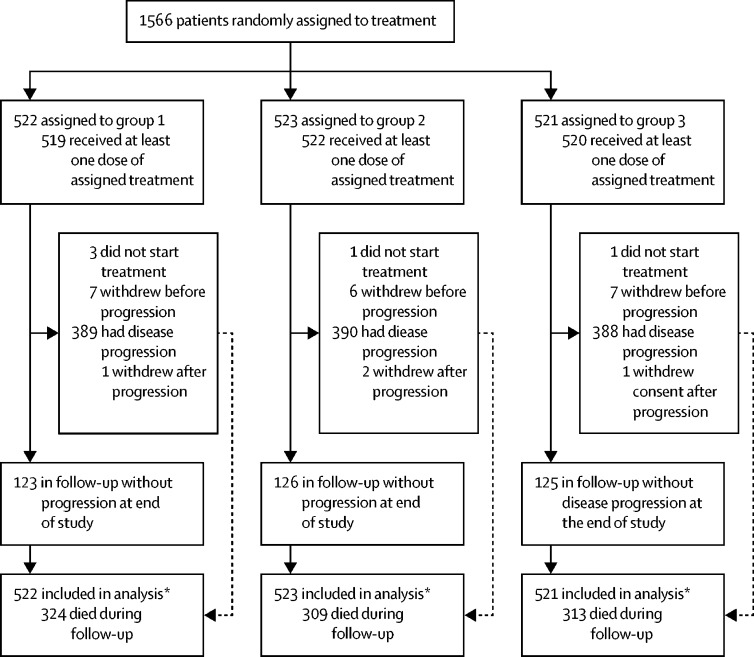
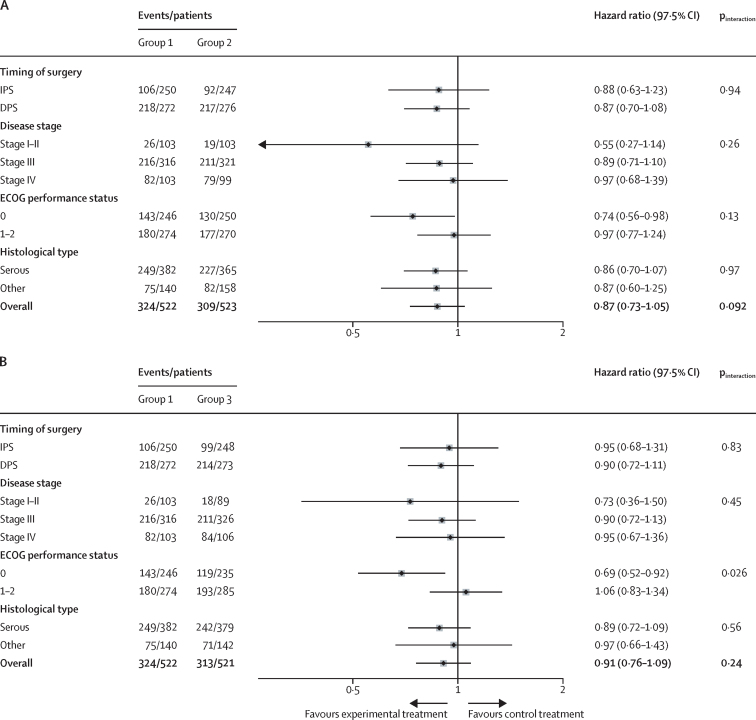
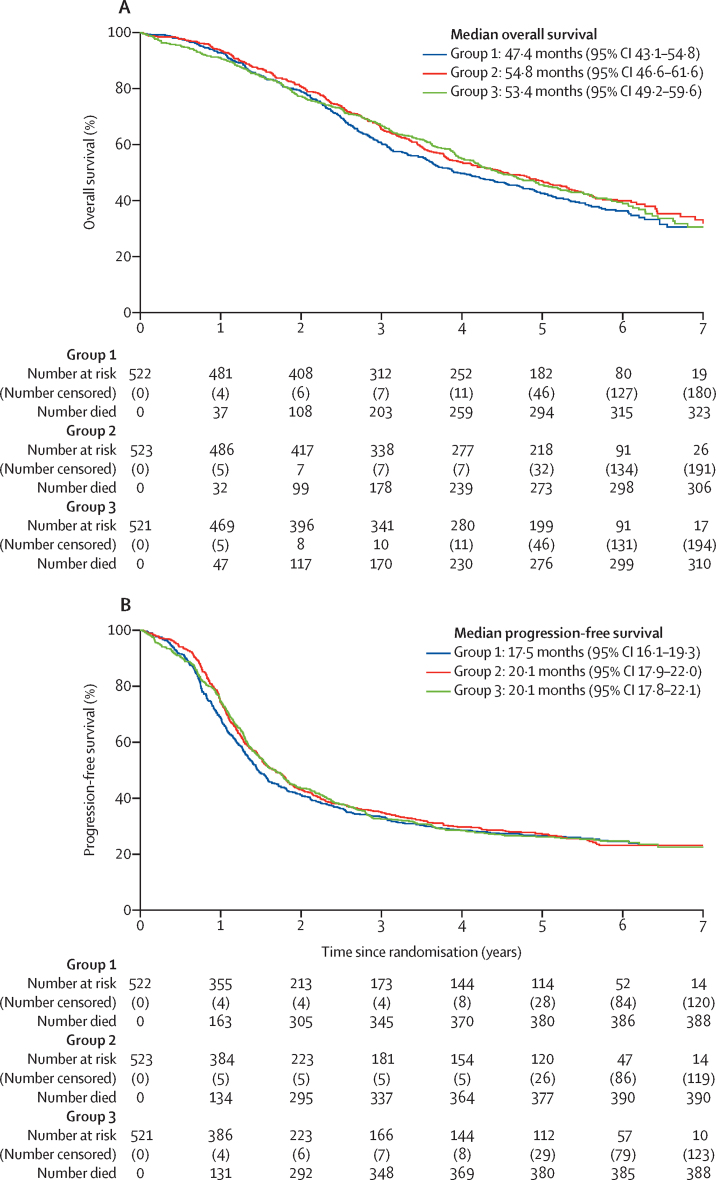
Between June 6, 2011, and Nov 28, 2014, 1566 patients were randomly assigned to group 1 (n=522), group 2 (n=523), or group 3 (n=521). The median age was 62 years (IQR 54-68), 1073 (69%) of 1566 patients had high-grade serous carcinoma, 1119 (71%) had stage IIIC-IV disease, and 745 (48%) had IPS. As of data cutoff (March 31, 2020), with a median follow-up of 69 months (IQR 61-75), no significant difference in overall survival was observed in either comparison: median overall survival of 47·4 months (95% CI 43·1-54·8) in group 1, 54·8 months (46·6-61·6) in group 2, and 53·4 months (49·2-59·6) in group 3 (group 2 vs group 1: hazard ratio 0·87 [97·5% CI 0·73-1·05]; group 3 vs group 1: 0·91 [0·76-1·09]). No significant difference was observed for progression-free survival in either comparison and evidence of non-proportional hazards was seen (p=0·037), with restricted mean survival time of 23·9 months (97·5% CI 22·1-25·6) in group 1, 25·3 months (23·6-27·1) in group 2, and 24·8 months (23·0-26·5) in group 3. The most common grade 3-4 adverse events were reduced neutrophil count (78 [15%] of 511 patients in group 1, 183 [36%] of 514 in group 2, and 154 [30%] of 513 in group 3), reduced white blood cell count (22 [4%] in group 1, 80 [16%] in group 2, and 71 [14%] in group 3), and anaemia (26 [5%] in group 1, 66 [13%] in group 2, and 24 [5%] in group 3). No new serious adverse events were reported. Seven treatment-related deaths were reported (two in group 1, four in group 2, and one in group 3).
In our cohort of predominantly European women with epithelial ovarian cancer, we found that first-line weekly dose-dense chemotherapy did not improve overall or progression-free survival compared with standard 3-weekly chemotherapy and should not be used as part of standard multimodality front-line therapy in this patient group.
Cancer Research UK, Medical Research Council, Health Research Board in Ireland, Irish Cancer Society, and Cancer Australia.
上皮性卵巢癌的标准一线化疗是每 3 周给予卡铂和紫杉醇。JGOG 3016 试验报告称,与每 3 周(即每 3 周一次)给予卡铂和每周给予紫杉醇相比,剂量密集型每周紫杉醇和 3 周(即每 3 周一次)卡铂显著改善了无进展生存期和总生存期。然而,ICON8 先前报告的无进展生存期结果并未观察到这一益处。在此,我们报告了 ICON8 的总生存期和更新的无进展生存期分析的最终主要结局。
在这项开放标签、随机对照、3 期临床试验(ICON8)中,招募了年龄在 18 岁及以上、新诊断为 IC-IV 期上皮性卵巢癌、原发性腹膜癌或输卵管癌(这里统称为卵巢癌,按国际妇产科联合会[FIGO]1988 标准定义)且东部肿瘤协作组表现状态为 0-2 的患者,来自英国、澳大利亚和新西兰、墨西哥、韩国和爱尔兰的 117 家有肿瘤科室的医院。患者可在立即行初始手术(IPS)后入组或在化疗期间计划行延迟初始手术(DPS),也可不行计划手术。参与者按 1:1:1 的比例随机分配(1:1:1),使用伦敦大学学院医学研究理事会临床试验单位的随机线,分层按妇科癌症协作组组、FIGO 疾病分期、手术的结果和时机,分别接受每周紫杉醇 80mg/m2(对照组;组 1)、每周卡铂 AUC2 和每周紫杉醇 80mg/m2(组 3)或每周卡铂 AUC5 或 AUC6 和每周紫杉醇 175mg/m2(组 2),所有药物均通过静脉输注给药,共进行 6 个 21 天周期。主要无进展生存期和总生存期的比较是在意向治疗人群中进行的,分别为组 2 与组 1 和组 3 与组 1 之间的比较。安全性评估在至少开始了一个化疗周期的所有患者中进行。该试验在 ClinicalTrials.gov 上注册,NCT01654146,ISRCTN 注册,ISRCTN10356387,现已关闭入组。
2011 年 6 月 6 日至 2014 年 11 月 28 日,共招募了 1566 名患者,随机分为组 1(n=522)、组 2(n=523)或组 3(n=521)。中位年龄为 62 岁(IQR 54-68),1566 名患者中有 1073 名(69%)患有高级别浆液性癌,1119 名(71%)患有 IIIIC-IV 期疾病,745 名(48%)患有 IPS。截至 2020 年 3 月 31 日,中位随访 69 个月(IQR 61-75),在任何比较中均未观察到总生存期的显著差异:组 1 的中位总生存期为 47.4 个月(95%CI 43.1-54.8),组 2 为 54.8 个月(46.6-61.6),组 3 为 53.4 个月(49.2-59.6)(组 2 与组 1 比较:风险比 0.87[97.5%CI 0.73-1.05];组 3 与组 1 比较:0.91[0.76-1.09])。在任何比较中均未观察到无进展生存期的显著差异,并且观察到非比例风险(p=0.037),组 1 的限制性平均生存时间为 23.9 个月(97.5%CI 22.1-25.6),组 2 为 25.3 个月(23.6-27.1),组 3 为 24.8 个月(23.0-26.5)。最常见的 3-4 级不良事件是中性粒细胞计数减少(组 1 中有 511 名患者中的 78 名[15%],组 2 中有 514 名患者中的 183 名[36%],组 3 中有 513 名患者中的 154 名[30%]),白细胞计数减少(组 1 中有 22 名[4%],组 2 中有 80 名[16%],组 3 中有 71 名[14%])和贫血(组 1 中有 26 名[5%],组 2 中有 66 名[13%],组 3 中有 24 名[5%])。未报告新的严重不良事件。报告了 7 例与治疗相关的死亡(两组各 2 例,三组各 1 例)。
在我们的欧洲女性上皮性卵巢癌队列中,我们发现一线每周剂量密集型化疗与标准的 3 周化疗相比并未改善总生存期或无进展生存期,因此不应在该患者群体的标准多模式一线治疗中使用。
英国癌症研究中心、医学研究理事会、爱尔兰健康研究委员会、爱尔兰癌症协会和澳大利亚癌症协会。