University Clinic of Medicine, Cantonal Hospital Baselland, Rheinstrasse 26, CH - 4410, Liestal, Switzerland.
Department of Pharmaceutical Sciences, University of Basel, Basel, Switzerland.
Respir Res. 2019 Dec 3;20(1):273. doi: 10.1186/s12931-019-1219-3.
Poor medication-adherence is common in chronic lung patients, resulting in reduced health-outcomes and increased healthcare-costs. This study aimed to investigate the impact of an acoustic reminder and support calls on adherence to inhaled therapy in asthma and COPD patients and to determine their effect on exacerbations.
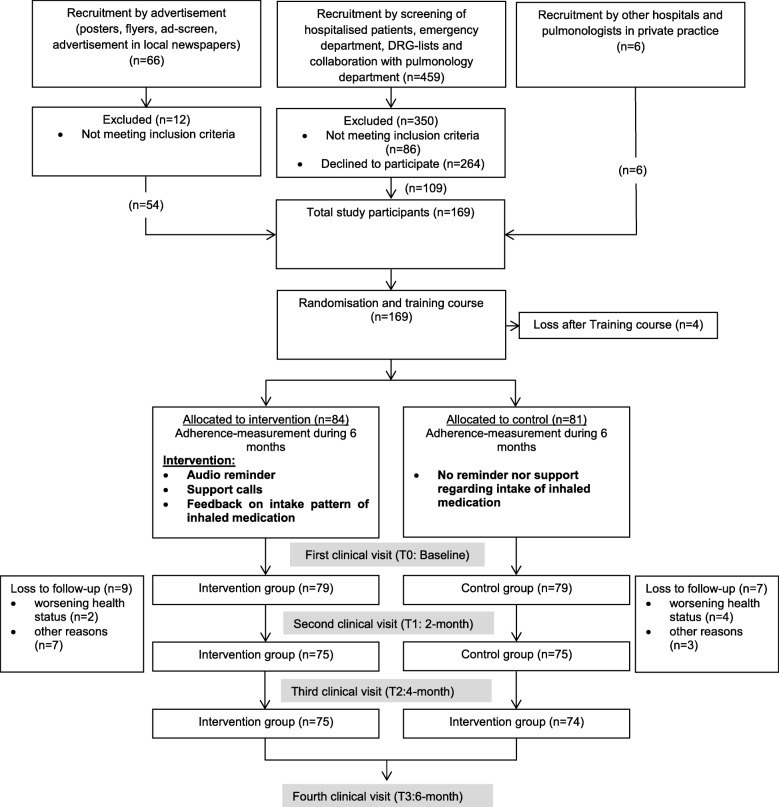
This single-blinded randomized controlled trial investigated asthma and COPD patients during 6 months in an ambulatory setting. The intervention consisted of daily alarm clock and support phone calls, whenever use of rescue medication doubled or inhaled medication was not taken as prescribed. Primary outcome was time to next exacerbation. Frequency of exacerbations, adherence to inhaled medication and quality of life scores were secondary outcomes. Cox and Poisson regression were used to determine intervention effect on time to exacerbation and frequency of exacerbations, respectively.
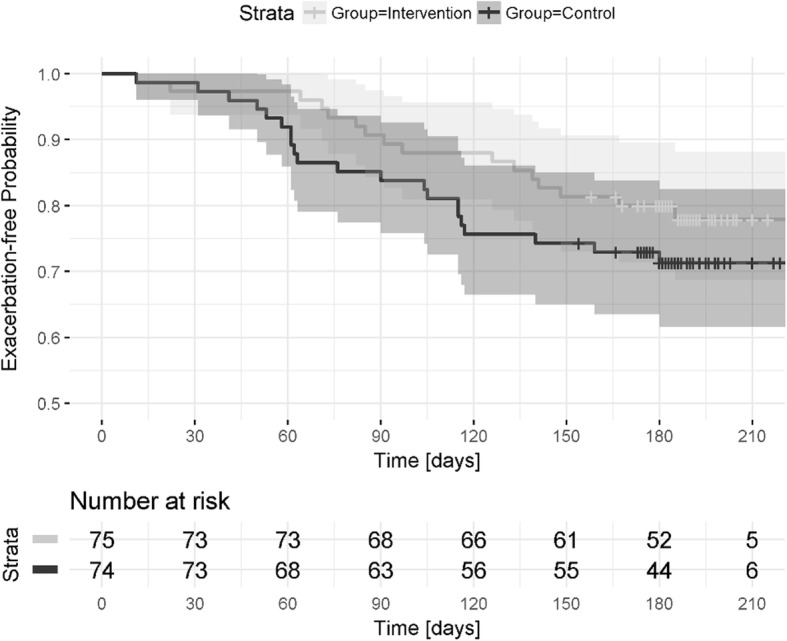
Seventy-five participants were assigned to the intervention group and 74 to usual follow-up care. During a median follow-up of 6.2 months, 22 and 28% in the intervention and control groups respectively, experienced at least one exacerbation. Intervention had no effect on time to first exacerbation (HR 0.65, 95% CI 0.21 to 2.07, P = .24), but showed a trend toward a 39% decreased frequency of exacerbations (RR = 0.61, 95% CI 0.35 to 1.03, P = .070) for the adjusted models, respectively. The intervention group had significantly more days with 80-100% taking adherence regarding puff inhalers (82 ± 14% vs. 60 ± 30%, P < .001) and dry powder capsules (90 ± .10% vs. 80 ± 21%, P = .01). Timing adherence in participants using puff inhalers was higher in the intervention group (69 ± 25% vs. 51 ± 33%, P < .001). No significant differences in QoL were found between the two groups.
Participants assigned to the intervention group had significantly better taking and timing adherence of inhaled medication resulting in a trend towards a decreased frequency of exacerbations. However, no effect on time to next exacerbation was observed.
ClinicalTrials.gov: NCT02386722, Registered 14 February 2014.
慢性肺部疾病患者普遍存在用药依从性差的情况,这导致健康状况恶化和医疗保健费用增加。本研究旨在探讨声学提醒和支持电话对哮喘和 COPD 患者吸入治疗依从性的影响,并确定其对加重的影响。
这项单盲随机对照试验在门诊环境中对哮喘和 COPD 患者进行了 6 个月的研究。干预措施包括每天闹钟和支持电话,每当急救药物使用量翻倍或吸入药物未按规定使用时。主要结局是下一次加重的时间。加重的频率、吸入药物的依从性和生活质量评分是次要结局。使用 Cox 和 Poisson 回归分别确定干预对加重时间和加重频率的影响。
75 名参与者被分配到干预组,74 名参与者被分配到常规随访组。在中位数为 6.2 个月的随访期间,干预组和对照组分别有 22%和 28%的患者至少经历了一次加重。干预措施对首次加重时间无影响(HR 0.65,95%CI 0.21 至 2.07,P=0.24),但调整模型显示加重频率有降低 39%的趋势(RR=0.61,95%CI 0.35 至 1.03,P=0.070)。干预组吸入器(puff 吸入器)的服药依从性(82±14% 与 60±30%,P<0.001)和干粉胶囊(90±0.10% 与 80±21%,P=0.01)的天数明显更多。干预组 puff 吸入器的服药时间依从性更高(69±25% 与 51±33%,P<0.001)。两组之间的生活质量没有显著差异。
分配到干预组的参与者吸入药物的服药和时间依从性显著提高,导致加重频率降低的趋势。然而,没有观察到对下一次加重时间的影响。
ClinicalTrials.gov:NCT02386722,2014 年 2 月 14 日注册。