Department of Anesthesiology, Loma Linda University, Loma Linda, CA, USA.
Department of Anesthesiology and Pain Medicine, University of California Davis, Sacramento, CA, USA.
J Clin Monit Comput. 2020 Oct;34(5):883-892. doi: 10.1007/s10877-019-00428-3. Epub 2019 Dec 3.
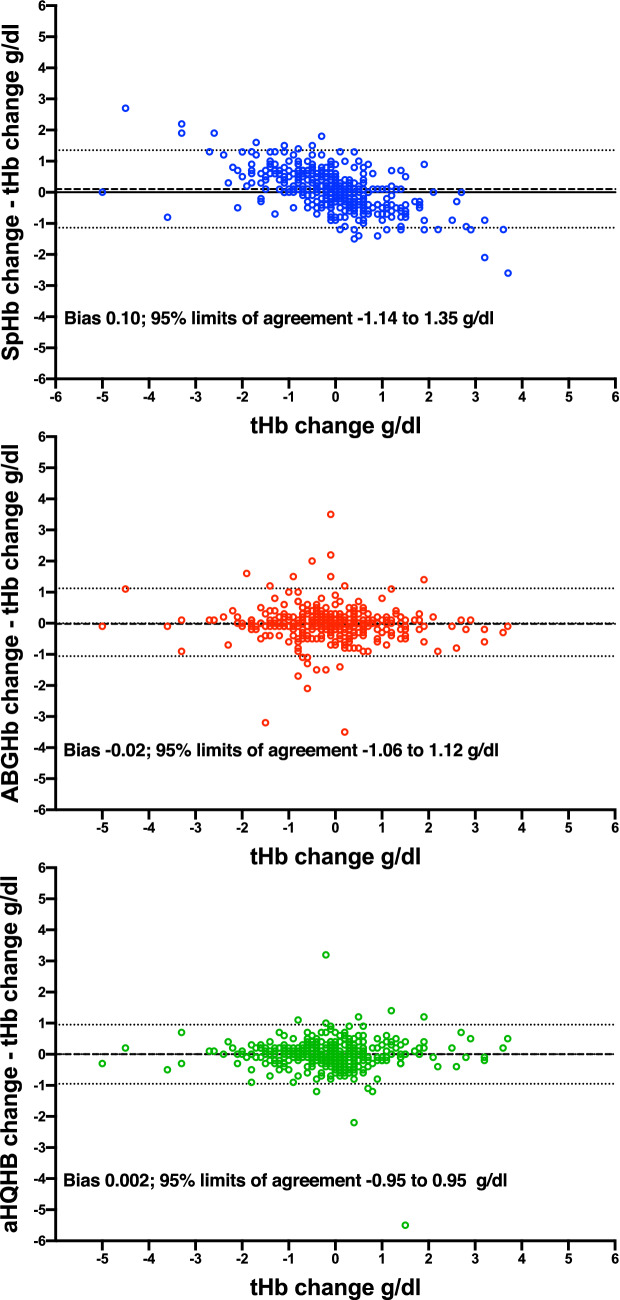
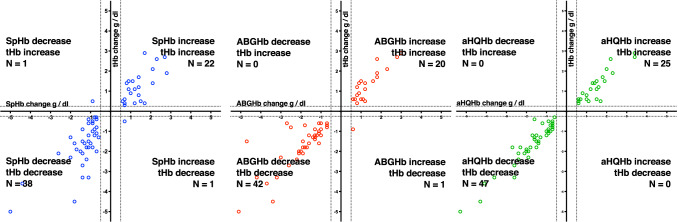
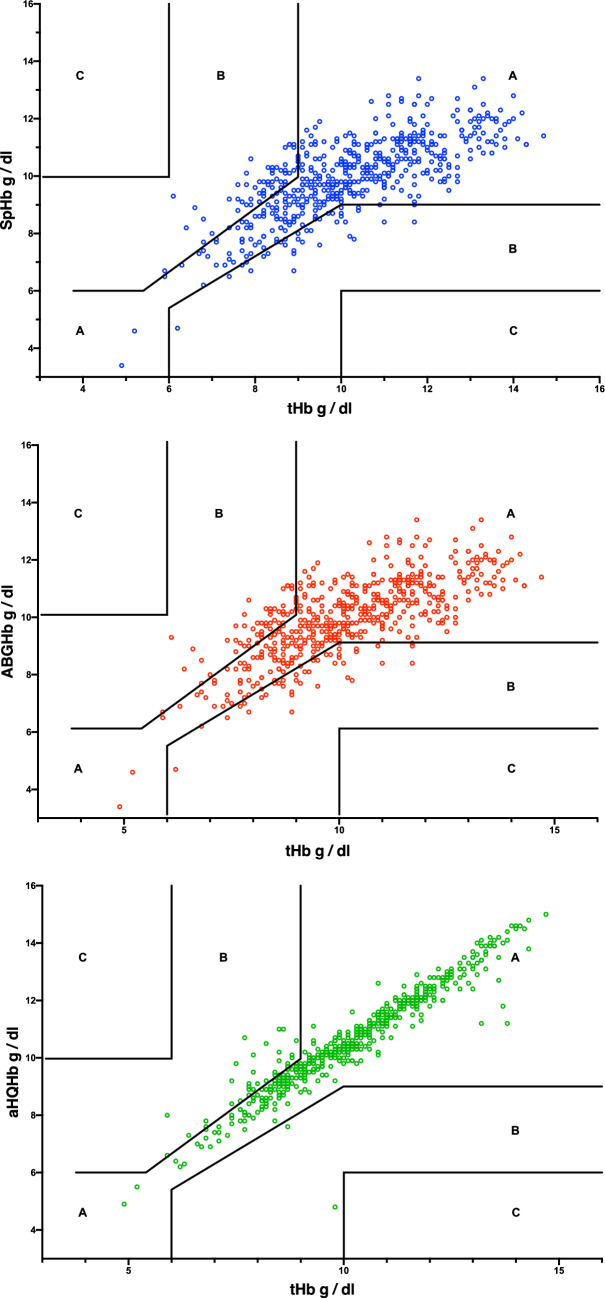
Transfusion decisions are guided by clinical factors and measured hemoglobin (Hb). Time required for blood sampling and analysis may cause Hb measurement to lag clinical conditions, thus continuous intraoperative Hb trend monitoring may provide useful information. This multicenter study was designed to compare three methods of determining intraoperative Hb changes (trend accuracy) to laboratory determined Hb changes. Adult surgical patients with planned arterial catheterization were studied. With each blood gas analysis performed, pulse cooximetry hemoglobin (SpHb) was recorded, and arterial blood Hb was measured by hematology (tHb), arterial blood gas cooximetry (ABGHb), and point of care (aHQHb) analyzers. Hb change was calculated and trend accuracy assessed by modified Bland-Altman analysis. Secondary measures included Hb measurement change direction agreement. Trend accuracy mean bias (95% limits of agreement; g/dl) for SpHb was 0.10 (- 1.14 to 1.35); for ABGHb was - 0.02 (- 1.06 to 1.02); and for aHQHb was 0.003 (- 0.95 to 0.95). Changes more than ± 0.5 g/dl agreed with tHb changes more than ± 0.25 g/dl in 94.2% (88.9-97.0%) SpHb changes, 98.9% (96.1-99.7%) ABGHb changes and 99.0% (96.4-99.7%) aHQHb changes. Sequential changes in SpHb, ABGHb and aHQHb exceeding ± 0.5 g/dl have similar agreement to the direction but not necessarily the magnitude of sequential tHb change. While Hb blood tests should continue to be used to inform transfusion decisions, intraoperative continuous noninvasive SpHb decreases more than - 0.5 g/dl could be a good indicator of the need to measure tHb.
输血决策受临床因素和测量的血红蛋白(Hb)水平的影响。采血管血和分析所需的时间可能导致 Hb 测量滞后于临床情况,因此,连续的术中 Hb 趋势监测可能提供有用的信息。本多中心研究旨在比较三种方法来确定术中 Hb 变化(趋势准确性)与实验室确定的 Hb 变化。研究纳入了计划进行动脉置管的成年手术患者。每次进行血气分析时,记录脉搏血氧仪血红蛋白(SpHb),并使用血液学分析仪(tHb)、动脉血气光电比色法(ABGHb)和即时检测(aHQHb)分析仪测量动脉血 Hb。通过改良的 Bland-Altman 分析评估 Hb 变化和趋势准确性。次要指标包括 Hb 测量变化方向的一致性。SpHb 的趋势准确性平均偏差(95%一致性界限;g/dl)为 0.10(-1.14 至 1.35);ABGHb 为-0.02(-1.06 至 1.02);aHQHb 为 0.003(-0.95 至 0.95)。变化超过±0.5 g/dl 与 tHb 变化超过±0.25 g/dl 的一致性大于 94.2%(88.9-97.0%)的 SpHb 变化、98.9%(96.1-99.7%)的 AGBHb 变化和 99.0%(96.4-99.7%)的 aHQHb 变化。SpHb、ABGHb 和 aHQHb 的连续变化超过±0.5 g/dl 与连续 tHb 变化的方向具有相似的一致性,但不一定与连续 tHb 变化的幅度一致。虽然 Hb 血液检测仍应继续用于指导输血决策,但术中连续无创 SpHb 下降超过-0.5 g/dl 可能是需要测量 tHb 的良好指标。