Faculty of Medicine, University of Turku, Turku, Finland.
Child Psychiatry, Turku University Hospital, Turku, Finland.
Addiction. 2020 Jun;115(6):1160-1171. doi: 10.1111/add.14904. Epub 2020 Jan 8.
The associations between traumatic events, substance use and perceived discrimination have been rarely studied among migrants in host countries. We examined whether pre-migration potentially traumatic experiences (PTEs) or perceived discrimination (PD) are associated with substance use among migrants with voluntary (Russians) and forced (Kurds) migration backgrounds.
Cross-sectional interview and health examination data from the Finnish Migrant Health and Wellbeing Study were used. The target sample (n = 1000 for each group) was drawn from the national population register using stratified random sampling by participants' country of birth and native language.
Population-based data were collected from six cities in Finland during 2010-12.
The participation rates were 68% (Russians) and 59% (Kurds). The analytical sample size varied (Russians n = 442-687, Kurds n = 459-613), as some participants completed only interview, health examination or short interview. The majority of Kurds had a refugee background (75%) while Russians had mainly migrated for other reasons (99%).
The three main outcomes were self-reported binge drinking, daily smoking and life-time cannabis use. PTEs and PD were self-reported in the interview. Socio-demographic background, migration-related factors and current affective symptoms were adjusted for.
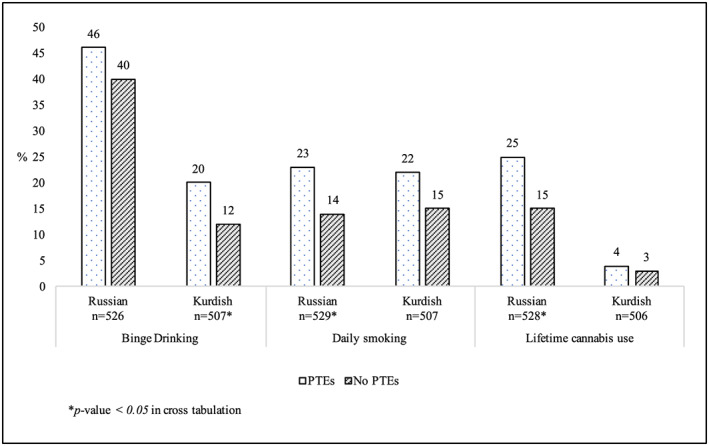
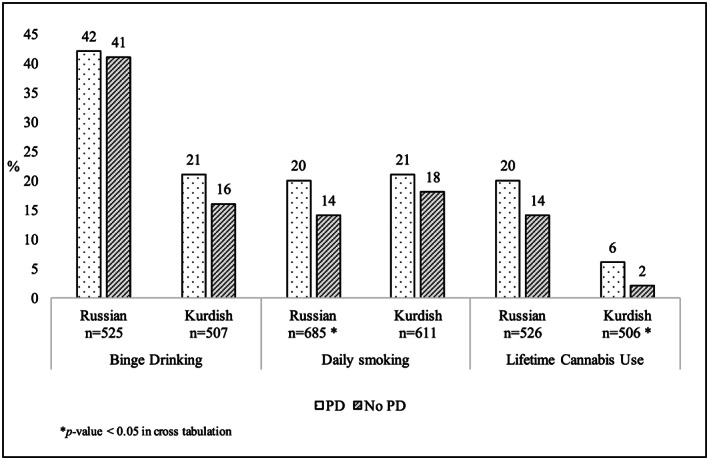
Among Kurds, PTEs were associated with binge drinking [adjusted odds ratio (aOR) = 2.65, 95% confidence interval (CI) = 1.30-5.42] and PD was associated with life-time cannabis use (aOR = 3.89, 95% CI = 1.38-10.97) after adjusting for contextual factors. Among Russians, PTEs were associated with life-time cannabis use adjusting for contextual factors (aOR = 2.17, 95% CI = 1.12-4.18).
In Finland, pre-migration traumatic experiences appear to be associated with life-time cannabis use among the Russian migrant population (voluntary migration) and binge drinking among the Kurdish migrant population (forced migration). Perceived discrimination in Finland appears to be associated with life-time cannabis use among Kurdish migrants.
创伤事件、物质使用和感知歧视之间的关联在东道国的移民中很少被研究。我们研究了在有自愿(俄罗斯人)和强制(库尔德人)移民背景的移民中,预先存在的创伤经历(PTE)或感知歧视(PD)是否与物质使用有关。
使用芬兰移民健康和幸福感研究的横断面访谈和健康检查数据。目标样本(每个群体为 1000 人)是根据参与者的出生国和母语通过分层随机抽样从国家人口登记册中抽取的。
2010-12 年期间在芬兰的六个城市进行了基于人群的数据收集。
俄罗斯人的参与率为 68%,库尔德人为 59%。分析样本量有所不同(俄罗斯人 n=442-687,库尔德人 n=459-613),因为有些参与者仅完成了访谈、健康检查或简短访谈。大多数库尔德人有难民背景(75%),而俄罗斯人主要出于其他原因移民(99%)。
三个主要结果是自我报告的狂饮、每日吸烟和终身使用大麻。创伤事件和感知歧视在访谈中自我报告。调整了社会人口背景、与移民有关的因素和当前的情感症状。
在库尔德人中,创伤事件与狂饮有关(调整后的优势比[aOR]=2.65,95%置信区间[CI]=1.30-5.42),在调整了背景因素后,感知歧视与终身使用大麻有关[aOR=3.89,95% CI=1.38-10.97]。在俄罗斯人中,创伤事件与终身使用大麻有关,调整了背景因素(aOR=2.17,95% CI=1.12-4.18)。
在芬兰,预先存在的创伤经历似乎与俄罗斯移民人群(自愿移民)的终身使用大麻以及库尔德移民人群(强制移民)的狂饮有关。在芬兰,感知歧视似乎与库尔德移民的终身使用大麻有关。