Doctoral Programme in Clinical Research, Faculty of Medicine, University of Turku, Finland.
Child Psychiatry, Turku University Hospital, Finland.
Transcult Psychiatry. 2022 Feb;59(1):37-51. doi: 10.1177/1363461520906028. Epub 2020 Mar 12.
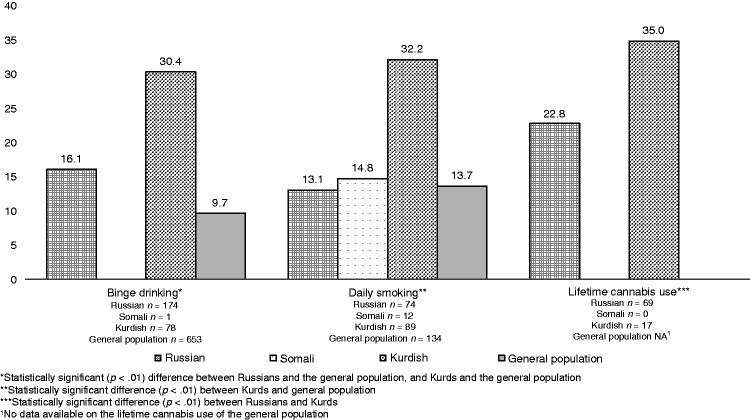
Comorbidity of substance use with affective symptoms and suicidality has been well documented in the general population. However, population-based migrant studies about this association are scarce. We examined the association of affective symptoms and suicidal ideation with binge drinking, daily smoking, and lifetime cannabis use among Russian, Somali, and Kurdish migrants in comparison with the Finnish general population. Cross-sectional data from the Finnish Migrant Health and Wellbeing Study (Maamu, = 1307) and comparison group data of the general Finnish population ( = 860) from the Health 2011 Survey were used. Substance use included self-reported current binge drinking, daily smoking, and lifetime cannabis use. Affective symptoms and suicidal ideation were measured using the Hopkins Symptom Checklist-25 (HSCL-25). We performed multivariate logistic regression analyses, including age, gender, and additional socio-demographic and migration-related factors. Suicidal ideation (OR 2.4 95% CI 1.3-4.3) was associated with binge drinking among Kurds and lifetime cannabis use among Russians (OR 5.6, 95% CI 1.9-17.0) and Kurds (OR 5.5, 95% CI 1.9-15.6). Affective symptoms were associated with daily smoking (OR 1.6, 95% CI 1.02-2.6) and lifetime cannabis use (OR 6.1, 95% CI 2.6-14.5) among Kurdish migrants. Our results draw attention to the co-occurrence of suicidal ideation, affective symptoms, and substance use, especially among Kurdish migrants. These results highlight the variation of comorbidity of substance use and affective symptoms between the different populations. This implies that screening for substance use in mental healthcare cannot be neglected based on presumed habits of substance use.
物质使用与情感症状和自杀意念的合并症在一般人群中已有充分记录。然而,基于人群的移民研究对此关联的研究很少。我们研究了情感症状和自杀意念与俄罗斯、索马里和库尔德移民中的狂欢性饮酒、每日吸烟和终生大麻使用之间的关联,并与芬兰一般人群进行了比较。本研究使用了来自芬兰移民健康和幸福感研究(Maamu,n=1307)的横断面数据和来自健康 2011 调查的一般芬兰人群(n=860)的对照群体数据。物质使用包括自我报告的当前狂欢性饮酒、每日吸烟和终生大麻使用。使用 Hopkins 症状清单-25(HSCL-25)来测量情感症状和自杀意念。我们进行了多变量逻辑回归分析,包括年龄、性别以及其他社会人口学和移民相关因素。自杀意念(OR 2.4,95%CI 1.3-4.3)与库尔德人的狂欢性饮酒以及俄罗斯人的终生大麻使用(OR 5.6,95%CI 1.9-17.0)和库尔德人的终生大麻使用(OR 5.5,95%CI 1.9-15.6)有关。情感症状与库尔德移民的每日吸烟(OR 1.6,95%CI 1.02-2.6)和终生大麻使用(OR 6.1,95%CI 2.6-14.5)有关。我们的结果提请注意自杀意念、情感症状和物质使用的同时发生,尤其是在库尔德移民中。这些结果突出了不同人群中物质使用和情感症状合并症的变化。这意味着不能根据假定的物质使用习惯忽视在精神保健中对物质使用的筛查。