Department of Gynecologic Oncology and Reproductive Medicine, University of Texas MD Anderson Cancer Center, Houston, TX, USA.
Department of Medicine, Stanford University, Stanford, CA, USA.
Sci Adv. 2019 Nov 20;5(11):eaax8849. doi: 10.1126/sciadv.aax8849. eCollection 2019 Nov.
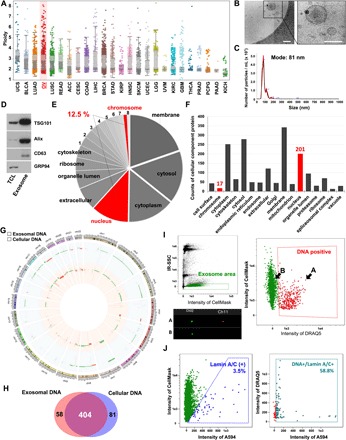
Exosome cargoes are highly varied and include proteins, small RNAs, and genomic DNA (gDNA). The presence of gDNA suggests that different intracellular compartments contribute to exosome loading, resulting in distinct exosome subpopulations. However, the loading of gDNA and other nuclear contents into exosomes (nExo) remains poorly understood. Here, we identify the relationship between cancer cell micronuclei (MN), which are markers of genomic instability, and nExo formation. Imaging flow cytometry analyses reveal that 10% of exosomes derived from cancer cells and <1% of exosomes derived from blood and ascites from patients with ovarian cancer carry nuclear contents. Treatment with genotoxic drugs resulted in increased MN and nExos both in vitro and in vivo. We observed that multivesicular body precursors and exosomal markers, such as the tetraspanins, directly interact with MN. Collectively, this work provides new insights related to nExos, which have implications for cancer biomarker development.
外泌体的货物种类繁多,包括蛋白质、小 RNA 和基因组 DNA(gDNA)。gDNA 的存在表明不同的细胞内隔室有助于外泌体的装载,从而产生不同的外泌体亚群。然而,gDNA 和其他核内容物(nExo)加载到外泌体中的情况仍知之甚少。在这里,我们确定了癌细胞微核(MN)与 nExo 形成之间的关系,MN 是基因组不稳定性的标志物。成像流式细胞术分析显示,10%的癌细胞衍生的外泌体和<1%的来自卵巢癌患者血液和腹水中的外泌体携带核内容物。在体外和体内用遗传毒性药物处理后,MN 和 nExo 的数量均增加。我们观察到多泡体前体和外泌体标记物(如四跨膜蛋白)直接与 MN 相互作用。总的来说,这项工作提供了与 nExo 相关的新见解,这对癌症生物标志物的发展有影响。