Institute of Immunology, Center for Pathophysiology, Infectiology and Immunology, Medical University of Vienna, Austria.
Eur J Immunol. 2020 Jan;50(1):17-32. doi: 10.1002/eji.201847810. Epub 2019 Dec 15.
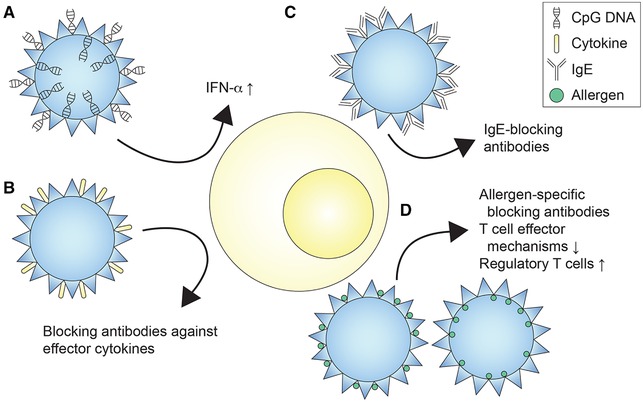
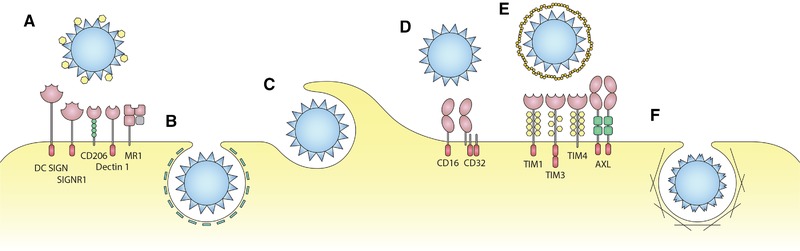
Recent years have seen a dramatic increase in the range of applications of virus-like nanoparticle (VNP)- and liposome-based antigen delivery systems for the treatment of allergies. These platforms rely on a growing number of inert virus-backbones or distinct lipid formulations and intend to engage the host's innate and/or adaptive immune system by virtue of their co-delivered immunogens. Due to their particulate nature, VNP and liposomal preparations are also capable of breaking tolerance against endogenous cytokines, Igs, and their receptors, allowing for the facile induction of anti-cytokine, anti-IgE, or anti-FcεR antibodies in the host. We here discuss the "pros and cons" of inducing such neutralizing autoantibodies. Moreover, we cover another major theme of the last years, i.e., the engineering of non-anaphylactogenic particles and the elucidation of the parameters relevant for the specific trafficking and processing of such particles in vivo. Finally, we put the various technical advances in VNP- and liposome-research into (pre-)clinical context by referring and critically discussing the relevant studies performed to treat allergic diseases.
近年来,病毒样纳米颗粒(VNP)和脂质体基于抗原传递系统在治疗过敏中的应用范围急剧扩大。这些平台依赖于越来越多的惰性病毒骨架或独特的脂质配方,并通过共递呈的免疫原来利用宿主的固有和/或适应性免疫系统。由于其颗粒性质,VNP 和脂质体制剂也能够打破对内源细胞因子、Ig 及其受体的耐受性,从而易于在宿主中诱导抗细胞因子、抗 IgE 或抗 FcεR 抗体。我们在这里讨论诱导这种中和自身抗体的“利弊”。此外,我们还涵盖了过去几年的另一个主要主题,即无过敏原性颗粒的工程化以及阐明与体内此类颗粒的特定运输和处理相关的参数。最后,我们通过参考和批判性讨论为治疗过敏疾病而进行的相关研究,将 VNP 和脂质体研究的各种技术进步置于(前)临床背景下。