Departments of Microbiology and Immunology and Earth, Ocean, and Atmospheric Sciences, University of British Columbia, Vancouver, British Columbia, Canada.
Department of Earth and Atmospheric Sciences, University of Alberta, Edmonton, Alberta T6G 2E3, Canada.
Sci Adv. 2019 Nov 27;5(11):eaav2869. doi: 10.1126/sciadv.aav2869. eCollection 2019 Nov.
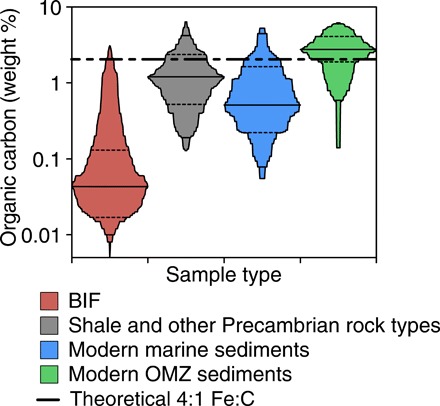
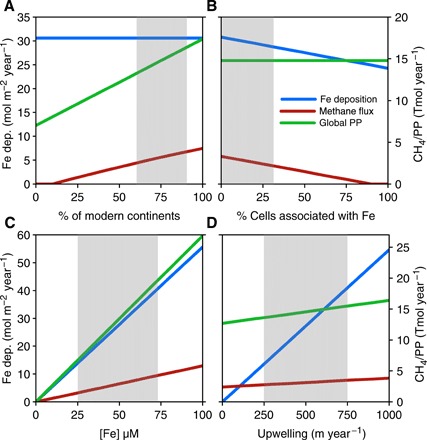
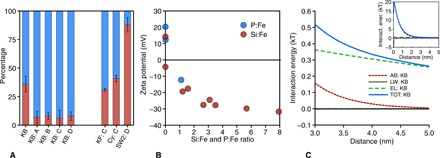
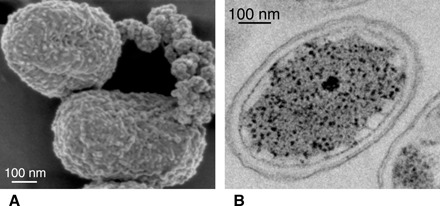
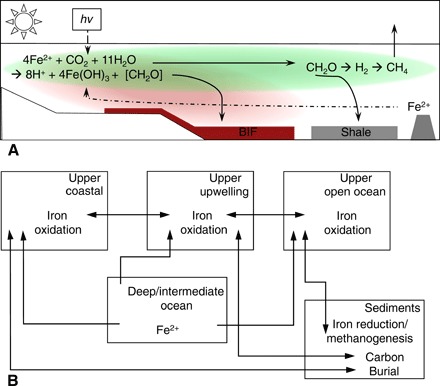
Banded iron formation (BIF) deposition was the likely result of oxidation of ferrous iron in seawater by either oxygenic photosynthesis or iron-dependent anoxygenic photosynthesis-photoferrotrophy. BIF deposition, however, remains enigmatic because the photosynthetic biomass produced during iron oxidation is conspicuously absent from BIFs. We have addressed this enigma through experiments with photosynthetic bacteria and modeling of biogeochemical cycling in the Archean oceans. Our experiments reveal that, in the presence of silica, photoferrotroph cell surfaces repel iron (oxyhydr)oxides. In silica-rich Precambrian seawater, this repulsion would separate biomass from ferric iron and would lead to large-scale deposition of BIFs lean in organic matter. Excess biomass not deposited with BIF would have deposited in coastal sediments, formed organic-rich shales, and fueled microbial methanogenesis. As a result, the deposition of BIFs by photoferrotrophs would have contributed fluxes of methane to the atmosphere and thus helped to stabilize Earth's climate under a dim early Sun.
条带状铁建造(BIF)的形成可能是海水中亚铁被好氧光合作用或铁依赖型厌氧光合作用-光亚铁还原作用氧化的结果。然而,BIF 的形成仍然是一个谜,因为在铁氧化过程中产生的光合作用生物量在 BIF 中明显缺失。我们通过与光合细菌的实验和太古宙海洋生物地球化学循环的建模来解决这个难题。我们的实验表明,在存在硅的情况下,光亚铁还原菌细胞表面排斥铁(氧)氢氧化物。在硅含量丰富的前寒武纪海水中,这种排斥作用会将生物量与三价铁分离,从而导致 BIF 的大规模贫有机质沉积。未与 BIF 一起沉积的多余生物量将沉积在沿海沉积物中,形成富含有机物的页岩,并为微生物甲烷生成提供燃料。因此,光亚铁还原菌对 BIF 的沉积会向大气中输送甲烷通量,从而有助于在昏暗的早期太阳下稳定地球的气候。