Zhou Shiqiang, Chen Mingpeng, Lu Qingjie, Zhang Yumin, Zhang Jin, Li Bo, Wei Haitang, Hu Jicu, Wang Huapeng, Liu Qingju
School of Materials Science and Engineering, Yunnan Key Laboratory for Micro/nano Materials & Technology, Yunnan University, Kunming, 650091, China.
Institute of Applied Physics and Materials Engineering, University of Macau, Macau SAR, China.
Nanoscale Res Lett. 2019 Dec 5;14(1):365. doi: 10.1186/s11671-019-3213-6.
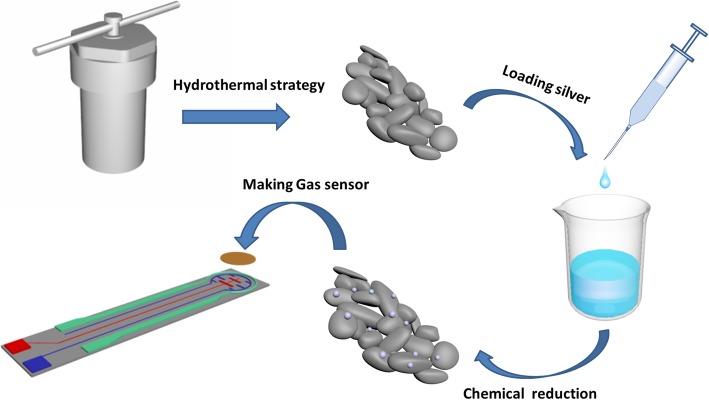
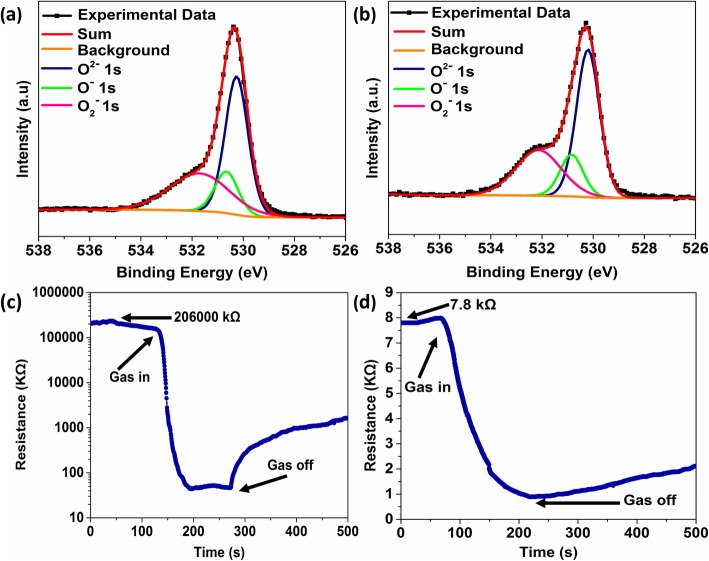
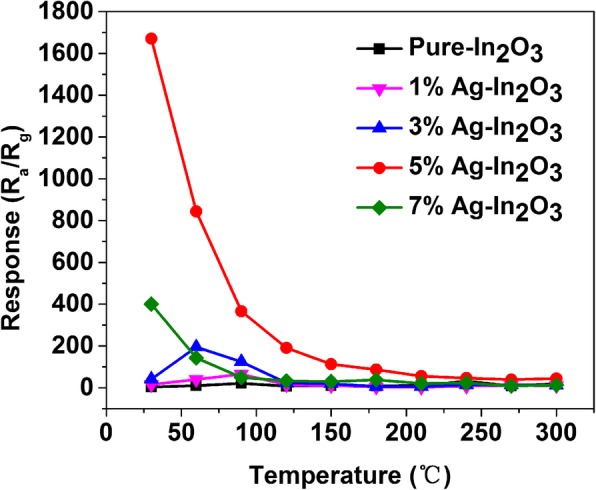
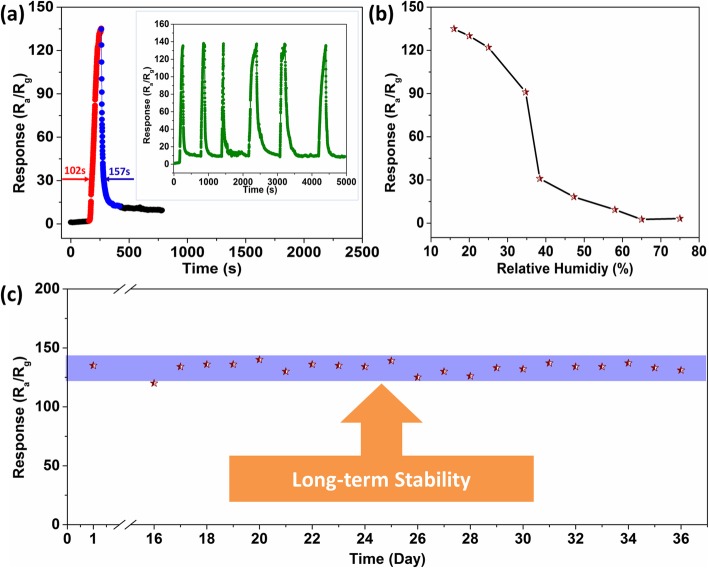
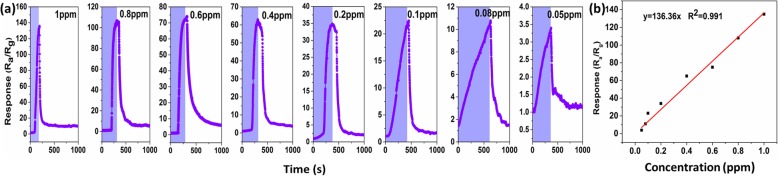
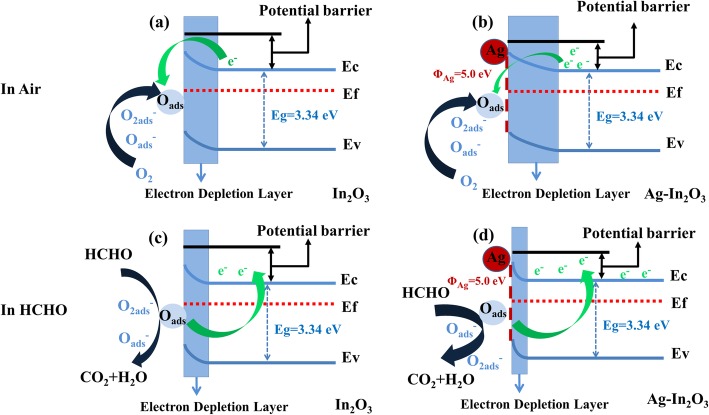
Formaldehyde (HCHO) is the main source of indoor air pollutant. HCHO sensors are therefore of paramount importance for timely detection in daily life. However, existing sensors do not meet the stringent performance targets, while deactivation due to sensing detection at room temperature, for example, at extremely low concentration of formaldehyde (especially lower than 0.08 ppm), is a widely unsolved problem. Herein, we present the Ag nanoparticles (Ag NPs) sensitized dispersed InO nanograin via a low-fabrication-cost hydrothermal strategy, where the Ag NPs reduces the apparent activation energy for HCHO transporting into and out of the InO nanoparticles, while low concentrations detection at low working temperature is realized. The pristine InO exhibits a sluggish response (R/R = 4.14 to 10 ppm) with incomplete recovery to HCHO gas. After Ag functionalization, the 5%Ag-InO sensor shows a dramatically enhanced response (135) with a short response time (102 s) and recovery time (157 s) to 1 ppm HCHO gas at 30 °C, which benefits from the Ag NPs that electronically and chemically sensitize the crystal InO nanograin, greatly enhancing the selectivity and sensitivity.
甲醛(HCHO)是室内空气污染物的主要来源。因此,甲醛传感器对于日常生活中的及时检测至关重要。然而,现有的传感器无法满足严格的性能指标,例如在室温下进行传感检测时会出现失活现象,尤其是在极低浓度的甲醛环境下(特别是低于0.08 ppm),这是一个普遍未解决的问题。在此,我们通过一种低成本的水热策略制备了银纳米颗粒(Ag NPs)敏化的分散InO纳米颗粒,其中Ag NPs降低了甲醛进出InO纳米颗粒的表观活化能,同时实现了在低工作温度下的低浓度检测。原始的InO对甲醛气体的响应迟缓(R/R = 4.14至10 ppm)且恢复不完全。经过Ag功能化后,5%Ag-InO传感器在30°C下对1 ppm甲醛气体表现出显著增强的响应(135)、较短的响应时间(102 s)和恢复时间(157 s),这得益于Ag NPs对InO纳米颗粒晶体的电子和化学敏化,极大地提高了选择性和灵敏度。