
老年心力衰竭住院患者中非心脏合并症的年龄特异性差异:特别关注年轻老年人、老老年人和最老老年人。
Age-specific differences in non-cardiac comorbidities among elderly patients hospitalized with heart failure: a special focus on young-old, old-old, and oldest-old.
机构信息
Department of Cardiology, China-Japan Friendship Hospital, Beijing 100029, China.
Department of Cardiology, Hebei General Hospital, Shijiazhuang, Hebei 050051, China.
出版信息
Chin Med J (Engl). 2019 Dec 20;132(24):2905-2913. doi: 10.1097/CM9.0000000000000560.
BACKGROUND
Despite the growing epidemic of heart failure (HF), there is limited data available to systematically compare non-cardiac comorbidities in the young-old, old-old, and oldest-old patients hospitalized for HF. The precise differences will add valuable information for better management of HF in elderly patients.
METHODS
A total of 1053 patients aged 65 years or older hospitalized with HF were included in this study. Patients were compared among three age groups: (1) young-old: 65 to 74 years, (2) old-old: 75 to 84 years, and (3) oldest-old: ≥85 years. Clinical details of presentation, comorbidities, and prescribed medications were recorded.
RESULTS
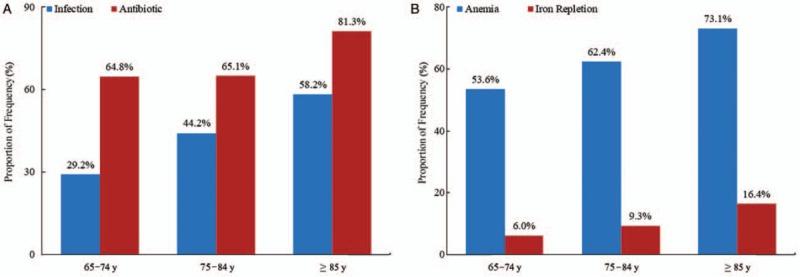
The mean age was 76.7 years and 12.7% were 85 years or older. Most elderly patients with HF (97.5%) had at least one of the non-cardiac comorbidities. The patterns of common non-cardiac comorbidities were different between the young-old and oldest-old group. The three most common non-cardiac comorbidities were anemia (53.6%), hyperlipidemia (45.9%), and diabetes (42.4%) in the young-old group, while anemia (73.1%), infection (58.2%), and chronic kidney disease (44.0%) in the oldest-old group. Polypharmacy was observed in 93.0% elderly patients with HF. Additionally, 29.2% patients were diagnosed with infection, and 67.0% patients were prescribed antibiotics. However, 60.4% patients were diagnosed with anemia with only 8.9% of them receiving iron repletion.
CONCLUSIONS
Non-cardiac comorbidities are nearly universal in three groups but obviously differ by age, and inappropriate medications are very common in elderly patients with HF. Further treatment strategies should be focused on providing optimal medications for age-specific non-cardiac conditions.
背景
尽管心力衰竭(HF)的流行不断加剧,但可用于系统比较因 HF 住院的年轻老年人、老年人和最老年人中非心脏合并症的数据有限。这些确切的差异将为更好地管理老年 HF 患者提供有价值的信息。
方法
本研究共纳入 1053 名年龄在 65 岁及以上的 HF 住院患者。患者在三个年龄组之间进行比较:(1)年轻老年人:65-74 岁,(2)老年人:75-84 岁,(3)最老年人:≥85 岁。记录入院时的临床表现、合并症和处方药物。
结果
平均年龄为 76.7 岁,12.7%的患者年龄在 85 岁及以上。大多数患有 HF 的老年患者(97.5%)至少有一种非心脏合并症。年轻老年人和最老年人组之间常见非心脏合并症的模式不同。最常见的三种非心脏合并症是年轻老年人组中的贫血(53.6%)、高脂血症(45.9%)和糖尿病(42.4%),而最老年人组中则是贫血(73.1%)、感染(58.2%)和慢性肾脏病(44.0%)。HF 老年患者中观察到 93.0%的患者存在多种药物治疗。此外,29.2%的患者被诊断为感染,67.0%的患者接受了抗生素治疗。然而,仅有 8.9%的贫血患者被诊断为贫血,其中 60.4%的患者接受了铁补充治疗。
结论
三组患者均存在非心脏合并症,但年龄不同,且 HF 老年患者中存在大量不恰当的药物治疗。进一步的治疗策略应侧重于为特定年龄的非心脏疾病提供最佳药物治疗。

 Zotero 插件