Chen Zimo, Mo Jinglin, Xu Jie, Qin Haiqiang, Zheng Huaguang, Pan Yuesong, Meng Xia, Jing Jing, Xiang Xianglong, Wang Yongjun
Department of Neurology, Beijing Tiantan Hospital, Capital Medical University, Beijing, China.
China National Clinical Research Center for Neurological Diseases, Beijing, China.
Front Neurol. 2019 Nov 27;10:1213. doi: 10.3389/fneur.2019.01213. eCollection 2019.
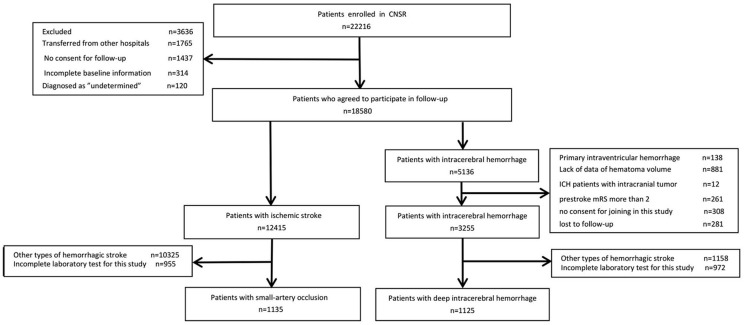
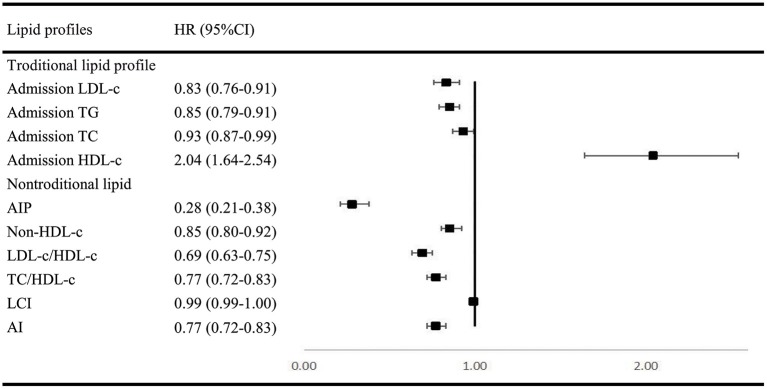
Small-artery occlusion (SAO) subtype accounts for a quarter of the cases of ischemic stroke and is mainly caused by pathological changes in cerebral small vessels, which also involve in deep intracerebral hemorrhage (dICH). However, the factors that drive some cases to SAO and others to dICH remained incompletely defined. This study is a cross-sectional study from the China National Stroke Registry that included consecutive patients with ischemic stroke or intracerebral hemorrhage between August 2007 and September 2008. We compared the risk profile between the two subgroups using multivariable logistic regression. A total of 1,135 patients with SAO stroke and 1,125 dICH patients were included for analyses. Generally, patients with SAO stroke were more likely to be male (odds ratio = 0.74, confidence interval = 0.58-0.94) and have diabetes (0.30, 0.22-0.40), higher atherogenic lipid profiles, higher body mass index (0.96, 0.94-0.99), higher waist/height ratio (0.12, 0.03-0.48), higher platelet count (0.84, 0.77-0.91), and higher proportion of abnormal estimated glomerular filtration rate (<90, ml/min/1.73 m) (0.77, 0.62-0.95). Conversely, patients with dICH were more likely to have higher blood pressure parameters, inflammation levels (white blood cell count: 1.61, 1.48-1.76; high sensitivity C-reactive protein: 2.07, 1.36-3.16), and high-density lipoprotein-c (1.57, 1.25-1.98). The risk profile between SAO stroke and dICH were different. Furthermore, despite of traditional indexes, waist/height ratio, platelet count, inflammation levels, lipid profile, and estimated glomerular filtration rate also play important roles in driving arteriolosclerosis into opposite ends.
小动脉闭塞(SAO)亚型占缺血性中风病例的四分之一,主要由脑小血管的病理变化引起,脑小血管病理变化也与深部脑出血(dICH)有关。然而,导致一些病例发生SAO而另一些病例发生dICH的因素仍未完全明确。本研究是一项来自中国国家卒中登记处的横断面研究,纳入了2007年8月至2008年9月期间连续的缺血性中风或脑出血患者。我们使用多变量逻辑回归比较了两个亚组之间的风险概况。共纳入1135例SAO中风患者和1125例dICH患者进行分析。一般来说,如果是SAO中风患者,男性居多(比值比=0.74,置信区间=0.58 - 0.94),且患有糖尿病(0.30,0.22 - 0.40),动脉粥样硬化血脂水平较高,体重指数较高(0.96,0.94 - 0.99),腰高比更高(0.12 , 0.03 - 0.48),血小板计数较高(0.84,0.77 - 0.91),以及异常估计肾小球滤过率(<90,ml/min/1.73 m²)的比例较高(0.77,0.62 - 0.95)。相反,dICH患者更可能具有较高的血压参数、炎症水平(白细胞计数:1.61 , 1.48 - 1.76;高敏C反应蛋白:2.07,1.36 - 3.16)和高密度脂蛋白胆固醇(1.57,1.25 - 1.98)。SAO中风和dICH之间存在不同的风险概况差异。此外,除了传统指标外,腰高比、血小板计数、炎症水平、血脂谱和估计肾小球滤过率在促使动脉硬化走向相反结局方面也发挥着重要作用。