Cheng Yajun, Valdés Hernández Maria Del C, Xu Mangmang, Zhang Shuting, Pan Xiaohua, An Baoqiang, Wardlaw Joanna M, Liu Ming, Wu Bo
Department of Neurology, West China Hospital, Sichuan University, Chengdu, China.
Centre for Clinical Brain Sciences, UK Dementia Research Institute, University of Edinburgh, Edinburgh, UK.
Ther Adv Neurol Disord. 2024 May 23;17:17562864241253901. doi: 10.1177/17562864241253901. eCollection 2024.
Lacunar ischemic stroke (LIS) and deep intracerebral hemorrhage (dICH) are two stroke phenotypes of deep perforator arteriopathy. It is unclear what factors predispose individuals with deep perforator arteriopathy to either ischemic or hemorrhagic events.
We aimed to investigate risk factors and neuroimaging features of small vessel disease (SVD) associated with LIS dICH in a cross-sectional study.
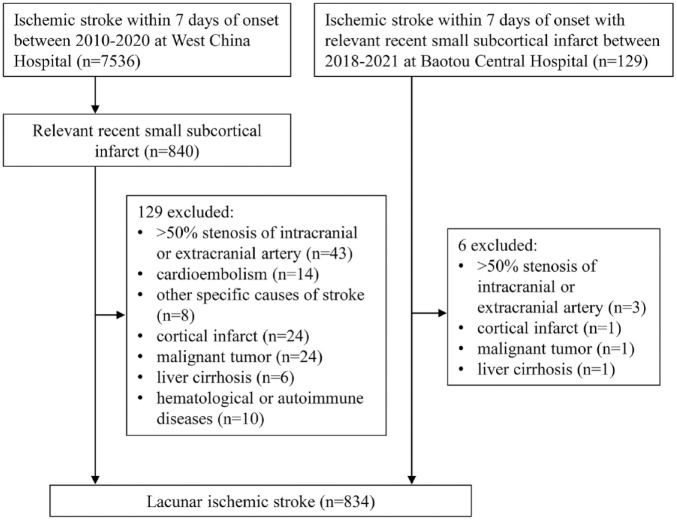
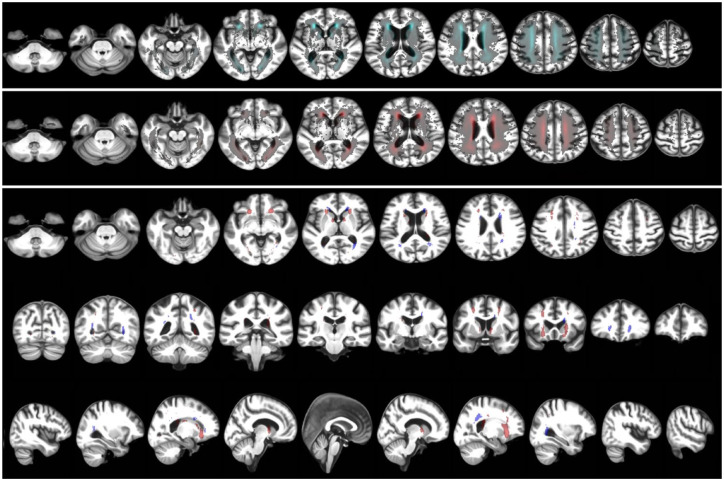
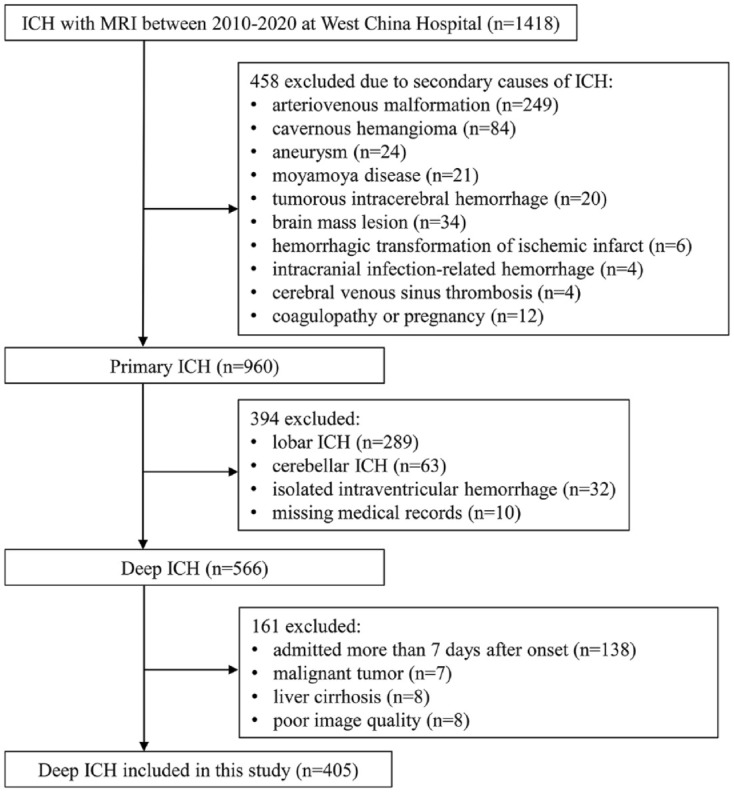
We included patients with clinically presenting, magnetic resonance imaging-confirmed LIS or dICH from two tertiary hospitals between 2010 and 2021. We recorded vascular risk factors and SVD markers, including lacunes, white matter hyperintensities (WMH), perivascular spaces (PVS), and cerebral microbleeds (CMB). Logistic regression modeling was used to determine the association between vascular risk factors, SVD markers, and stroke phenotype. We further created WMH probability maps to compare WMH distribution between LIS and dICH.
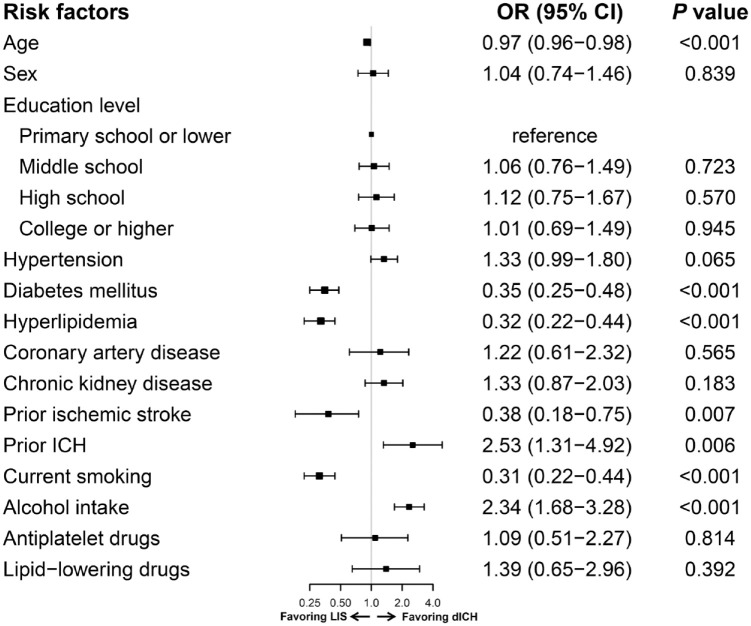
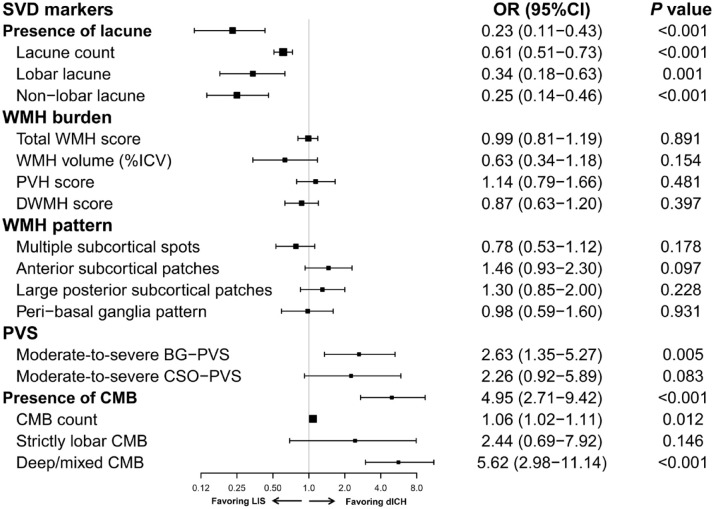
A total of 834 patients with LIS (mean age 61.7 ± 12.1 years) and 405 with dICH (57.7 ± 13.2 years) were included. Hypertension was equally frequent between LIS and dICH (72.3% 74.8%, = 0.349). Diabetes mellitus, hyperlipidemia, smoking, and prior ischemic stroke were more associated with LIS [odds ratio (OR) (95% confidence interval (CI)), 0.35 (0.25-0.48), 0.32 (0.22-0.44), 0.31 (0.22-0.44), and 0.38 (0.18-0.75)]. Alcohol intake and prior ICH were more associated with dICH [OR (95% CI), 2.34 (1.68-3.28), 2.53 (1.31-4.92)]. Lacunes were more prevalent in LIS [OR (95% CI) 0.23 (0.11-0.43)], while moderate-to-severe basal-ganglia PVS and CMB were more prevalent in dICH [OR (95% CI) 2.63 (1.35-5.27), 4.95 (2.71-9.42)]. WMH burden and spatial distribution did not differ between groups.
The microangiopathy underlying LIS and dICH reflects distinct risk profiles and SVD features, hence possibly SVD subtype susceptibility. Prospective studies with careful phenotyping and genetics are needed to clarify the mechanisms underlying this difference.
腔隙性缺血性卒中(LIS)和深部脑出血(dICH)是深部穿支动脉病变的两种卒中表型。目前尚不清楚哪些因素会使深部穿支动脉病变个体易发生缺血性或出血性事件。
在一项横断面研究中,我们旨在调查与LIS和dICH相关的小血管疾病(SVD)的危险因素和神经影像学特征。
我们纳入了2010年至2021年间来自两家三级医院的临床诊断且经磁共振成像确认的LIS或dICH患者。我们记录了血管危险因素和SVD标志物,包括腔隙、白质高信号(WMH)、血管周围间隙(PVS)和脑微出血(CMB)。采用逻辑回归模型来确定血管危险因素、SVD标志物与卒中表型之间的关联。我们进一步创建了WMH概率图,以比较LIS和dICH之间WMH的分布情况。
共纳入834例LIS患者(平均年龄61.7±12.1岁)和405例dICH患者(57.7±13.2岁)。LIS和dICH患者中高血压的发生率相当(72.3%对74.8%,P=0.349)。糖尿病、高脂血症、吸烟和既往缺血性卒中与LIS的相关性更强[比值比(OR)(95%置信区间(CI))分别为0.35(0.25 - 0.48)、0.32(0.22 - 0.44)、0.31(0.22 - 0.44)和0.38(0.18 - 0.75)]。饮酒和既往脑出血与dICH的相关性更强[OR(95%CI)分别为2.34(1.68 - 3.28)、2.53(1.31 - 4.92)]。腔隙在LIS中更为常见[OR(95%CI)0.23(0.11 - 0.43)],而中度至重度基底节区PVS和CMB在dICH中更为常见[OR(95%CI)分别为2.63(1.35 - 5.27)、4.95(2.71 - 9.42)]。两组之间WMH负担和空间分布无差异。
LIS和dICH潜在的微血管病变反映了不同的风险特征和SVD特征,因此可能存在SVD亚型易感性。需要进行仔细表型分析和遗传学的前瞻性研究,以阐明这种差异背后的机制。