Department of Obstetrics and Gynecology, Linkoping University, 58183, Linkoping, Sweden.
Department of Clinical and Experimental Medicine, Linkoping University, 58183, Linkoping, Sweden.
BMC Pregnancy Childbirth. 2019 Dec 11;19(1):494. doi: 10.1186/s12884-019-2633-8.
As a quality marker and a tool for benchmarking between units, a visual analogue scale (VAS) (ranging from 1 to 10) to estimate woman's satisfaction with childbirth was introduced in 2014. This study aimed to assess how obstetric interventions and complications affected women's satisfaction with childbirth.
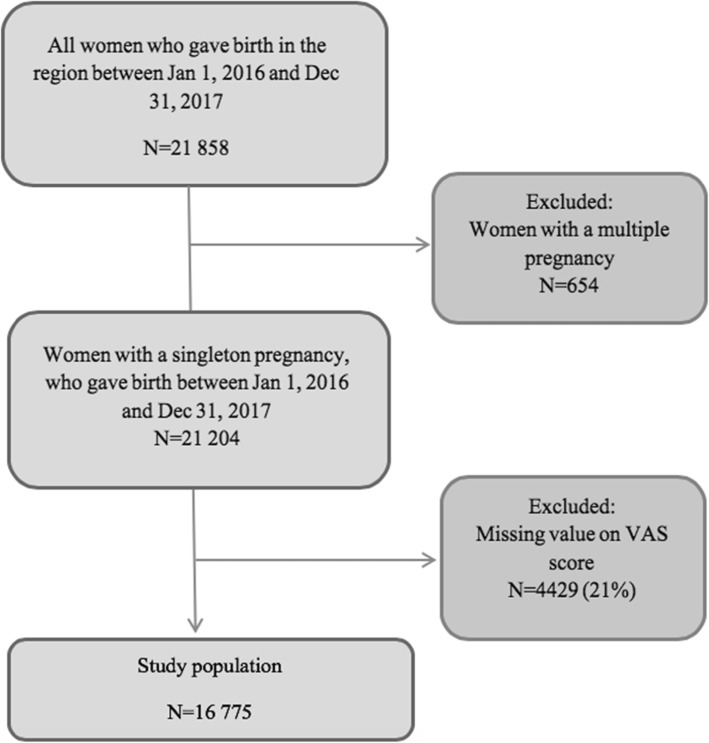
A retrospective cohort study including 16,775 women with an available VAS score who gave birth between January 2016 and December 2017. VAS score, maternal and obstetric characteristics were obtained from electronic medical records and crude and adjusted odds ratios (aOR) were calculated.
The total prevalence of dissatisfaction with childbirth (VAS 1-3) was 5.7%. The main risk factors for dissatisfaction with childbirth were emergency cesarean section, aOR 3.98 95% confidence interval (CI) 3.27-4.86, postpartum hemorrhage ≥2000 ml, aOR 1.85 95%CI 1.24-2.76 and Apgar score < 7 at five minutes, aOR 2.95 95%CI 1.95-4.47. The amount of postpartum hemorrhage showed a dose-response relation to dissatisfaction with childbirth. Moreover, labor induction, instrumental vaginal delivery, and obstetric anal sphincter injury were significantly associated with women's dissatisfaction with childbirth. A total number of 4429/21204 (21%) women giving birth during the study period had missing values on VAS. A comparison of characteristics between women with and without a recorded VAS score was performed. There were statistically significant differences in maternal age and maternal BMI between the study population and excluded women due to missing values on VAS. Moreover, 64% of the women excluded were multiparas, compared to 59% in the study population.
Obstetric interventions and complications, including emergency cesareans section and postpartum hemorrhage, were significantly related to dissatisfaction with childbirth. Such events are common and awareness of these associations might lead to a more individualized care of women during and after childbirth.
作为一种质量标志物和单位间基准比较的工具,1986 年引入了视觉模拟评分(VAS)(范围为 1 到 10)来评估女性对分娩的满意度。本研究旨在评估产科干预措施和并发症如何影响女性对分娩的满意度。
这是一项回顾性队列研究,纳入了 2016 年 1 月至 2017 年 12 月间分娩且 VAS 评分可用的 16775 名女性。从电子病历中获取 VAS 评分、产妇和产科特征,并计算了粗比值比(OR)和调整比值比(aOR)。
总共有 5.7%的女性对分娩不满意(VAS 评分为 1-3)。对分娩不满意的主要危险因素是急诊剖宫产,OR 为 3.98(95%CI 3.27-4.86)、产后出血量≥2000ml,OR 为 1.85(95%CI 1.24-2.76)和 5 分钟时 Apgar 评分<7,OR 为 2.95(95%CI 1.95-4.47)。产后出血量与对分娩的不满意程度呈剂量反应关系。此外,引产、器械性阴道分娩和产科肛门括约肌损伤与女性对分娩的不满显著相关。在研究期间,21204 名分娩的女性中有 4429 名(21%)的 VAS 值缺失。对有记录 VAS 评分的女性和无记录 VAS 评分的女性的特征进行了比较。由于 VAS 值缺失,研究人群和排除的女性在母亲年龄和母亲 BMI 方面存在统计学差异。此外,排除的女性中有 64%是多产妇,而研究人群中这一比例为 59%。
产科干预措施和并发症,包括急诊剖宫产和产后出血,与对分娩的不满显著相关。这些事件很常见,了解这些关联可能会导致在分娩期间和之后对女性进行更个性化的护理。