Department of Ethology, Institute of Biology, Eötvös Loránd University, Pázmány Péter sétány 1/c, Budapest, 1117, Hungary.
Anim Cogn. 2020 Mar;23(2):337-350. doi: 10.1007/s10071-019-01337-3. Epub 2019 Dec 12.
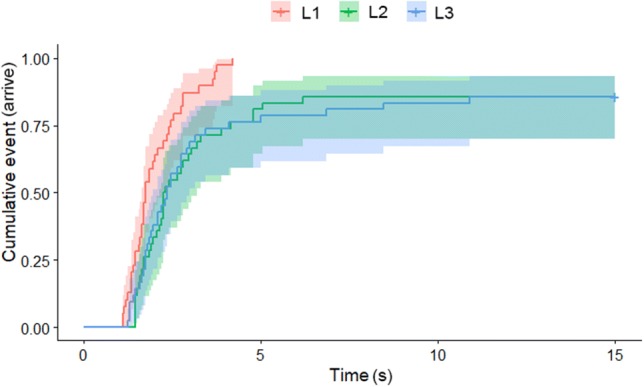
With very few exceptions, no coherent model of representing the self exists for nonhuman species. According to our hypothesis, understanding of the Self as an object' can also be found in a wide range of animals including the dog, a fast-moving terrestrial predator/scavenger, with highly developed senses and complex cognitive capacity. We tested companion dogs in three experiments in which they faced three different variations of the same physical challenge: passing through an opening in a wall. We predicted that if dogs are capable of representing their own body size, they will react differently when faced with adequate or too small openings. We found that dogs started to move towards and approached the too small openings with significantly longer latencies than the suitable ones; and upon reaching it, they did not try to get through the too small openings. In another experiment, the medium-size (still large enough) opening was approached with latencies that fell between the latencies measured in the cases of the very large or the too small openings. Having discussed the potential underlying mechanisms, we concluded that our results convincingly assume that dogs can represent their own body size in novel contexts.
除了极少数例外,目前还没有一个连贯的模型可以用来描述非人类物种的自我。根据我们的假设,对于包括狗在内的各种动物来说,它们也能理解自我是一个“物体”,狗是一种快速移动的陆地捕食者/清道夫,具有高度发达的感官和复杂的认知能力。我们在三个实验中测试了伴侣犬,它们在三个不同的物理挑战变体中面临挑战:穿过一堵墙的开口。我们预测,如果狗能够代表自己的体型,那么当它们面对足够大和太小的开口时,它们的反应会有所不同。我们发现,狗在接近太小的开口时开始移动,并显著延迟比合适的开口更长的时间;到达开口后,它们不会试图穿过太小的开口。在另一个实验中,狗以中等大小(仍然足够大)的开口接近,其延迟时间介于非常大和太小的开口的测量延迟时间之间。在讨论了潜在的潜在机制之后,我们得出结论,我们的结果令人信服地假设狗可以在新的环境中代表自己的体型。