Department of Epidemiology and Biostatistics, School of Public Health, Imperial College London, London, UK; CRONICAS Centre of Excellence in Chronic Diseases, Universidad Peruana Cayetano Heredia, Lima, Peru.
Department of Epidemiology and Biostatistics, School of Public Health, Imperial College London, London, UK; MRC-PHE Centre for Environment and Health, School of Public Health, Imperial College London, London, UK.
Diabetes Res Clin Pract. 2020 Feb;160:107978. doi: 10.1016/j.diabres.2019.107978. Epub 2019 Dec 12.
Body mass index (BMI) has increased in Latin-America, but the implications for the diabetes burden have not been quantified. We estimated the proportion and absolute number of diabetes cases attributable to high BMI in Bolivia, Ecuador and Peru (Andean Latin-America), with estimation of region-level indicators in Peru.
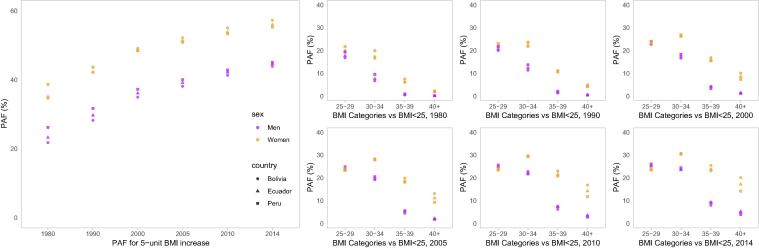
We estimated the population attributable fraction (PAF) of BMI on diabetes (regardless of type 1 or 2) from 1980 to 2014, including the number of cases attributable to overweight (BMI 25-<30), class I (30-<35), class II (BMI 35-<40) and class III (BMI ≥ 40) obesity. We used age- and sex-specific prevalence estimates of diabetes and BMI categories (NCD-RisC and Peru's DHS survey) combined with relative risks from population-based cohorts in Peru.
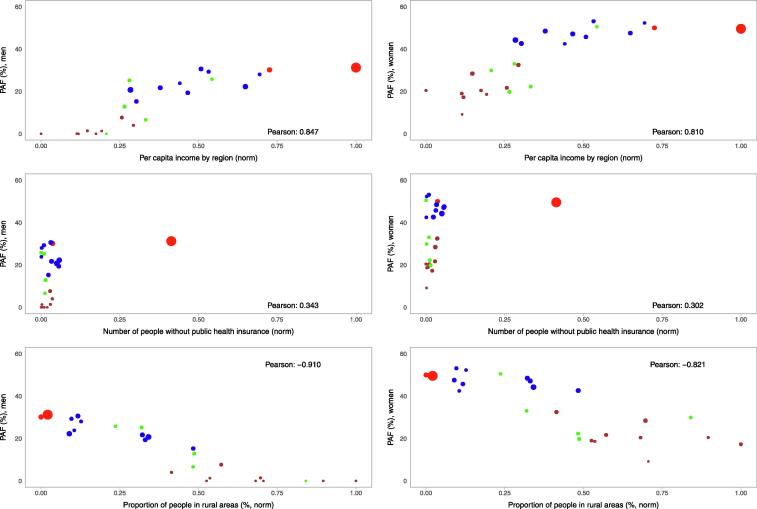
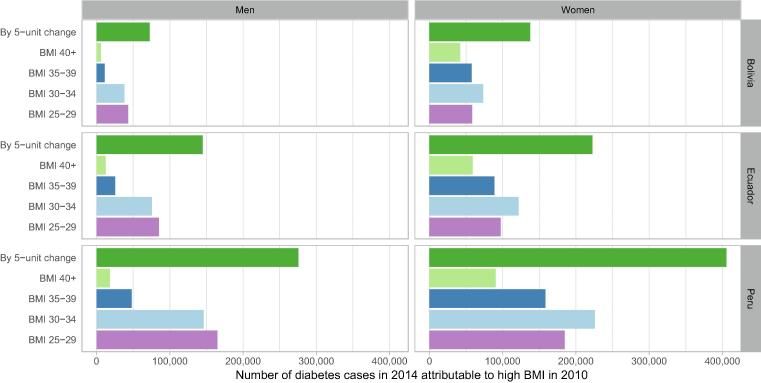
Across Andean Latin-America in 2014, there were 1,258,313 diabetes cases attributable to high BMI: 209,855 in Bolivia, 367,440 in Ecuador and 681,018 in Peru. Between 1980 and 2010, the absolute proportion of diabetes cases attributable to class I obesity increased the most (from 12.9% to 27.2%) across the region. The second greatest increase was for class II obesity (from 3.6% to 16.5%). There was heterogeneity in the fraction of diabetes cases attributable to high BMI by region in Peru, as coastal regions had the largest fractions, and so did high-income regions.
Over one million diabetes cases are attributable to high BMI in Andean Latin-America. Public health efforts should focus on implementing population-based interventions to reduce high BMI and to develop focused interventions targeted at those at highest risk of diabetes.
拉丁美洲的身体质量指数(BMI)有所增加,但 BMI 对糖尿病负担的影响尚未量化。我们评估了 BMI 升高导致玻利维亚、厄瓜多尔和秘鲁(安第斯拉丁美洲)糖尿病病例的比例和绝对数量,并对秘鲁的区域指标进行了估计。
我们评估了 1980 年至 2014 年 BMI 对糖尿病(无论 1 型或 2 型)的人群归因分数(PAF),包括超重(BMI 25-<30)、I 类(30-<35)、II 类(BMI 35-<40)和 III 类(BMI≥40)肥胖导致的病例数。我们使用了糖尿病和 BMI 类别(NCD-RisC 和秘鲁的 DHS 调查)的年龄和性别特异性流行率估计值,并结合了来自秘鲁基于人群的队列的相对风险。
在 2014 年的安第斯拉丁美洲,有 1258313 例糖尿病病例归因于 BMI 升高:玻利维亚 209855 例,厄瓜多尔 367440 例,秘鲁 681018 例。在 1980 年至 2010 年期间,该地区 I 类肥胖导致的糖尿病病例绝对比例增加最多(从 12.9%增加到 27.2%)。其次是 II 类肥胖(从 3.6%增加到 16.5%)。秘鲁各地区归因于 BMI 升高的糖尿病病例比例存在异质性,沿海地区的比例最大,高收入地区也是如此。
在安第斯拉丁美洲,有超过 100 万例糖尿病病例归因于 BMI 升高。公共卫生工作应重点实施基于人群的干预措施,以降低 BMI,并制定针对糖尿病高危人群的针对性干预措施。