Department of otorhinolaryngology, Union Hospital, Tongji Medical College, Huazhong University of Science and Technology, Wuhan, 430022, China.
Department of otorhinolaryngology, The First Affiliated Hospital, Shihezi University School of Medicine, Shihezi, Xinjiang, 832000, China.
Int J Med Sci. 2019 Nov 9;16(12):1631-1641. doi: 10.7150/ijms.35936. eCollection 2019.
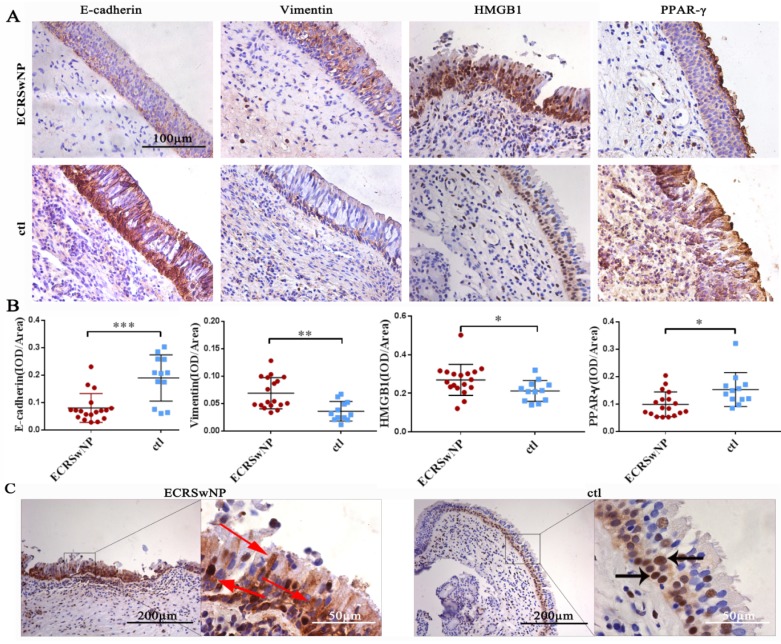
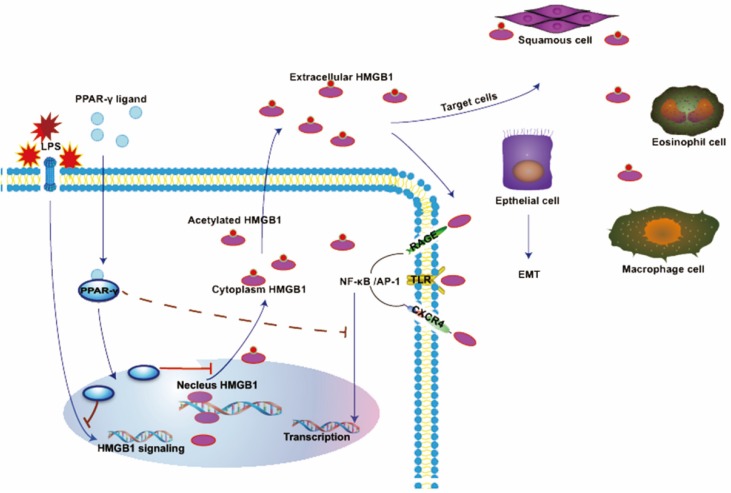
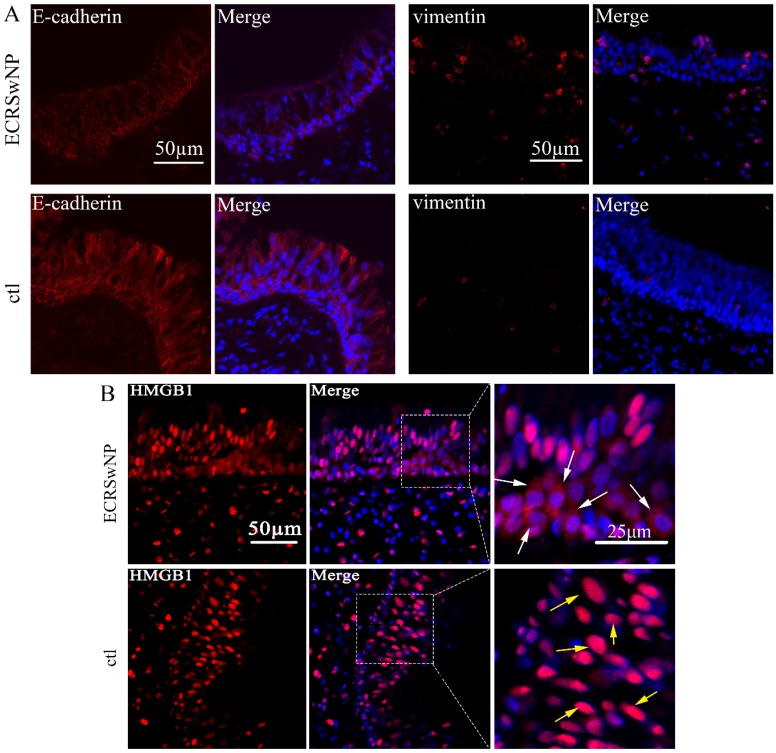
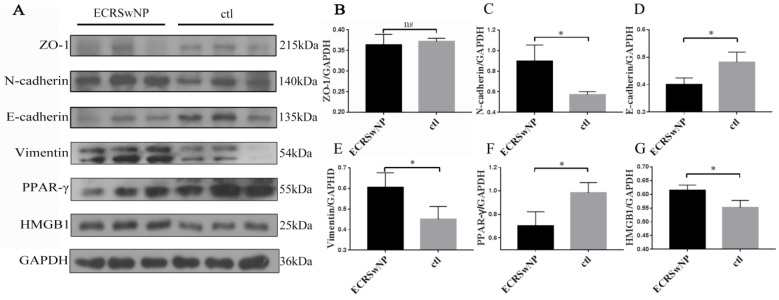
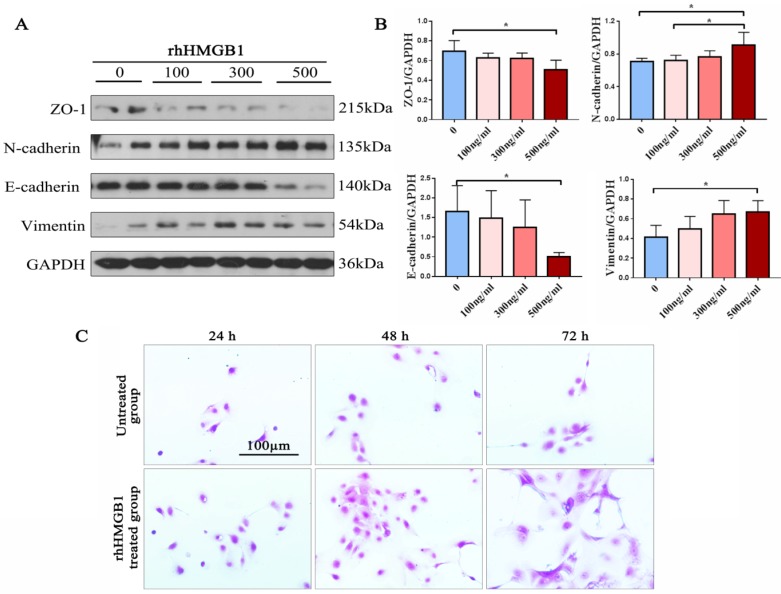
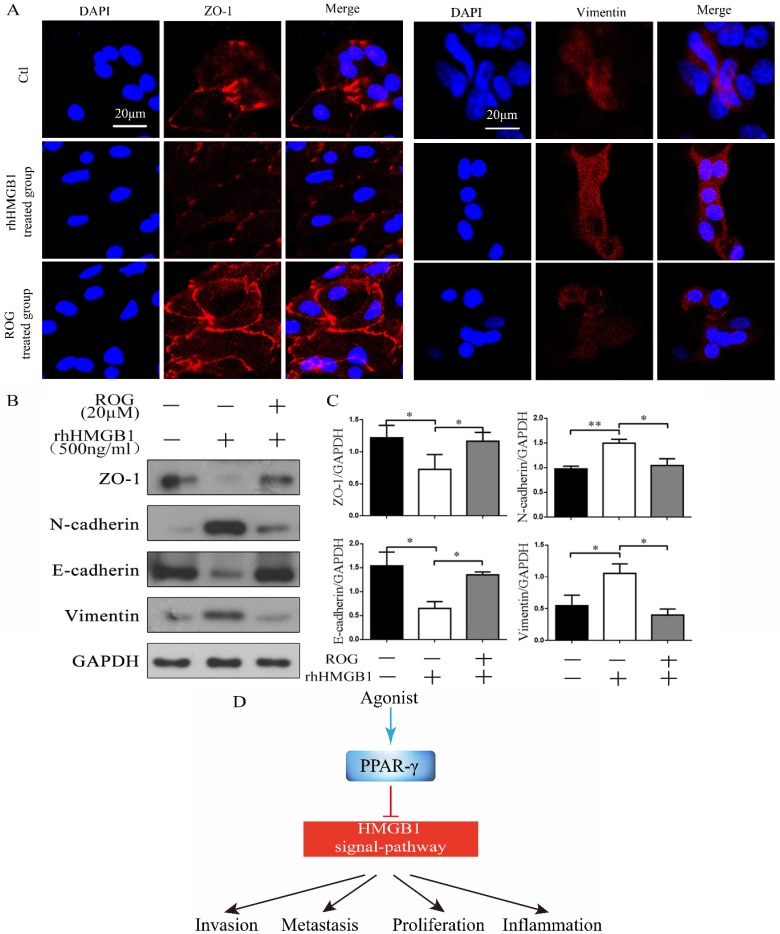
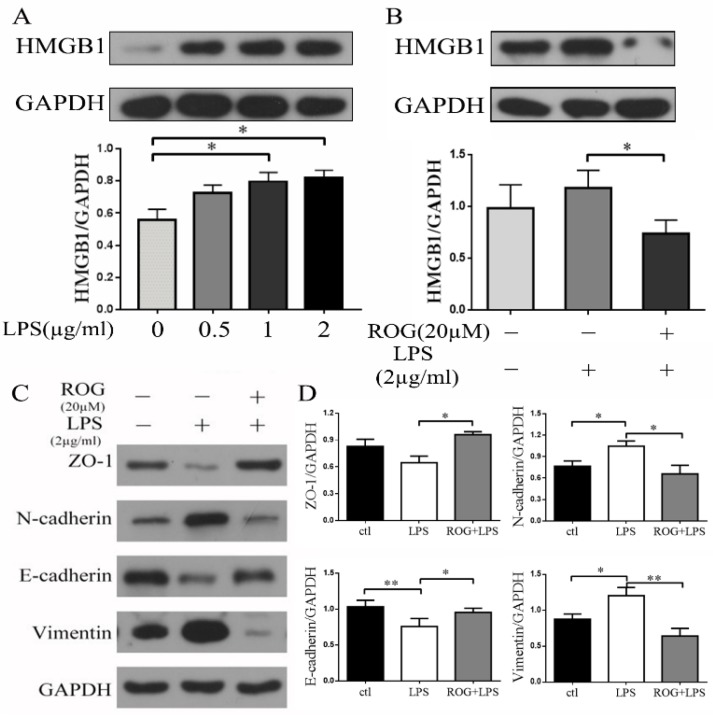
Epithelial-mesenchymal transition (EMT) has been reported to occur in eosinophilic chronic rhinosinusitis with nasal polyps (ECRSwNP). Among the cytokines that cause EMT, high mobility group box 1 (HMGB1) has been shown to give rise to EMT in airway epithelial cells. However, the mechanism of HMGB1-induced EMT in ECRSwNP is unknown. We explored the mechanism and possible inhibitor. Immunohistochemistry (IHC), immunofluorescence (IF), and western blot assay were used to detect the expression and location of HMGB1, peroxisome proliferator-activated receptor-γ (PPAR-γ), and EMT markers in eighteen ECRSwNP and twelve normal nasal mucosa tissues. Epithelial cells isolated from ECRSwNP were cultured with various doses of recombinant human HMGB1 (rhHMGB1) to study the expression of PPAR-γ, and EMT markers. Additionally, the ligand of PPAR-γ was incubated with epithelial cells to interfere with the effects of lipopolysaccharide (LPS) or rhHMGB1 to explore the effect on expression of HMGB1 and EMT markers. These results suggest that HMGB1 was highly expressed in ECRSwNP compared with its expression in control tissues, and EMT was also found highly in ECRSwNP compared with control tissues. Moreover, the cytoplasmic accumulation of HMGB1 in ECRSwNP was obvious compared with normal tissues. We also found dose-dependent induction by rhHMGB1 of up-regulation of N-cadherin and vimentin and down-regulation of ZO-1 and E-cadherin in epithelial cells isolated from ECRSwNP. The agonist of PPAR-γ not only reduced release of HMGB1 induced by LPS, but also reversed the EMT. The protective role of PPAR-γ also appeared in cells that had been incubated with rhHMGB1. In the current study, we discovered that the agonist of PPAR-γ has a potential role in inhibited HMGB1-induced EMT in ECRSwNP. The agonist of PPAR-γ may contribute to inhabit epithelial cells to become mesenchymal-like cells which play an important role in the pathogenesis of ECRSwNP.
上皮-间充质转化(EMT)已被报道发生在伴有鼻息肉的嗜酸性慢性鼻-鼻窦炎(ECRSwNP)中。在导致 EMT 的细胞因子中,高迁移率族蛋白 B1(HMGB1)已被证明可引起气道上皮细胞发生 EMT。然而,HMGB1 在 ECRSwNP 中诱导 EMT 的机制尚不清楚。我们探讨了该机制和可能的抑制剂。我们使用免疫组织化学(IHC)、免疫荧光(IF)和 Western blot 检测了十八例 ECRSwNP 和十二例正常鼻黏膜组织中 HMGB1、过氧化物酶体增殖物激活受体-γ(PPAR-γ)和 EMT 标志物的表达和位置。用不同剂量的重组人 HMGB1(rhHMGB1)培养从 ECRSwNP 中分离出的上皮细胞,以研究 PPAR-γ 和 EMT 标志物的表达。此外,用 PPAR-γ 的配体孵育上皮细胞,以干扰脂多糖(LPS)或 rhHMGB1 的作用,以探讨对 HMGB1 和 EMT 标志物表达的影响。这些结果表明,与对照组织相比,HMGB1 在 ECRSwNP 中的表达水平较高,并且 EMT 在 ECRSwNP 中的表达水平也较高。此外,与正常组织相比,HMGB1 在 ECRSwNP 中的细胞质蓄积更为明显。我们还发现,rhHMGB1 呈剂量依赖性诱导 ECRSwNP 分离的上皮细胞中 N-钙黏蛋白和波形蛋白的上调,以及 ZO-1 和 E-钙黏蛋白的下调。PPAR-γ 的激动剂不仅降低了 LPS 诱导的 HMGB1 的释放,而且逆转了 EMT。PPAR-γ 的保护作用也出现在用 rhHMGB1 孵育的细胞中。在本研究中,我们发现 PPAR-γ 的激动剂在抑制 ECRSwNP 中 HMGB1 诱导的 EMT 中具有潜在作用。PPAR-γ 的激动剂可能有助于抑制上皮细胞向间充质样细胞转化,而这种转化在 ECRSwNP 的发病机制中起着重要作用。