Sturmberg Joachim P, Bircher Johannes
School of Medicine and Public Health, Faculty of Health and Medicine, University of Newcastle, Holgate, NSW, 2250, Australia.
International Society for Systems and Complexity Sciences for Health, Waitsfield, VT, USA.
F1000Res. 2019 Jun 5;8:789. doi: 10.12688/f1000research.19414.1. eCollection 2019.
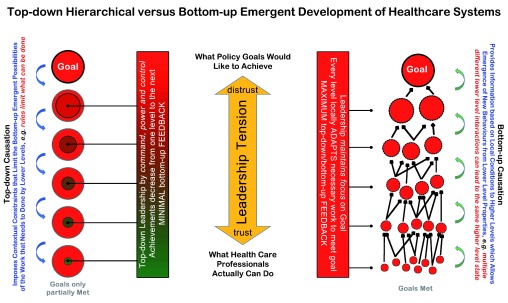
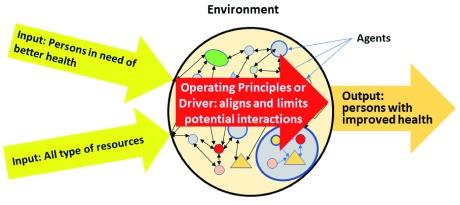
Rising healthcare costs are major concerns in most high-income countries. Yet, political measures to reduce costs have so far remained futile and have damaged the best interests of patients and citizen. We therefore explored the possibilities to analyze healthcare systems as a socially constructed complex adaptive system (CAS) and found that by their very nature such CAS tend not to respond as expected to top-down interventions. As CAS have emergent behaviors, the focus on their drivers - purpose, economy and behavioral norms - requires particular attention. First, the importance of understanding the purpose of health care as improvement of health and its experience has been emphasized by two recent complementary re-definitions of health and disease. The economic models underpinning today's healthcare - profit maximization - have shifted the focus away from its main purpose. Second, although economic considerations are important, they must serve and not dominate the provision of healthcare delivery. Third, expected health professionals' behavioral norms - to first consider the health and wellbeing of patients - have been codified in the universally accepted Declaration of Geneva 2017. Considering these three aspects it becomes clear that complex adaptive healthcare systems need mindful top-down/bottom-up leadership that supports the nature of innovation for health care driven by local needs. The systemic focus on improving people's health will then result in significant cost reductions.
医疗成本不断上涨是大多数高收入国家的主要担忧。然而,迄今为止,降低成本的政治措施仍然徒劳无功,损害了患者和公民的最大利益。因此,我们探讨了将医疗系统作为一个社会构建的复杂适应系统(CAS)进行分析的可能性,并发现就其本质而言,此类复杂适应系统往往不会按预期对自上而下的干预措施做出反应。由于复杂适应系统具有涌现行为,因此对其驱动因素——目的、经济和行为规范——的关注需要特别注意。首先,最近对健康和疾病的两种互补性重新定义强调了理解医疗保健目的是改善健康及其体验的重要性。支撑当今医疗保健的经济模式——利润最大化——已经将重点从其主要目的上转移开了。其次,虽然经济因素很重要,但它们必须服务于而不是主导医疗服务的提供。第三,预期的卫生专业人员行为规范——首先考虑患者的健康和福祉——已在普遍接受的《2017年日内瓦宣言》中得到编纂。考虑到这三个方面,很明显,复杂适应医疗系统需要谨慎的自上而下/自下而上的领导,以支持由当地需求驱动的医疗保健创新的本质。对改善人们健康的系统性关注将进而带来显著的成本降低。