Department of Physiology, College of Medicine, The Catholic University of Korea, Seoul, 06591, Korea.
Department of Biomedicine & Health Sciences, Graduate School, The Catholic University of Korea, Seoul, 06591, Korea.
Sci Rep. 2019 Dec 16;9(1):19140. doi: 10.1038/s41598-019-55745-z.
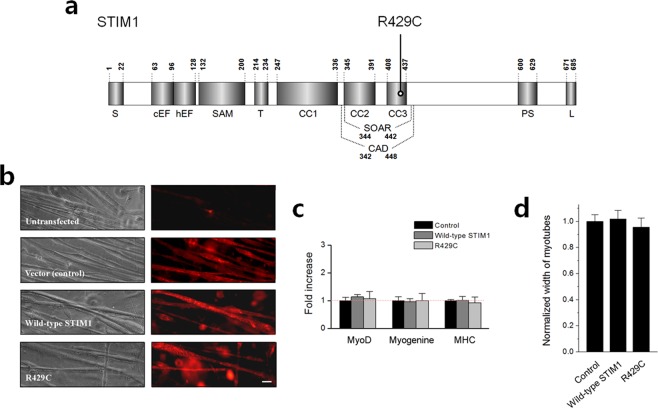
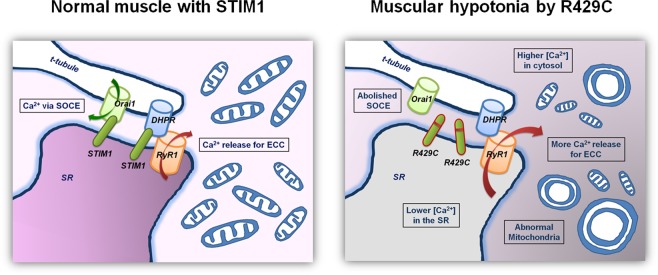
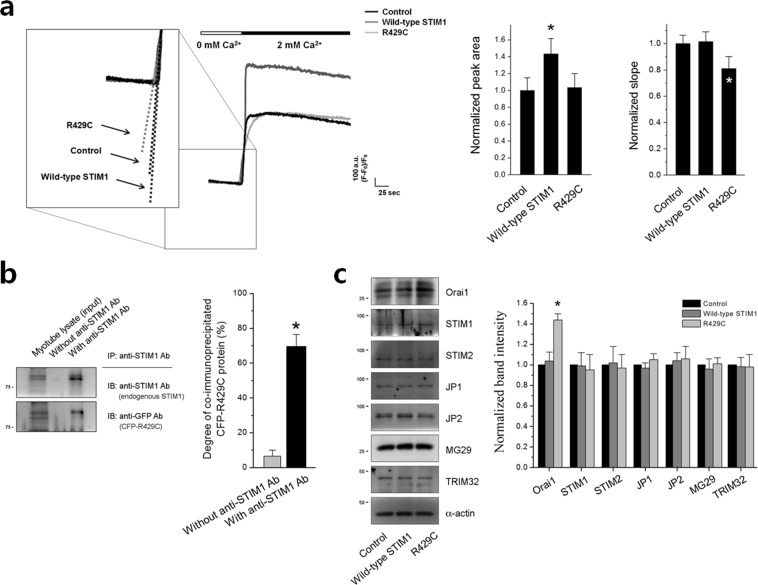
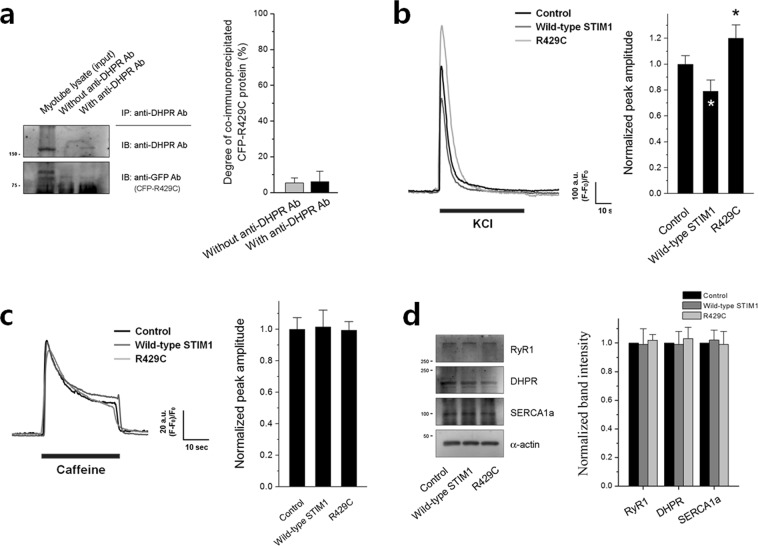
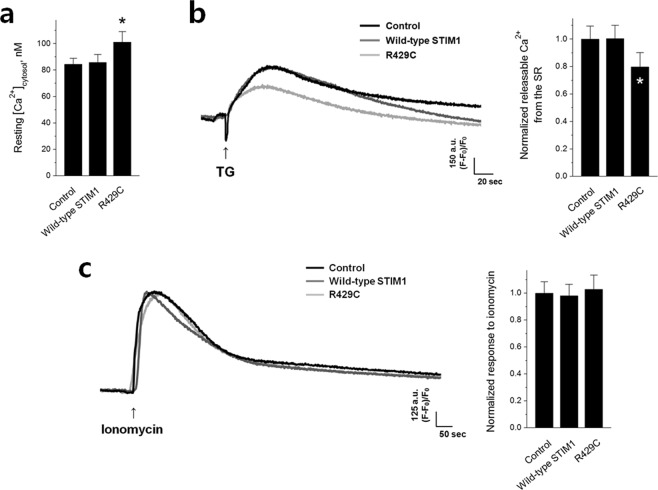
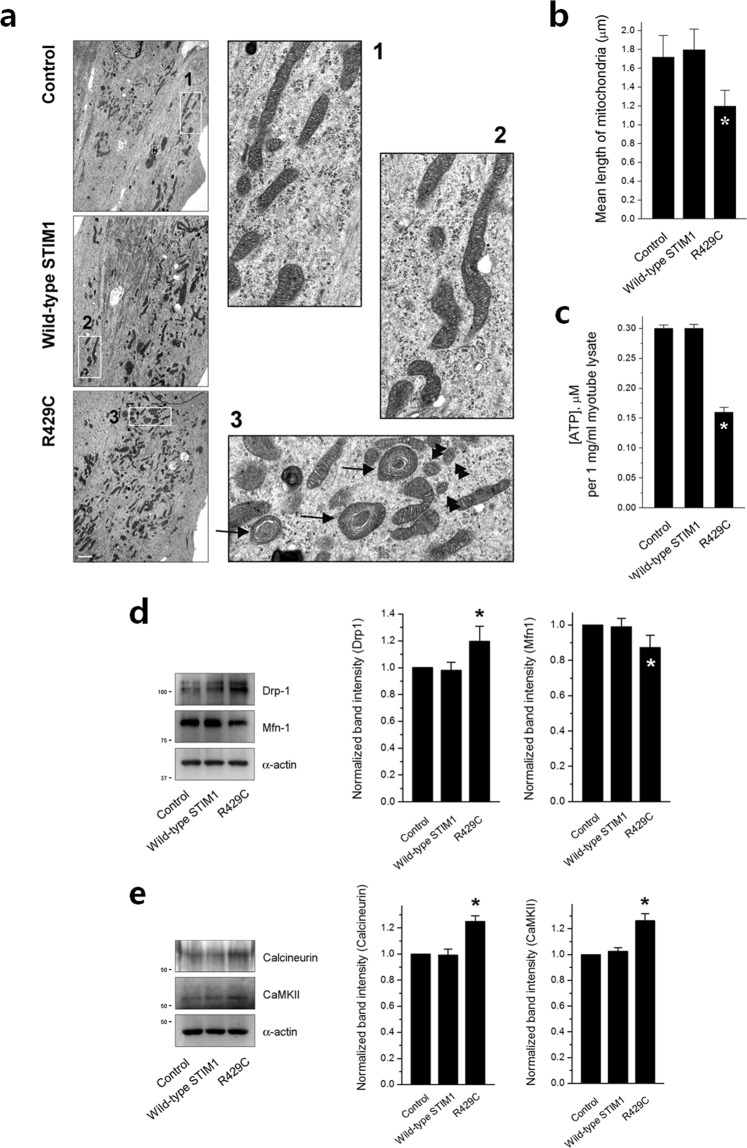
Stromal interaction molecule 1 (STIM1) mediates extracellular Ca entry into the cytosol through a store-operated Ca entry (SOCE) mechanism, which is involved in the physiological functions of various tissues, including skeletal muscle. STIM1 is also associated with skeletal muscle diseases, but its pathological mechanisms have not been well addressed. The present study focused on examining the pathological mechanism(s) of a mutant STIM1 (R429C) that causes human muscular hypotonia. R429C was expressed in mouse primary skeletal myotubes, and the properties of the skeletal myotubes were examined using single-cell Ca imaging of myotubes and transmission electron microscopy (TEM) along with biochemical approaches. R429C did not interfere with the terminal differentiation of myoblasts to myotubes. Unlike wild-type STIM1, there was no further increase of SOCE by R429C. R429C bound to endogenous STIM1 and slowed down the initial rate of SOCE that were mediated by endogenous STIM1. Moreover, R429C increased intracellular Ca movement in response to membrane depolarization by eliminating the attenuation on dihydropyridine receptor-ryanodine receptor (DHPR-RyR1) coupling by endogenous STIM1. The cytosolic Ca level was also increased due to the reduction in SR Ca level. In addition, R429C-expressing myotubes showed abnormalities in mitochondrial shape, a significant decrease in ATP levels, and the higher expression levels of mitochondrial fission-mediating proteins. Therefore, serial defects in SOCE, intracellular Ca movement, and cytosolic Ca level along with mitochondrial abnormalities in shape and ATP level could be a pathological mechanism of R429C for human skeletal muscular hypotonia. This study also suggests a novel clue that STIM1 in skeletal muscle could be related to mitochondria via regulating intra and extracellular Ca movements.
基质相互作用分子 1(STIM1)通过一种钙库操纵的钙内流(SOCE)机制介导细胞外 Ca 进入细胞质,该机制参与各种组织的生理功能,包括骨骼肌。STIM1 也与骨骼肌疾病有关,但它的病理机制尚未得到很好的解决。本研究集中研究了导致人类肌肉张力减退的突变 STIM1(R429C)的病理机制。在小鼠原代骨骼肌成肌细胞中表达 R429C,并通过骨骼肌成肌细胞的单细胞钙成像和透射电子显微镜(TEM)以及生化方法来检查骨骼肌成肌细胞的特性。R429C 不干扰成肌细胞向肌管的终末分化。与野生型 STIM1 不同,R429C 没有进一步增加 SOCE。R429C 与内源性 STIM1 结合,并通过内源性 STIM1 减慢由其介导的 SOCE 的初始速率。此外,R429C 通过消除内源性 STIM1 对二氢吡啶受体-ryanodine 受体(DHPR-RyR1)偶联的衰减,增加了对膜去极化的细胞内 Ca 运动。由于 SR Ca 水平的降低,细胞质 Ca 水平也升高。此外,R429C 表达的肌管显示线粒体形状异常、ATP 水平显著降低以及线粒体分裂介导蛋白的表达水平升高。因此,SOCE、细胞内 Ca 运动和细胞质 Ca 水平的连续缺陷以及线粒体形状和 ATP 水平的异常可能是 R429C 引起人类骨骼肌张力减退的病理机制。本研究还提示了一个新的线索,即骨骼肌中的 STIM1 可能通过调节细胞内外 Ca 运动与线粒体有关。