Xuan Yahui, Wu Yue, Li Peng, Liu Ruiling, Luo Yiwei, Yuan Jianglian, Xiang Zhonghuai, He Ningjia
State Key Laboratory of Silkworm Genome Biology, Southwest University, Chongqing, China.
PeerJ. 2019 Dec 12;7:e8158. doi: 10.7717/peerj.8158. eCollection 2019.
Species in the genus (Moraceae) are deciduous woody plants of great economic importance. The classification and phylogenetic relationships of , especially the abundant mulberry resources in China, is still undetermined. Internal transcribed spacer (ITS) regions are among the most widely used molecular markers in phylogenetic analyses of angiosperms. However, according to the previous phylogenetic analyses of ITS sequences, most of the mulberry accessions collected in China were grouped into the largest clade lacking for phylogenetic resolution. Compared with functional ITS sequences, ITS pseudogenes show higher sequence diversity, so they can provide useful phylogenetic information.
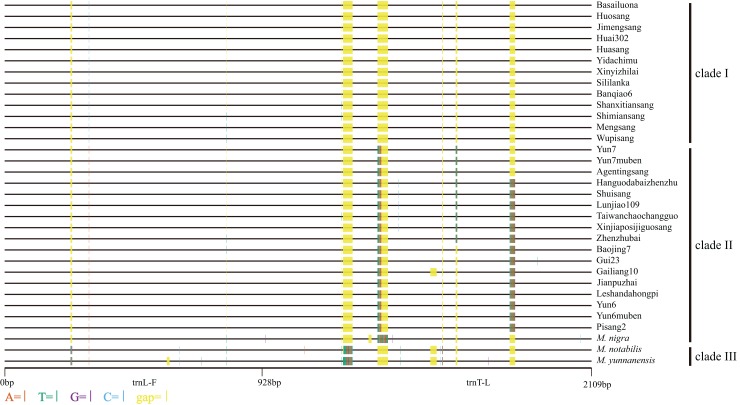
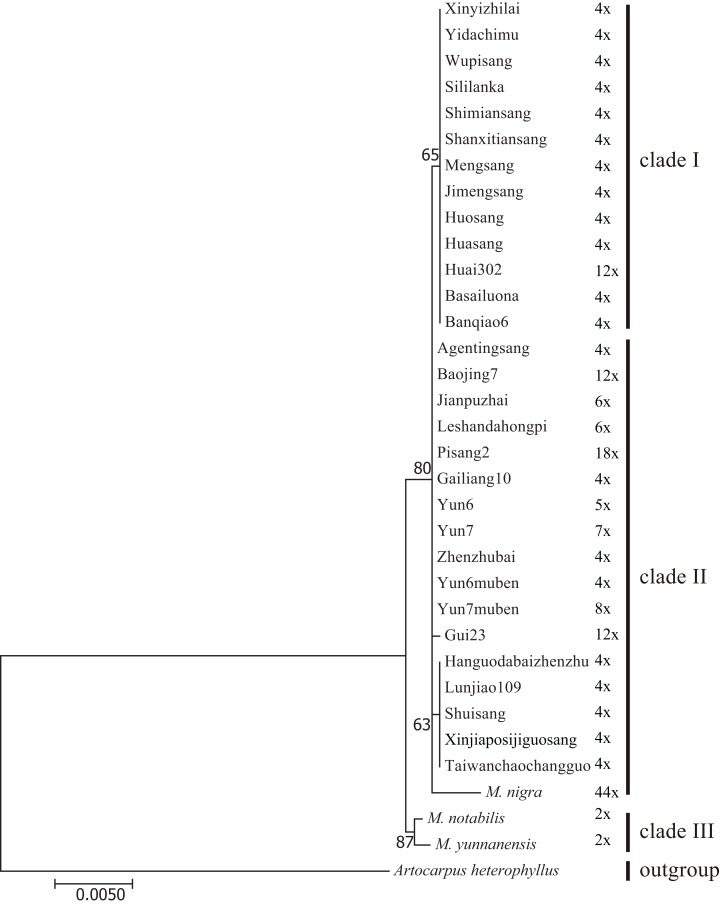
We sequenced the ITS regions and the chloroplast DNA regions and from 33 mulberry accessions, and performed phylogenetic analyses to explore the evolution of mulberry.
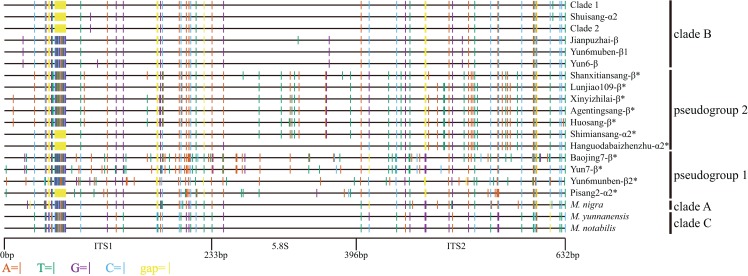
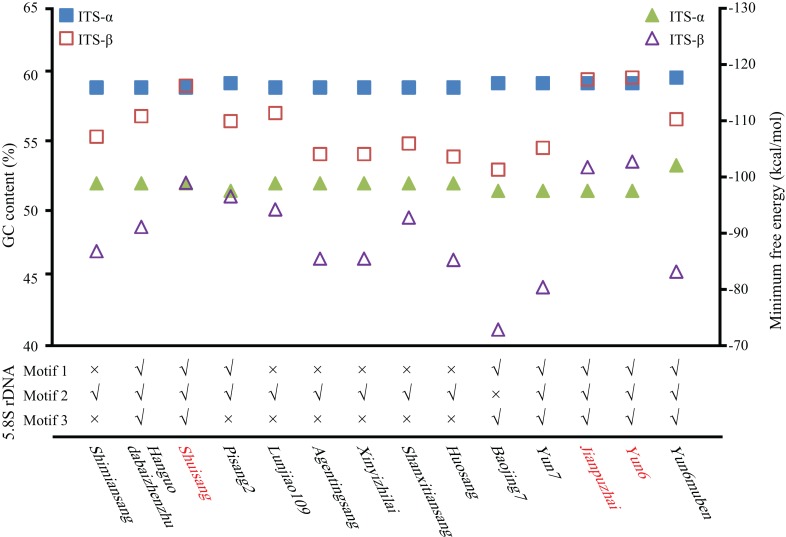
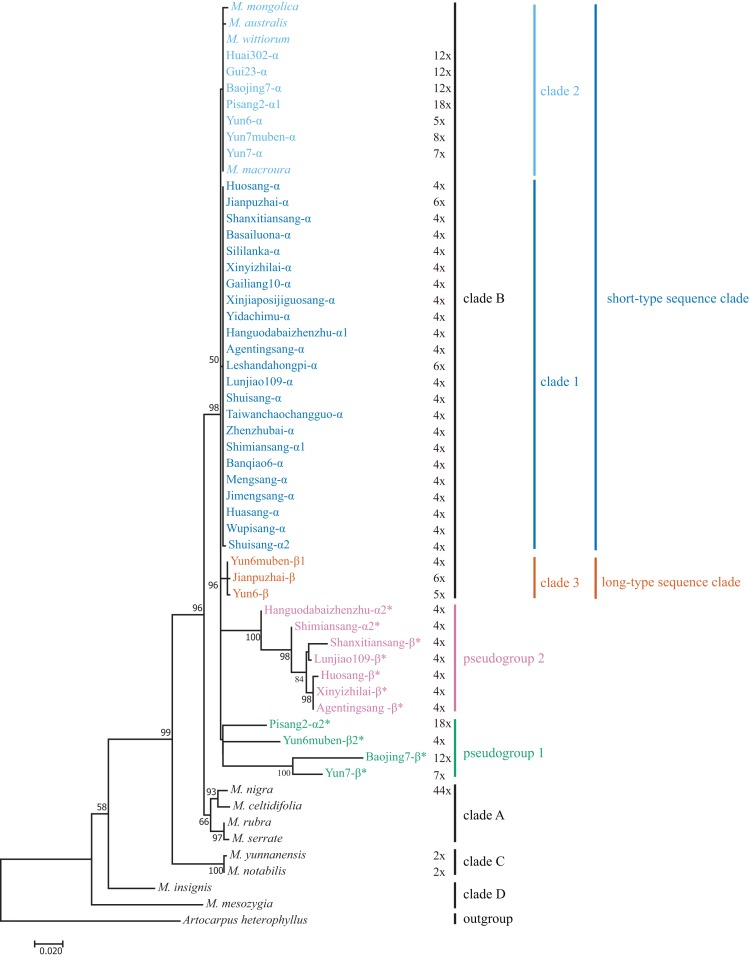
We found ITS pseudogenes in 11 mulberry accessions. In the phylogenetic tree constructed from ITS sequences, clade B was separated into short-type sequence clades (clades 1 and 2), and a long-type sequence clade (clade 3). Pseudogene sequences were separately clustered into two pseudogroups, designated as pseudogroup 1 and pseudogroup 2. The phylogenetic tree generated from cpDNA sequences also separated clade B into two clades.
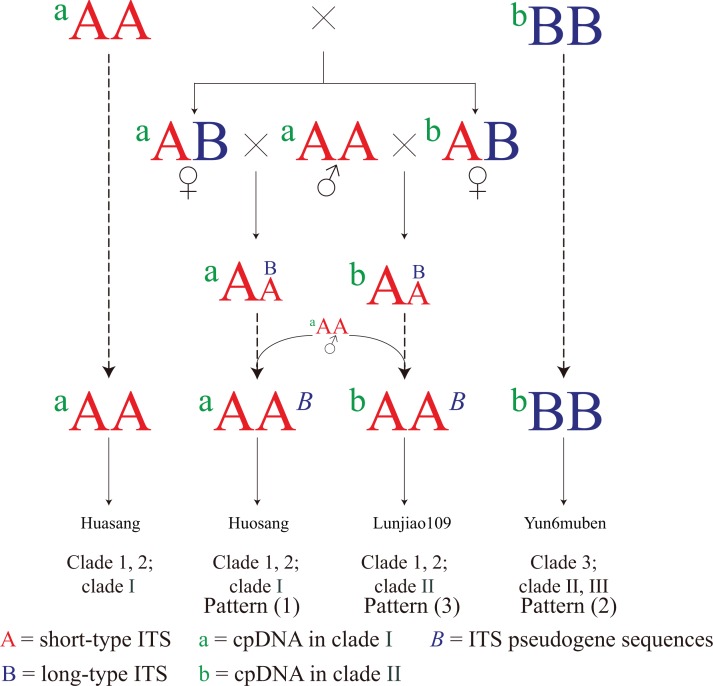
Two species were separated in clade B. The existence of three connection patterns and incongruent distribution patterns between the phylogenetic trees generated from cpDNA and ITS sequences suggested that the ITS pseudogene sequences connect with genetic information from the female progenitor. Hybridization has played important roles in the evolution of mulberry, resulting in low resolution of the phylogenetic analysis based on ITS sequences. An evolutionary pattern illustrating the evolution history of mulberry is proposed. These findings have significance for the conservation of local mulberry resources. Polyploidy, hybridization, and concerted evolution have all played the roles in the evolution of ITS sequences in mulberry. This study will expand our understanding of mulberry evolution.
桑属(桑科)植物为落叶木本植物,具有重要的经济价值。桑属的分类及系统发育关系,尤其是中国丰富的桑树种质资源,仍未确定。内转录间隔区(ITS)是被子植物系统发育分析中应用最广泛的分子标记之一。然而,根据以往对ITS序列的系统发育分析,中国收集的大多数桑树种质被归入缺乏系统发育分辨率的最大分支中。与功能性ITS序列相比,ITS假基因具有更高的序列多样性,因此可以提供有用的系统发育信息。
我们对33份桑树种质的ITS区域以及叶绿体DNA区域trnL-F和psbA-trnH进行了测序,并进行系统发育分析以探究桑属的进化。
我们在11份桑树种质中发现了ITS假基因。在由ITS序列构建的系统发育树中,分支B被分为短型序列分支(分支1和分支2)和长型序列分支(分支3)。假基因序列分别聚为两个假类群,命名为假类群1和假类群2。由cpDNA序列生成的系统发育树也将分支B分为两个分支。
分支B中分离出两个物种。cpDNA和ITS序列生成的系统发育树之间存在三种连接模式和不一致的分布模式,这表明ITS假基因序列与来自母本祖先的遗传信息相关。杂交在桑属的进化中发挥了重要作用,导致基于ITS序列的系统发育分析分辨率较低。提出了一种说明桑属进化历史的进化模式。这些发现对当地桑树种质资源的保护具有重要意义。多倍体、杂交和协同进化都在桑属ITS序列的进化中发挥了作用。本研究将扩展我们对桑属进化的理解。