Department of Immunology, Institute of Biomedical Sciences, University of São Paulo, São Paulo, Brazil.
Department of Rheumatology and Clinical Immunology, Faculty of Medicine, Center for Chronic Immunodeficiency (CCI), Medical Center-University of Freiburg, University of Freiburg, Freiburg im Breisgau, Germany.
Front Immunol. 2019 Nov 26;10:2742. doi: 10.3389/fimmu.2019.02742. eCollection 2019.
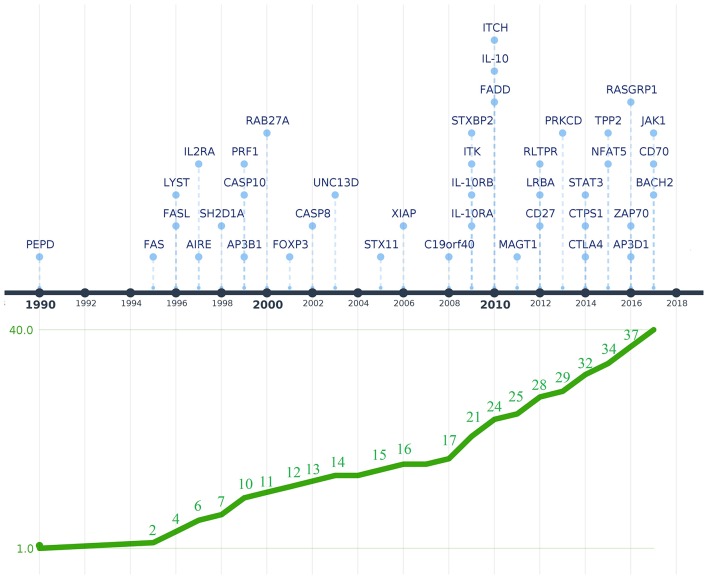
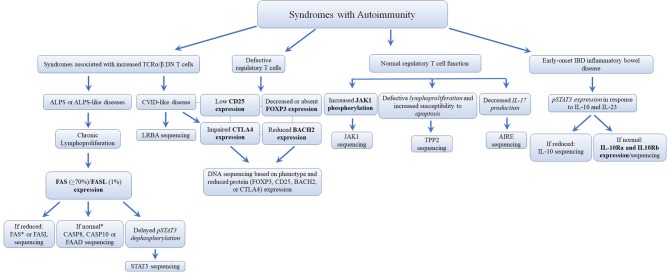
Almost 70 years after establishing the concept of primary immunodeficiency disorders (PIDs), more than 320 monogenic inborn errors of immunity have been identified thanks to the remarkable contribution of high-throughput genetic screening in the last decade. Approximately 40 of these PIDs present with autoimmune or auto-inflammatory symptoms as the primary clinical manifestation instead of infections. These PIDs are now recognized as diseases of immune dysregulation. Loss-of function mutations in genes such as , as well as heterozygous gain-of-function mutations in and have been reported as causative of these disorders. Identifying these syndromes has considerably contributed to expanding our knowledge on the mechanisms of immune regulation and tolerance. Although whole exome and whole genome sequencing have been extremely useful in identifying novel causative genes underlying new phenotypes, these approaches are time-consuming and expensive. Patients with monogenic syndromes associated with autoimmunity require faster diagnostic tools to delineate therapeutic strategies and avoid organ damage. Since these PIDs present with severe life-threatening phenotypes, the need for a precise diagnosis in order to initiate appropriate patient management is necessary. More traditional approaches such as flow cytometry are therefore a valid option. Here, we review the application of flow cytometry and discuss the relevance of this powerful technique in diagnosing patients with PIDs presenting with immune dysregulation. In addition, flow cytometry represents a fast, robust, and sensitive approach that efficiently uncovers new immunopathological mechanisms underlying monogenic PIDs.
近 70 年来,随着高通量基因筛查技术在过去十年中的显著贡献,已经发现了 320 多种单基因遗传性免疫缺陷病。其中约 40 种 PID 以自身免疫或自身炎症为主要临床表现,而不是感染。这些 PID 现在被认为是免疫失调疾病。已经报道了 基因的功能丧失突变,以及 和 基因的杂合获得性功能突变是这些疾病的原因。这些综合征的鉴定极大地促进了我们对免疫调节和耐受机制的认识。虽然外显子组和全基因组测序在鉴定新表型的新致病基因方面非常有用,但这些方法耗时且昂贵。患有与自身免疫相关的单基因综合征的患者需要更快的诊断工具来制定治疗策略并避免器官损伤。由于这些 PID 表现出严重的危及生命的表型,因此需要进行精确诊断,以便启动适当的患者管理。因此,更传统的方法,如流式细胞术,是一种有效的选择。在这里,我们回顾了流式细胞术的应用,并讨论了该强大技术在诊断表现出免疫失调的 PID 患者中的相关性。此外,流式细胞术是一种快速、稳健和敏感的方法,可以有效地揭示单基因 PID 背后的新免疫病理机制。