Department of Rheumatology and Clinical Immunology, Justus-Liebig-University Gießen, Giessen, Germany.
Department of Internal Medicine III, Endocrinology, Diabetes, Metabolism, Justus-Liebig-University of Giessen, Giessen, Germany.
Front Immunol. 2019 Dec 3;10:2757. doi: 10.3389/fimmu.2019.02757. eCollection 2019.
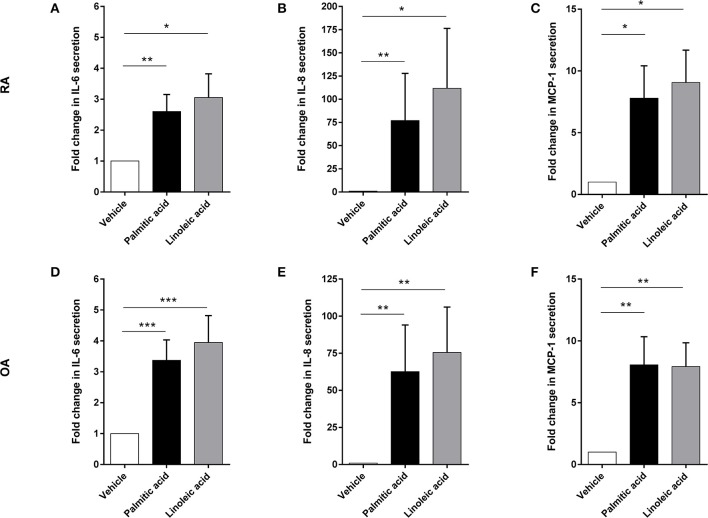
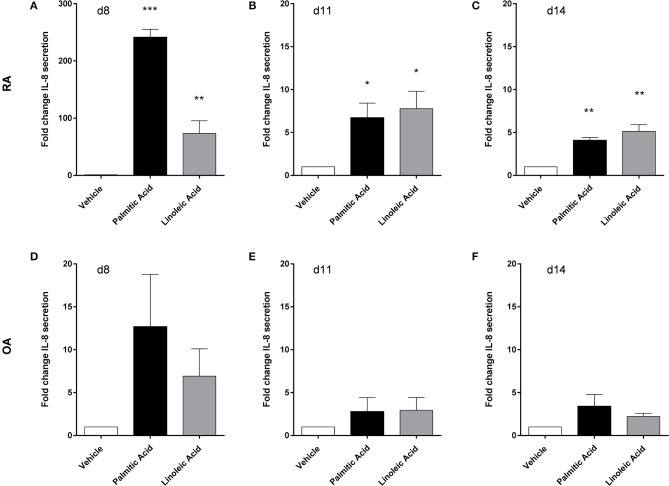
Obesity-in which free fatty acid (FFA) levels are chronically elevated-is a known risk factor for different rheumatic diseases, and obese patients are more likely to develop osteoarthritis (OA) also in non-weight-bearing joints. These findings suggest that FFA may also play a role in inflammation-related joint damage and bone loss in rheumatoid arthritis (RA) and OA. Therefore, the objective of this study was to analyze if and how FFA influence cells of bone metabolism in rheumatic diseases. When stimulated with FFA, osteoblasts from RA and OA patients secreted higher amounts of the proinflammatory cytokine interleukin (IL)-6 and the chemokines IL-8, growth-related oncogene α, and monocyte chemotactic protein 1. Receptor activator of nuclear factor kappa B ligand (RANKL), osteoprotegerin, and osteoblast differentiation markers were not influenced by FFA. Mineralization activity of osteoblasts correlated inversely with the level of FFA-induced IL-6 secretion. Expression of the Wnt signaling molecules, axin-2 and β-catenin, was not changed by palmitic acid (PA) or linoleic acid (LA), suggesting no involvement of the Wnt signaling pathway in FFA signaling for osteoblasts. On the other hand, Toll-like receptor 4 blockade significantly reduced PA-induced IL-8 secretion by osteoblasts, while blocking Toll-like receptor 2 had no effect. In osteoclasts, IL-8 secretion was enhanced by PA and LA particularly at the earliest time point of differentiation. Differences were observed between the responses of RA and OA osteoclasts. FFA might therefore represent a new molecular factor by which adipose tissue contributes to subchondral bone damage in RA and OA. In this context, their mechanisms of action appear to be dependent on inflammation and innate immune system rather than Wnt-RANKL pathways.
肥胖症是一种游离脂肪酸(FFA)水平长期升高的疾病,是多种风湿性疾病的已知危险因素,肥胖症患者也更容易在非承重关节患上骨关节炎(OA)。这些发现表明,FFA 可能在类风湿关节炎(RA)和 OA 的炎症相关关节损伤和骨丢失中也发挥作用。因此,本研究旨在分析 FFA 是否以及如何影响风湿性疾病中的骨代谢细胞。当用 FFA 刺激时,RA 和 OA 患者的成骨细胞分泌了更高水平的促炎细胞因子白细胞介素(IL)-6 和趋化因子 IL-8、生长相关癌基因α和单核细胞趋化蛋白 1。核因子κB 配体(RANKL)、骨保护素和成骨细胞分化标志物不受 FFA 影响。成骨细胞的矿化活性与 FFA 诱导的 IL-6 分泌水平呈反比。Wnt 信号分子轴蛋白-2 和β-连环蛋白的表达不受棕榈酸(PA)或亚油酸(LA)的影响,这表明 Wnt 信号通路不参与 FFA 对成骨细胞的信号转导。另一方面,Toll 样受体 4 阻断显著减少了 PA 诱导的成骨细胞中 IL-8 的分泌,而阻断 Toll 样受体 2 则没有影响。在破骨细胞中,PA 和 LA 尤其在分化的最早时间点增强了 IL-8 的分泌。RA 和 OA 破骨细胞的反应存在差异。因此,FFA 可能是脂肪组织促进 RA 和 OA 软骨下骨损伤的新分子因素。在这种情况下,它们的作用机制似乎依赖于炎症和先天免疫系统,而不是 Wnt-RANKL 途径。