Kieslinger Matthias, Swoboda Alexander, Kramer Nina, Pratscher Barbara, Wolfesberger Birgitt, Burgener Iwan A
Division of Small Animal Internal Medicine, Department of Companion Animals and Horses, University of Veterinary Medicine Vienna, 1210 Vienna, Austria.
Cancers (Basel). 2019 Dec 17;11(12):2035. doi: 10.3390/cancers11122035.
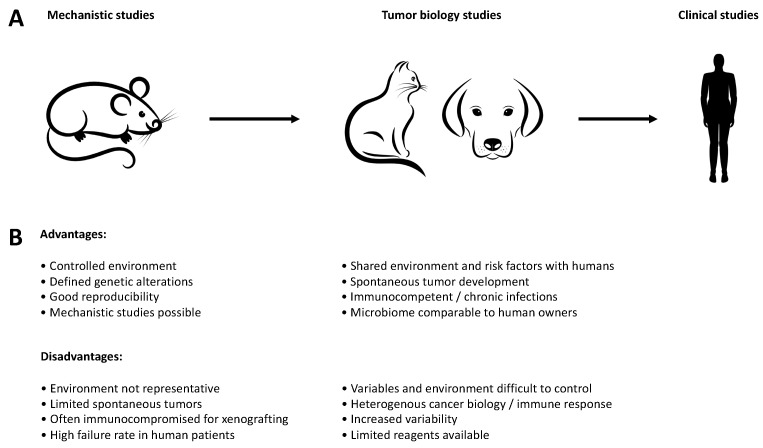
The use of transgenic mouse models has revolutionized the study of many human diseases. However, murine models are limited in their representation of spontaneously arising tumors and often lack key clinical signs and pathological changes. Thus, a closer representation of complex human diseases is of high therapeutic relevance. Given the high failure rate of drugs at the clinical trial phase (i.e., around 90%), there is a critical need for additional clinically relevant animal models. Companion animals like cats and dogs display chronic inflammatory or neoplastic diseases that closely resemble the human counterpart. Cat and dog patients can also be treated with clinically approved inhibitors or, if ethics and drug safety studies allow, pilot studies can be conducted using, e.g., inhibitors of the evolutionary conserved JAK-STAT pathway. The incidence by which different types of cancers occur in companion animals as well as mechanisms of disease are unique between humans and companion animals, where one can learn from each other. Taking advantage of this situation, existing inhibitors of known oncogenic STAT3/5 or JAK kinase signaling pathways can be studied in the context of rare human diseases, benefitting both, the development of drugs for human use and their application in veterinary medicine.
转基因小鼠模型的使用彻底改变了许多人类疾病的研究。然而,小鼠模型在自发产生肿瘤的代表性方面存在局限性,并且常常缺乏关键的临床症状和病理变化。因此,更接近地模拟复杂的人类疾病具有很高的治疗相关性。鉴于药物在临床试验阶段的高失败率(即约90%),迫切需要更多与临床相关的动物模型。猫和狗等伴侣动物会出现与人类极为相似的慢性炎症或肿瘤性疾病。猫和狗患者也可以使用临床批准的抑制剂进行治疗,或者,如果伦理和药物安全性研究允许,可以进行试点研究,例如使用进化保守的JAK-STAT途径的抑制剂。伴侣动物中不同类型癌症的发病率以及疾病机制在人类和伴侣动物之间是独特的,双方可以相互借鉴。利用这种情况,可以在罕见人类疾病的背景下研究已知致癌STAT3/5或JAK激酶信号通路的现有抑制剂,这对人类用药的药物开发及其在兽医学中的应用都有好处。