Cancer Research Institute, Beth Israel Deaconess Cancer Center, Department of Medicine and Pathology, Beth Israel Deaconess Medical Center, Harvard Medical School, Boston, MA 02115, USA.
Department of Molecular and Cellular Biology, Baylor College of Medicine, Houston, TX 77030, USA.
Nucleic Acids Res. 2020 Mar 18;48(5):2621-2642. doi: 10.1093/nar/gkz1176.
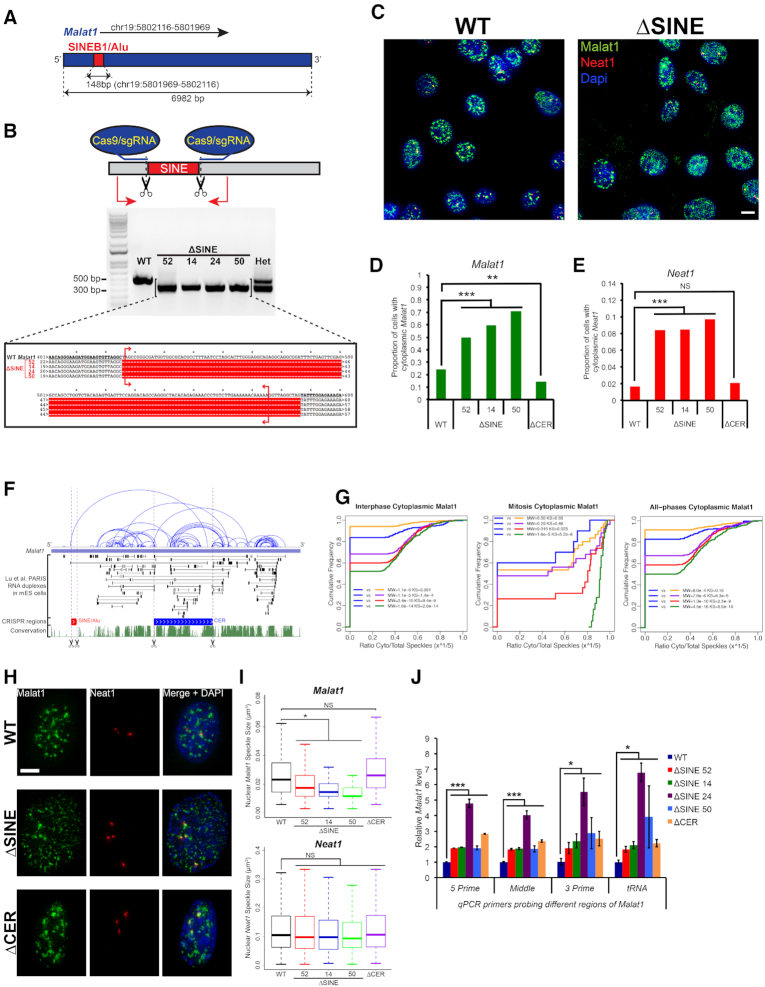
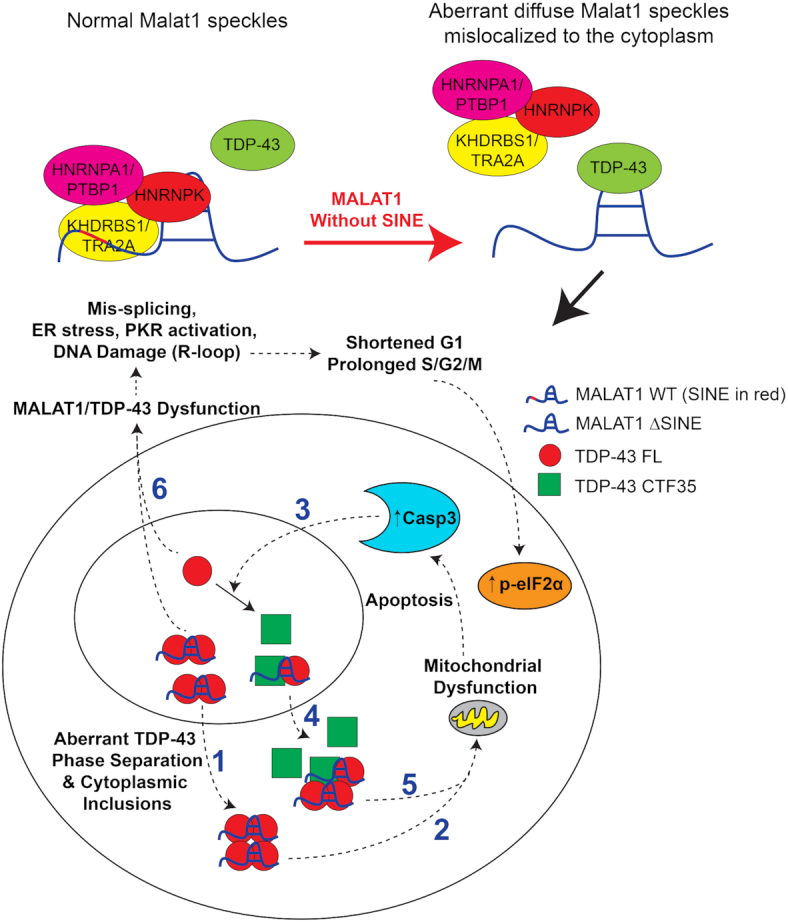
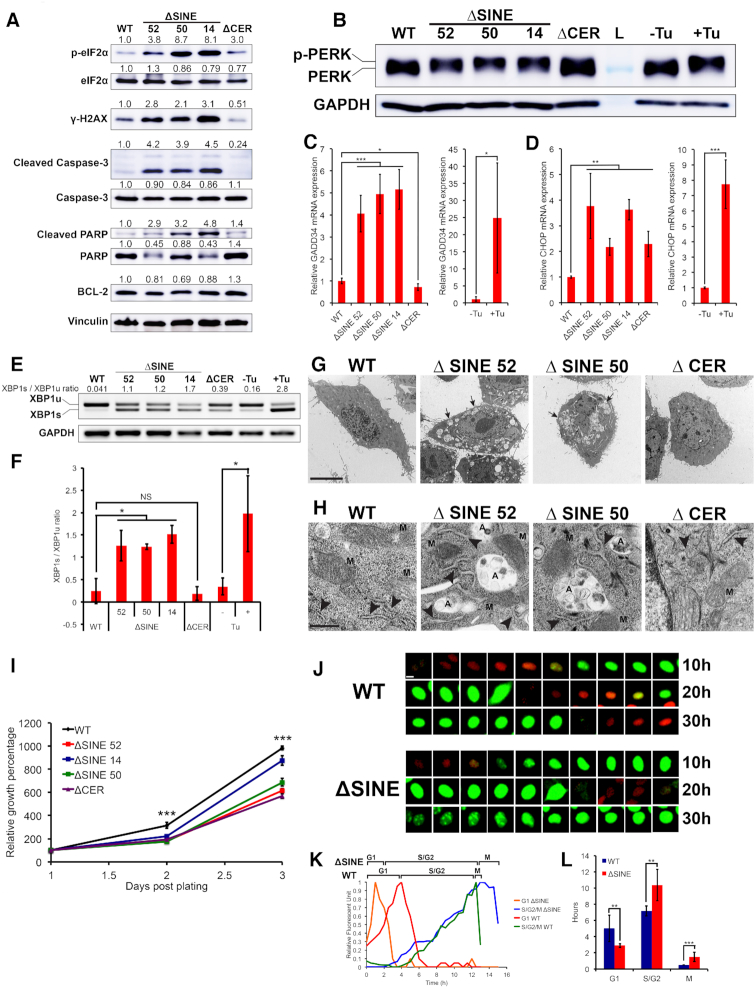
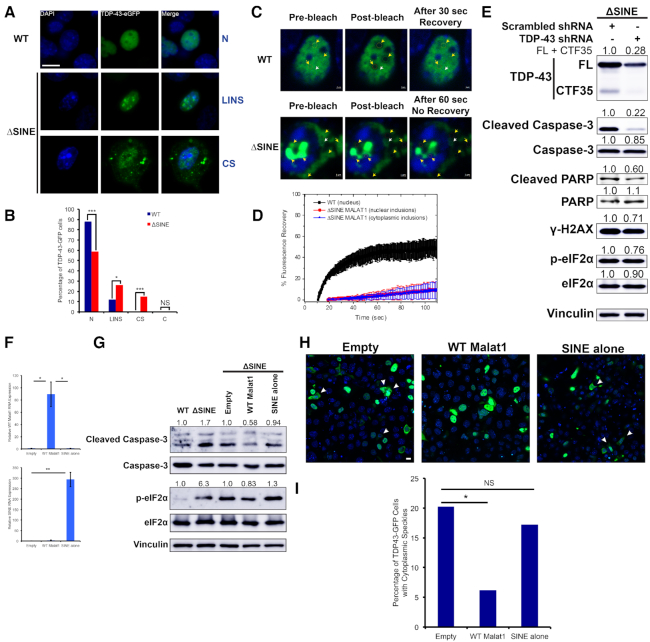
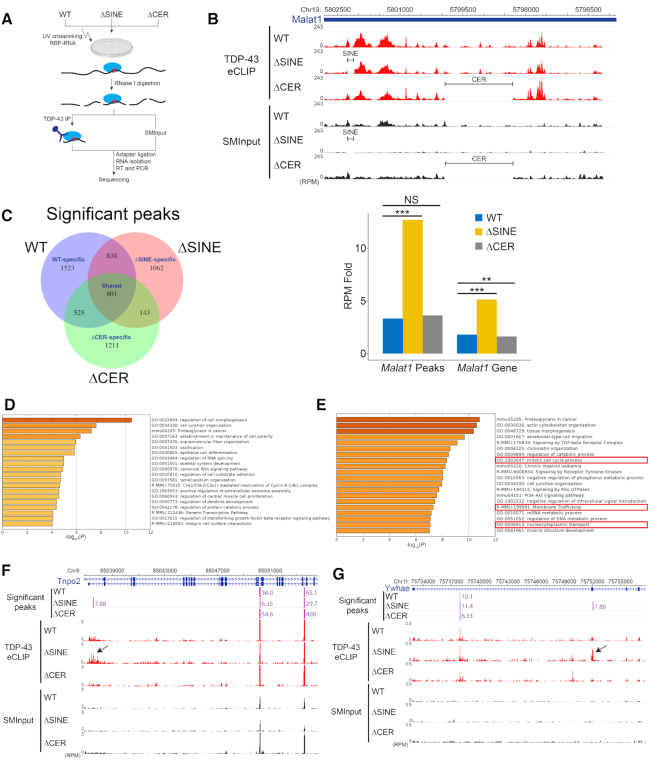
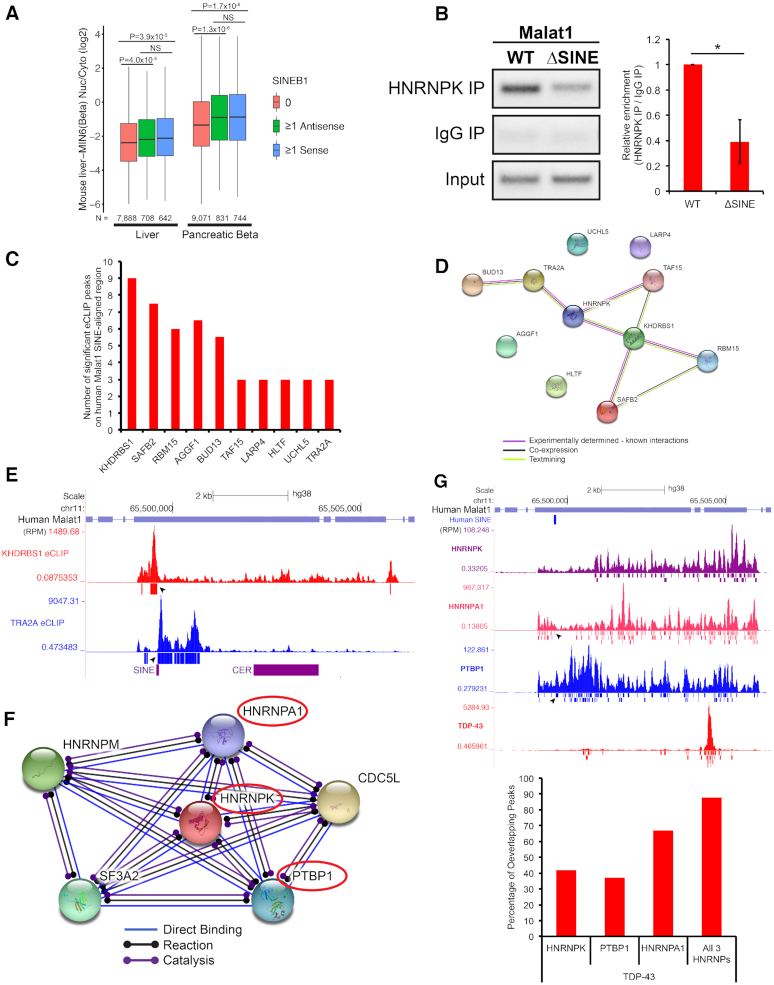
Transposable elements (TEs) comprise a large proportion of long non-coding RNAs (lncRNAs). Here, we employed CRISPR to delete a short interspersed nuclear element (SINE) in Malat1, a cancer-associated lncRNA, to investigate its significance in cellular physiology. We show that Malat1 with a SINE deletion forms diffuse nuclear speckles and is frequently translocated to the cytoplasm. SINE-deleted cells exhibit an activated unfolded protein response and PKR and markedly increased DNA damage and apoptosis caused by dysregulation of TDP-43 localization and formation of cytotoxic inclusions. TDP-43 binds stronger to Malat1 without the SINE and is likely 'hijacked' by cytoplasmic Malat1 to the cytoplasm, resulting in the depletion of nuclear TDP-43 and redistribution of TDP-43 binding to repetitive element transcripts and mRNAs encoding mitotic and nuclear-cytoplasmic regulators. The SINE promotes Malat1 nuclear retention by facilitating Malat1 binding to HNRNPK, a protein that drives RNA nuclear retention, potentially through direct interactions of the SINE with KHDRBS1 and TRA2A, which bind to HNRNPK. Losing these RNA-protein interactions due to the SINE deletion likely creates more available TDP-43 binding sites on Malat1 and subsequent TDP-43 aggregation. These results highlight the significance of lncRNA TEs in TDP-43 proteostasis with potential implications in both cancer and neurodegenerative diseases.
转座元件 (TEs) 构成了长非编码 RNA (lncRNA) 的很大一部分。在这里,我们采用 CRISPR 技术删除了癌症相关 lncRNA Malat1 中的一个短散在核元件 (SINE),以研究其在细胞生理学中的意义。我们发现,缺失 SINE 的 Malat1 形成弥散的核斑点,并且经常易位到细胞质中。SINE 缺失的细胞表现出激活的未折叠蛋白反应和 PKR,并且由于 TDP-43 定位的失调和细胞毒性包含物的形成导致明显增加的 DNA 损伤和细胞凋亡。TDP-43 与没有 SINE 的 Malat1 结合更强,并且可能被细胞质中的 Malat1“劫持”到细胞质中,导致核 TDP-43 的耗竭和 TDP-43 与重复元件转录本和编码有丝分裂和核细胞质调节剂的 mRNA 的结合重新分布。SINE 通过促进 Malat1 与 HNRNPK 的结合来促进 Malat1 的核保留,HNRNPK 是一种驱动 RNA 核保留的蛋白质,这可能是通过 SINE 与 KHDRBS1 和 TRA2A 的直接相互作用实现的,KHDRBS1 和 TRA2A 与 HNRNPK 结合。由于 SINE 缺失导致这些 RNA-蛋白质相互作用丢失,可能在 Malat1 上产生更多可用的 TDP-43 结合位点,并随后导致 TDP-43 聚集。这些结果突出了 lncRNA TEs 在 TDP-43 蛋白稳态中的重要性,这可能对癌症和神经退行性疾病都有潜在的影响。