Urology Centre, Guy's & St Thomas' NHS Trust, London, SE1 7EH, UK.
Cancer Imaging Department, School of Biomedical Engineering and Imaging Sciences, King's College London, London, UK.
Eur J Nucl Med Mol Imaging. 2020 Mar;47(3):674-686. doi: 10.1007/s00259-019-04643-7. Epub 2019 Dec 23.
To determine the impact on clinical management of patients with high-risk (HR) prostate cancer at diagnosis and patients with biochemical recurrence (BCR) using a new kit form of Ga-prostate-specific membrane antigen (PSMA), namely tris(hydroxypyridinone) (THP)-PSMA, with positron emission tomography-computed tomography (PET-CT).
One hundred eighteen consecutive patients (50 HR, 68 BCR) had management plans documented at a multidisciplinary meeting before Ga-THP-PSMA PET-CT. Patients underwent PET-CT scans 60-min post-injection of Ga-THP-PSMA (mean 159 ± 21.2 MBq). Post-scan management plans, Gleason score, prostate-specific antigen (PSA) and PSA doubling time (PSAdt) were recorded.
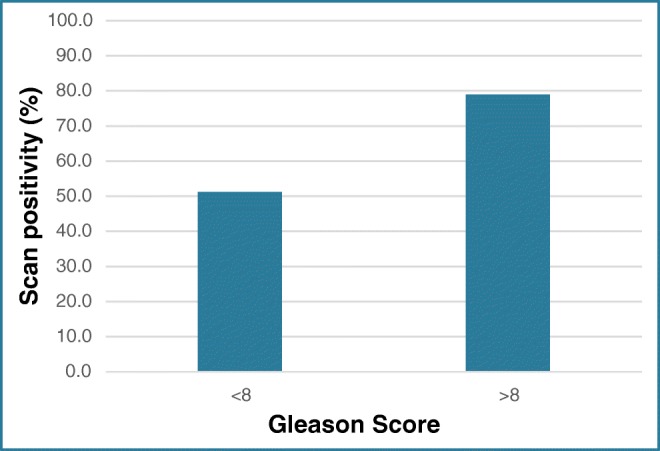
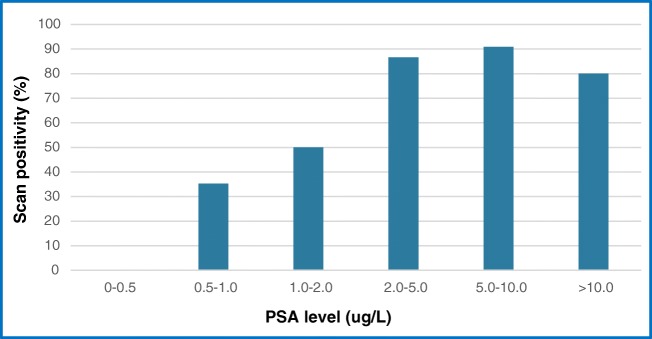
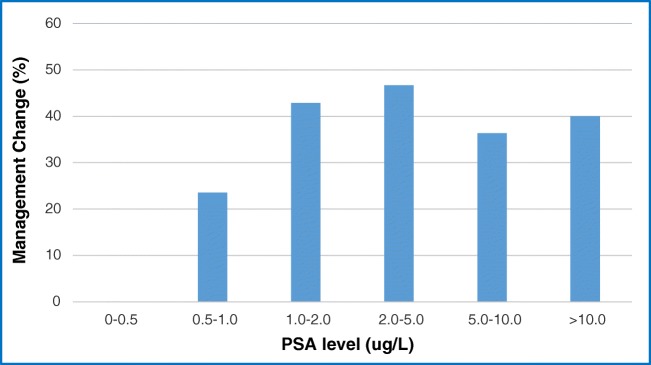
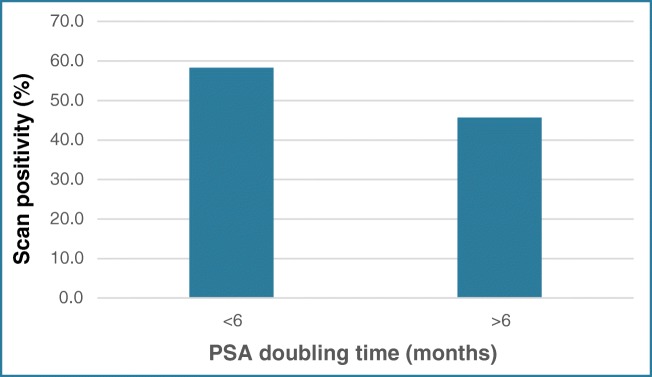
HR group: 12/50 (24%) patients had management changed (9 inter-modality, 3 intra-modality). Patients with PSA < 20 μg/L had more frequent management changes (9/26, 34.6%) compared with PSA > 20 μg/L (3/24, 12.5%). Gleason scores > 8 were associated with detection of more nodal (4/16, 25% vs 5/31, 16.1%) and bone (2/16, 12.5% vs 2/31, 6.5%) metastases. BCR group: Clinical management changed in 23/68 (34%) patients (17 inter-modality, 6 intra-modality). Forty out of 68 (59%) scans were positive. Positivity rate increased with PSA level (PSA < 0.5 μg/L, 0%; PSA 0.5-1.0 μg/L, 35%; PSA 1.0-5.0 μg/L, 69%; PSA 5.0-10.0 μg/L, 91%), PSAdt of < 6 months (56% vs 45.7%) and Gleason score > 8 (78.9% vs 51.2%).
Ga-THP-PSMA PET-CT influences clinical management in significant numbers of patient with HR prostate cancer pre-radical treatment and is associated with PSA. Management change also occurs in patients with BCR and is associated with PSA and Gleason score, despite lower scan positivity rates at low PSA levels < 0.5 μg/L.
使用新的 Ga-前列腺特异性膜抗原(PSMA)试剂盒形式三(羟基吡啶酮)(THP)-PSMA 结合正电子发射断层扫描-计算机断层扫描(PET-CT),确定对高风险(HR)前列腺癌患者和生化复发(BCR)患者的临床管理的影响。
118 名连续患者(50 名 HR,68 名 BCR)在 Ga-THP-PSMA PET-CT 前在多学科会议上记录了管理计划。患者在 Ga-THP-PSMA 注射后 60 分钟进行 PET-CT 扫描(平均 159 ± 21.2 MBq)。记录了扫描后的管理计划、Gleason 评分、前列腺特异性抗原(PSA)和 PSA 倍增时间(PSAdt)。
HR 组:50 名患者中有 12 名(24%)患者的管理发生变化(9 例为跨模式,3 例为模式内)。PSA<20μg/L 的患者更频繁地改变管理(9/26,34.6%),而 PSA>20μg/L 的患者(3/24,12.5%)。Gleason 评分>8 与更多的淋巴结(4/16,25%比 5/31,16.1%)和骨(2/16,12.5%比 2/31,6.5%)转移的检测相关。BCR 组:68 名患者中有 23 名(34%)患者的临床管理发生变化(17 名跨模式,6 名模式内)。40 例扫描结果为阳性。阳性率随 PSA 水平升高而增加(PSA<0.5μg/L,0%;PSA 0.5-1.0μg/L,35%;PSA 1.0-5.0μg/L,69%;PSA 5.0-10.0μg/L,91%)、PSA<6 个月(56%比 45.7%)和 Gleason 评分>8(78.9%比 51.2%)。
Ga-THP-PSMA PET-CT 在前放射性治疗前显著影响 HR 前列腺癌患者的临床管理,并与 PSA 相关。即使在 PSA<0.5μg/L 的低水平下,扫描阳性率较低,BCR 患者的管理也会发生变化,并且与 PSA 和 Gleason 评分相关。