Lepareur Nicolas
Comprehensive Cancer Center Eugène Marquis, Rennes, France.
Univ Rennes, Inrae, Inserm, Institut NUMECAN (Nutrition, Métabolismes et Cancer), UMR_A 1341, UMR_S 1241, Rennes, France.
Front Med (Lausanne). 2022 Feb 10;9:812050. doi: 10.3389/fmed.2022.812050. eCollection 2022.
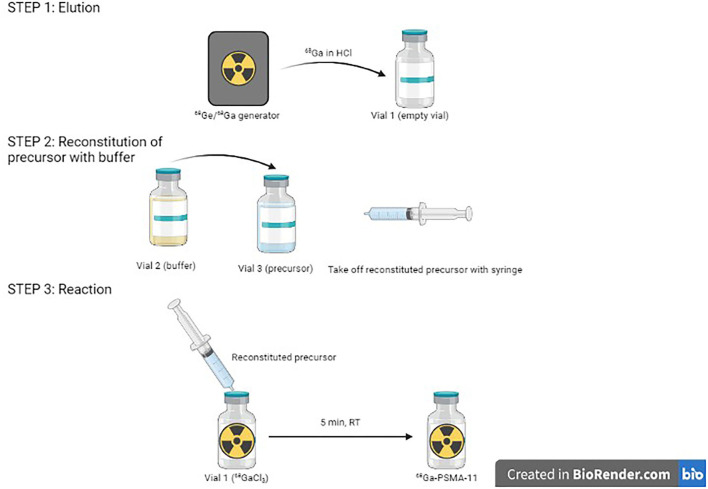
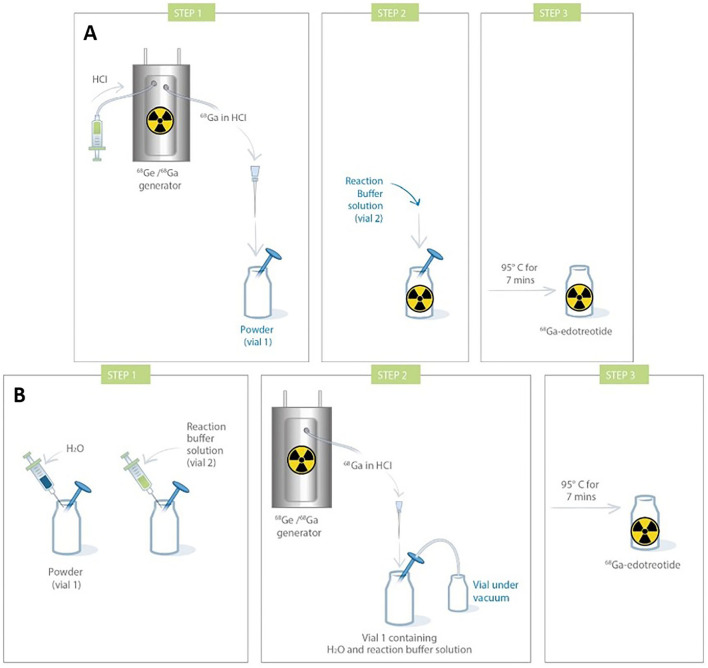
Over the last couple of decades, gallium-68 (Ga) has gained a formidable interest for PET molecular imaging of various conditions, from cancer to infection, through cardiac pathologies or neuropathies. It has gained routine use, with successful radiopharmaceuticals such as somatostatin analogs ([Ga]Ga-DOTATOC and [Ga]GaDOTATATE) for neuroendocrine tumors, and PSMA ligands for prostate cancer. It represents a major clinical impact, particularly in the context of theranostics, coupled with their Lu-labeled counterparts. Beside those, a bunch of new Ga-labeled molecules are in the preclinical and clinical pipelines, with some of them showing great promise for patient care. Increasing clinical demand and regulatory issues have led to the development of automated procedures for the production of Ga radiopharmaceuticals. However, the widespread use of these radiopharmaceuticals may rely on simple and efficient radiolabeling methods, undemanding in terms of equipment and infrastructure. To make them technically and economically accessible to the medical community and its patients, it appears mandatory to develop a procedure similar to the well-established kit-based Tc chemistry. Already available commercial kits for the production of Ga radiopharmaceuticals have demonstrated the feasibility of using such an approach, thus paving the way for more kit-based Ga radiopharmaceuticals to be developed. This article discusses the development of Ga cold kit radiopharmacy, including technical issues, and regulatory aspects.
在过去几十年中,镓-68(Ga)在正电子发射断层扫描(PET)分子成像领域引发了极大关注,其应用范围涵盖了从癌症到感染,再到心脏疾病或神经病变等各种病症。它已得到常规使用,例如用于神经内分泌肿瘤的生长抑素类似物([Ga]Ga-DOTATOC和[Ga]Ga-DOTATATE)以及用于前列腺癌的前列腺特异性膜抗原(PSMA)配体等放射性药物都取得了成功。它具有重大的临床影响,特别是在治疗诊断学方面,与它们的镥标记对应物相结合。除此之外,一系列新的Ga标记分子正处于临床前和临床研发阶段,其中一些对患者护理显示出巨大潜力。临床需求的增加和监管问题促使了用于生产Ga放射性药物的自动化程序的发展。然而,这些放射性药物的广泛使用可能依赖于简单高效的放射性标记方法,对设备和基础设施要求不高。为了使医疗界及其患者在技术和经济上都能使用这些药物,开发一种类似于成熟的基于试剂盒的锝化学方法的程序似乎是必不可少的。已有的用于生产Ga放射性药物的商业试剂盒已证明了使用这种方法的可行性,从而为更多基于试剂盒的Ga放射性药物的开发铺平了道路。本文讨论了Ga冷试剂盒放射性药物学的发展,包括技术问题和监管方面。