
亚洲国家血液循环维生素 D 与结直肠癌风险的关联:系统评价和剂量反应荟萃分析。
Association between blood circulating vitamin D and colorectal cancer risk in Asian countries: a systematic review and dose-response meta-analysis.
机构信息
Department of Clinical Laboratory, Peking Union Medical College Hospital, Chinese Academy of Medical Sciences, Beijing, China.
School of Public Health, Chinese Academy of Medical Sciences & Peking Union Medical College, Beijing, China.
出版信息
BMJ Open. 2019 Dec 23;9(12):e030513. doi: 10.1136/bmjopen-2019-030513.
OBJECTIVES
To assess the association between blood circulating vitamin D levels and colorectal cancer risk in the Asian population.
DESIGN
This is a systematic review and dose-response meta-analysis of observational studies that investigated the relationship between blood circulating vitamin D levels and colorectal cancer risk in the Asian population.
DATA SOURCES
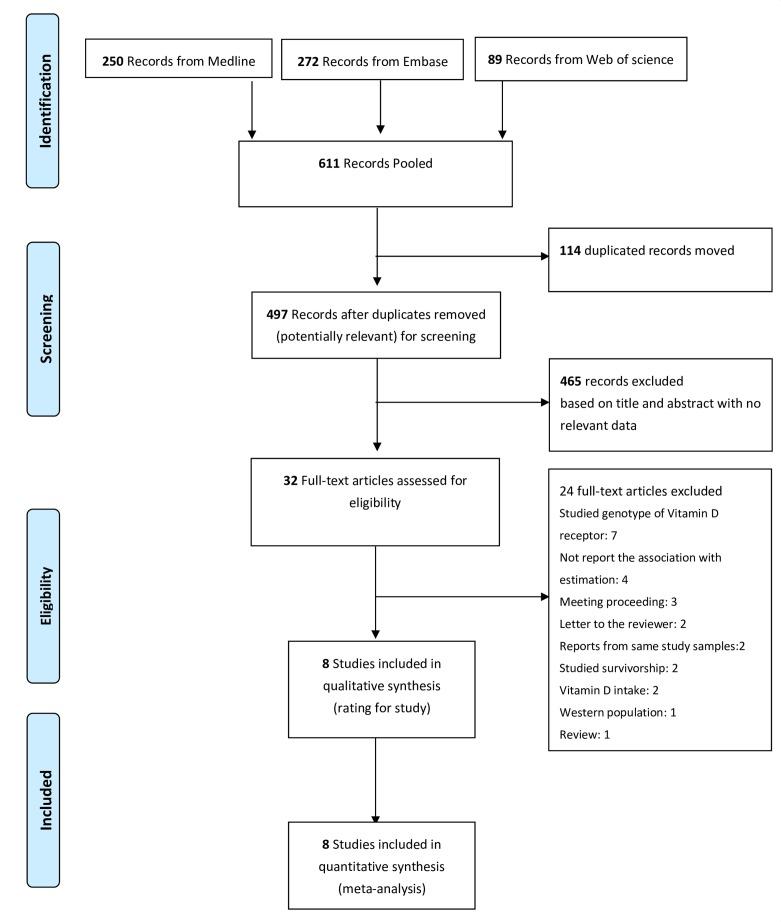
Relevant studies were identified through a literature search in Medline, Embase and Web of Science from 1st January 1980 to 31st January 2019. Eligibility criteria: original studies published in peer-reviewed journals investigating the association between blood circulating vitamin D levels and the risk of colorectal cancer and/or adenoma in Asian countries.
DATA EXTRACTION AND SYNTHESIS
Two authors independently extracted data and assessed the quality of included studies. Study-specific ORs were pooled using a random-effects model. A dose-response meta-analysis was performed with generalised least squares regression. We applied the Newcastle-Ottawa Scale quality assessment to evaluate the quality of the selected studies.
RESULTS
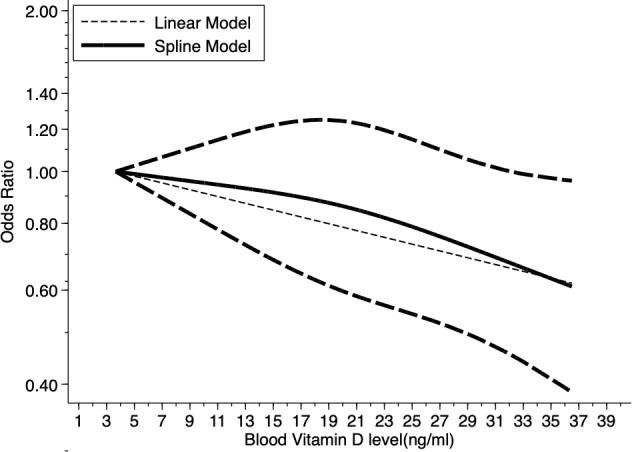
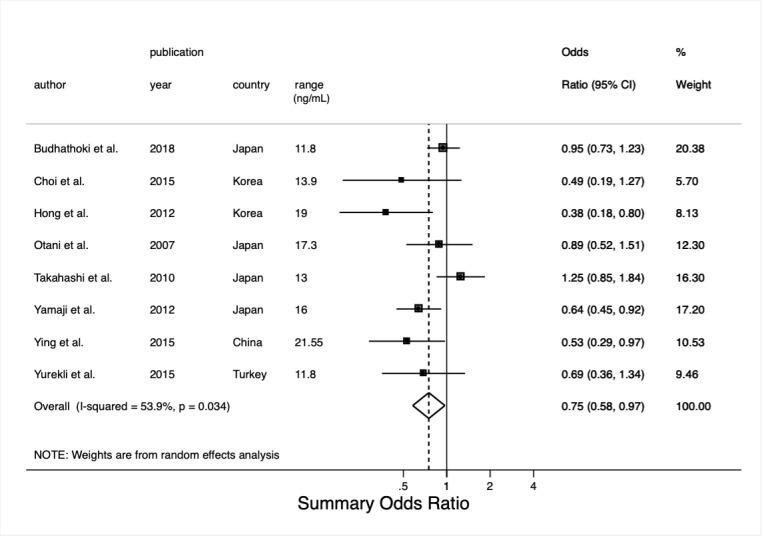
The eight included studies encompassed a total of 2916 cases and 6678 controls. The pooled ORs of colorectal cancer for the highest versus lowest categories of blood circulating vitamin D levels was 0.75 (95% CI 0.58 to 0.97) up to 36.5 ng/mL in the Asian population. There was heterogeneity among the studies (=53.9%, =0.034). The dose-response meta-analysis indicated a significant linear relationship (=0.11). An increment of 16 ng/mL in blood circulating vitamin D level corresponded to an OR of 0.79 (95% CI 0.64 to 0.97).
CONCLUSIONS
The results of this meta-analysis indicate that blood circulating vitamin D level is associated with decreased risk of colorectal cancer in Asian countries. The dose-response meta-analysis shows that the strength of this association among the Asian population is similar to that among the Western population. Our study suggests that the Asian population should improve nutritional status and maintain a higher level of blood circulating vitamin D.
目的
评估亚洲人群血液循环维生素 D 水平与结直肠癌风险之间的关联。
设计
这是一项系统评价和剂量反应荟萃分析,对调查亚洲人群血液循环维生素 D 水平与结直肠癌风险之间关系的观察性研究进行了分析。
数据来源
通过在 Medline、Embase 和 Web of Science 上从 1980 年 1 月 1 日到 2019 年 1 月 31 日进行文献检索,确定了相关研究。纳入标准:发表在同行评议期刊上的原始研究,调查亚洲国家血液循环维生素 D 水平与结直肠癌和/或腺瘤风险之间的关系。
数据提取和综合
两名作者独立提取数据并评估纳入研究的质量。使用随机效应模型对研究特异性 OR 进行汇总。使用广义最小二乘法回归进行剂量反应荟萃分析。我们应用纽卡斯尔-渥太华量表质量评估来评估所选研究的质量。
结果
纳入的八项研究共纳入了 2916 例病例和 6678 例对照。在亚洲人群中,血液循环维生素 D 水平最高与最低组之间结直肠癌的合并 OR 为 0.75(95%CI 0.58 至 0.97),最高值可达 36.5ng/mL。研究之间存在异质性(=53.9%,=0.034)。剂量反应荟萃分析表明存在显著的线性关系(=0.11)。血液循环维生素 D 水平每增加 16ng/mL,OR 为 0.79(95%CI 0.64 至 0.97)。
结论
荟萃分析结果表明,亚洲人群血液循环维生素 D 水平与结直肠癌风险降低相关。剂量反应荟萃分析表明,亚洲人群中这种关联的强度与西方人群相似。我们的研究表明,亚洲人群应该改善营养状况并保持更高水平的血液循环维生素 D。
 Zotero 插件