Department of Biomedical Engineering, 1080 Carmack Rd, 270 Bevis Hall, The Ohio State University, Columbus, OH, USA.
Department of Biomedical Engineering, 1080 Carmack Rd, 270 Bevis Hall, The Ohio State University, Columbus, OH, USA; Department of Ophthalmology & Visual Science, William H. Havener Eye Institute, 915 Olentangy River Rd, Suite, 5000, The Ohio State University, Columbus, OH, USA.
Exp Eye Res. 2020 Feb;191:107904. doi: 10.1016/j.exer.2019.107904. Epub 2019 Dec 25.
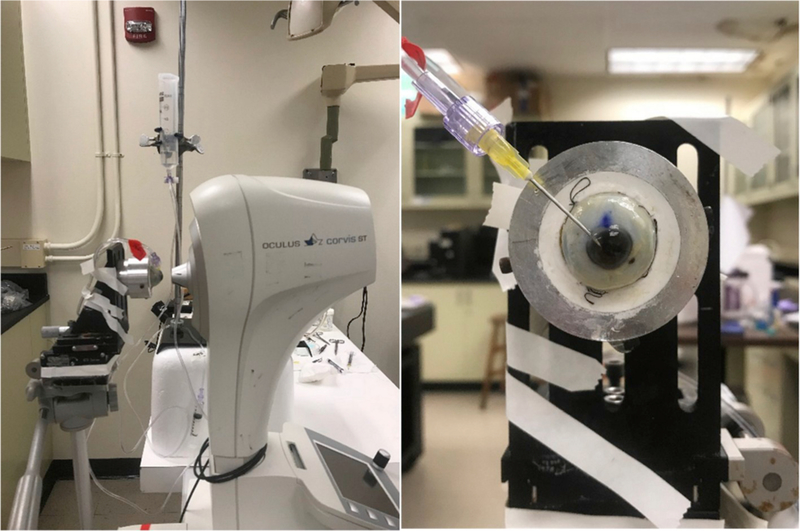
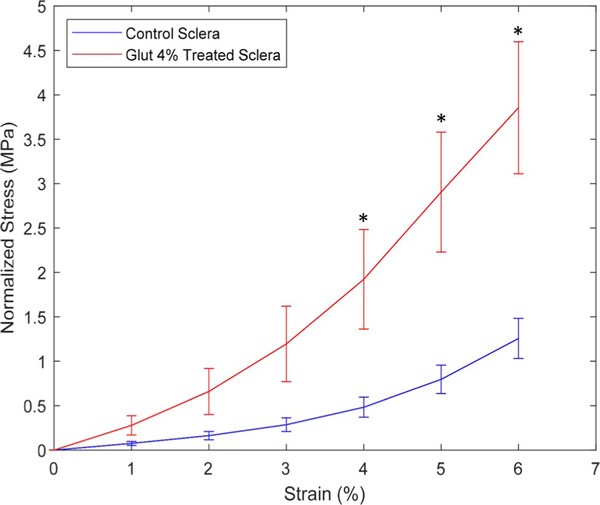
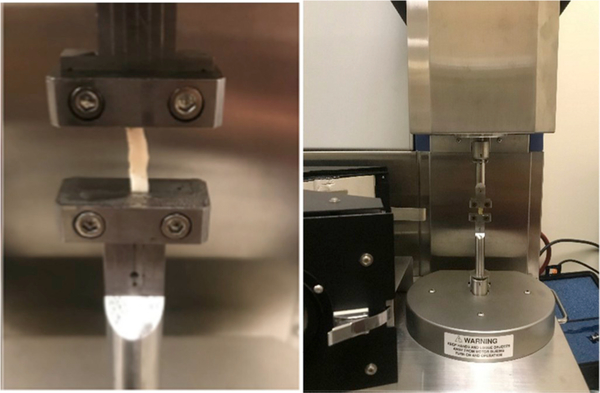
This study was conducted to evaluate the impact of varying scleral material properties on the biomechanical response of the cornea under air-puff induced deformation. Twenty pairs of human donor eyes were obtained for this study. One eye from each pair had its sclera stiffened using 4% glutaraldehyde, while the fellow eye served as control for uniaxial strip testing. The whole globes were mounted in a rigid holder and intraocular pressure (IOP) was set using a saline column. Dynamic corneal response parameters were measured before and after scleral stiffening using the CorVis ST, a dynamic Scheimpflug analyzer. IOP was set to 10, 20, 30, and 40 mmHg, with at least 3 examinations performed at each pressure step. Uniaxial tensile testing data were fit to a neo-Hookean model to estimate the Young's modulus of treated and untreated sclera. Scleral Young's modulus was found to be significantly correlated with several response parameters, including Highest Concavity Deformation Amplitude, Peak Distance, Highest Concavity Radius, and Stiffness Parameter-Highest Concavity (SP-HC). There were significant increases in SP-HC after scleral stiffening at multiple levels of IOP, while no significant difference was observed in the corneal Stiffness Parameter - Applanation 1 (SP-A1) at any level of IOP. Scleral mechanical properties significantly influenced the corneal deformation response to an air-puff. The stiffer the sclera, the greater the constraining effect on corneal deformation resulting in lower displaced amplitude. This may have important clinical implications and suggests that both corneal and scleral material properties contribute to the observed corneal response in air-puff induced deformation.
本研究旨在评估不同巩膜材料特性对空气脉冲诱导变形下角膜生物力学响应的影响。为此研究,共获得了 20 对人供体眼球。每对眼球中的一只眼球使用 4%戊二醛使其巩膜变硬,而另一只眼球作为未进行单轴带测试的对照。整个眼球都安装在刚性夹具中,并使用盐水柱设置眼内压(IOP)。使用 CorVis ST(一种动态 Scheimpflug 分析仪)在巩膜变硬前后测量动态角膜响应参数。IOP 设置为 10、20、30 和 40mmHg,每个压力步骤至少进行 3 次检查。将单轴拉伸测试数据拟合到新的胡克模型中,以估算处理和未处理巩膜的杨氏模量。发现巩膜杨氏模量与多个响应参数显著相关,包括最大凹陷变形幅度、峰值距离、最大凹陷半径和最大凹陷硬度参数(SP-HC)。在多个 IOP 水平下,巩膜变硬后 SP-HC 显著增加,而在任何 IOP 水平下,角膜硬度参数 - 压平 1(SP-A1)均无显著差异。巩膜力学特性显著影响角膜对空气脉冲的变形响应。巩膜越硬,对角膜变形的约束作用越大,导致较低的位移幅度。这可能具有重要的临床意义,并表明角膜和巩膜材料特性都对空气脉冲诱导变形中的角膜响应有贡献。