Trujillo Elaine B, Claghorn Katrina, Dixon Suzanne W, Hill Emily B, Braun Ashlea, Lipinski Elizabeth, Platek Mary E, Vergo Maxwell T, Spees Colleen
Division of Cancer Prevention, National Cancer Institute, National Institutes of Health, Rockville, MD 20850, USA.
Abramson Cancer Center, University of Pennsylvania, Philadelphia, PA 19104, USA.
J Oncol. 2019 Nov 22;2019:7462940. doi: 10.1155/2019/7462940. eCollection 2019.
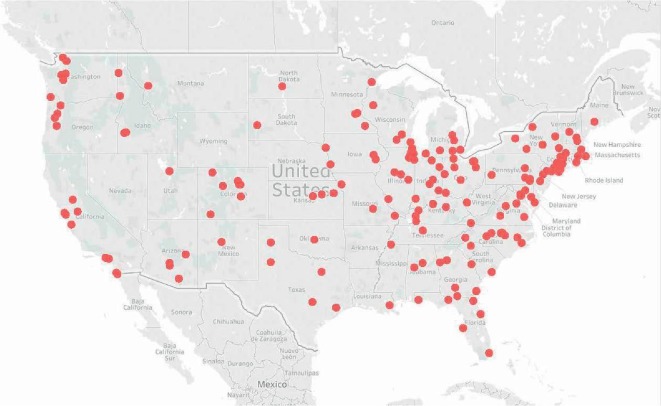
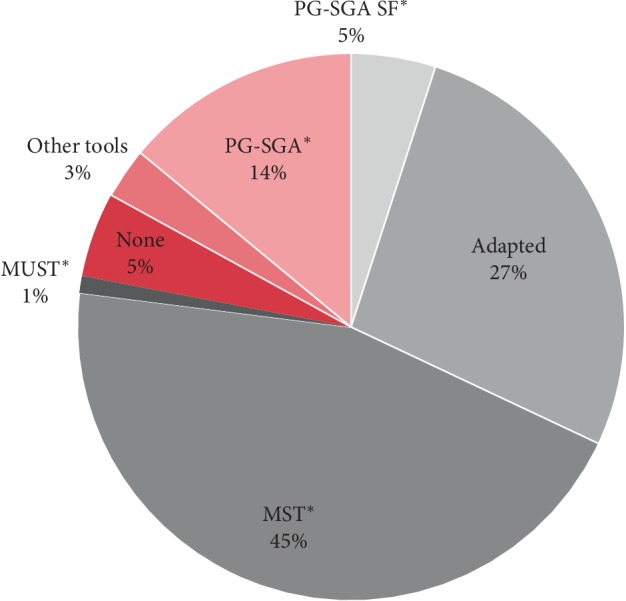
Cancer-related malnutrition is associated with poor health outcomes, including decreased tolerance to cancer therapy, greater treatment toxicities, and increased mortality. Medical nutrition therapy (MNT) optimizes clinical outcomes, yet registered dietitian nutritionists (RDNs), the healthcare professionals specifically trained in MNT, are not routinely employed in outpatient cancer centers where over 90% of all cancer patients are treated. The objective of this study was to evaluate RDN staffing patterns, nutrition services provided in ambulatory oncology settings, malnutrition screening practices, and referral and reimbursement practices across the nation in outpatient cancer centers. An online questionnaire was developed by the Oncology Nutrition Dietetic Practice Group (ON DPG) of the Academy of Nutrition and Dietetics and distributed via the ON DPG electronic mailing list. Complete data were summarized for 215 cancer centers. The mean RDN full-time equivalent (FTE) for all centers was 1.7 ± 2.0. After stratifying by type of center, National Cancer Institute-Designated Cancer Centers (NCI CCs) employed a mean of 3.1 ± 3.0 RDN FTEs compared to 1.3 ± 1.4 amongst non-NCI CCs. The RDN-to-patient ratio, based on reported analytic cases, was 1 : 2,308. Per day, RDNs evaluated and counseled an average of 7.4 ± 4.3 oncology patients. Approximately half (53.1%) of the centers screened for malnutrition, and 64.9% of these facilities used a validated malnutrition screening tool. The majority (76.8%) of centers do not bill for nutrition services. This is the first national study to evaluate RDN staffing patterns, provider-to-patient ratios, and reimbursement practices in outpatient cancer centers. These data indicate there is a significant gap in RDN access for oncology patients in need of nutritional care.
癌症相关营养不良与不良健康结局相关,包括对癌症治疗的耐受性降低、更高的治疗毒性以及死亡率增加。医学营养治疗(MNT)可优化临床结局,然而,注册营养师(RDN),即专门接受过MNT培训的医疗保健专业人员,在超过90%的癌症患者接受治疗的门诊癌症中心并未得到常规聘用。本研究的目的是评估全国门诊癌症中心的RDN人员配置模式、门诊肿瘤学环境中提供的营养服务、营养不良筛查实践以及转诊和报销实践。营养与饮食学会肿瘤营养饮食实践组(ON DPG)编制了一份在线问卷,并通过ON DPG电子邮件列表进行分发。对215个癌症中心的完整数据进行了汇总。所有中心的RDN全职等效人员(FTE)平均为1.7±2.0。按中心类型分层后,美国国立癌症研究所指定癌症中心(NCI CCs)平均聘用3.1±3.0名RDN FTE,而非NCI CCs为1.3±1.4名。根据报告的分析病例,RDN与患者的比例为1∶2308。RDN每天平均评估和咨询7.4±4.3名肿瘤患者。约一半(53.1%)的中心进行了营养不良筛查,其中64.9%的机构使用了经过验证的营养不良筛查工具。大多数(76.8%)中心未对营养服务收费。这是第一项评估门诊癌症中心RDN人员配置模式、医护人员与患者比例以及报销实践的全国性研究。这些数据表明,在需要营养护理的肿瘤患者获得RDN服务方面存在显著差距。