Dermond Philip, Melián Carlos J, Brodersen Jakob
1Department of Fish Ecology and Evolution, EAWAG Swiss Federal Institute of Aquatic Science and Technology, Centre of Ecology, Evolution and Biogeochemistry, Seestrasse 79, CH-6047 Kastanienbaum, Switzerland.
2Institute of Ecology and Evolution, Aquatic Ecology, University of Bern, Baltzerstrasse 6, CH-3012 Bern, Switzerland.
Mov Ecol. 2019 Dec 21;7:40. doi: 10.1186/s40462-019-0185-1. eCollection 2019.
Seasonal spatio-temporal variation in habitat quality and abiotic conditions leads to animals migrating between different environments around the world. Whereas mean population timing of migration is often fairly well understood, explanations for variation in migratory timing within populations are often lacking. Condition-dependent tradeoffs may be an understudied mechanism that can explain this differential migration. While fixed condition-specific thresholds have been identified in earlier work on ontogenetic niche shifts, they are rare in differential migration, suggesting that thresholds in such systems can shift based on temporally variable environmental conditions.
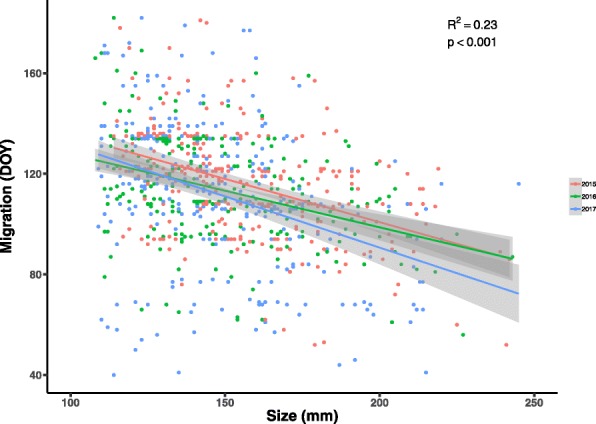
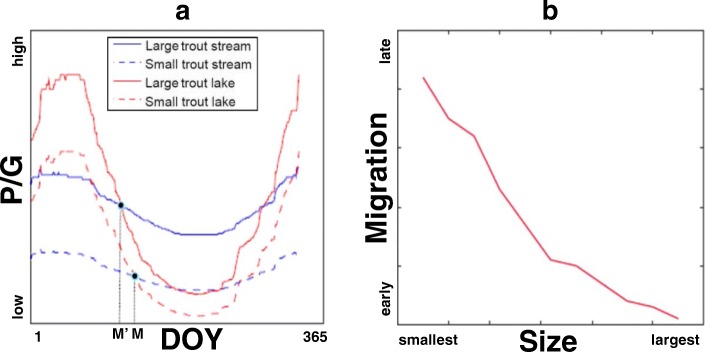
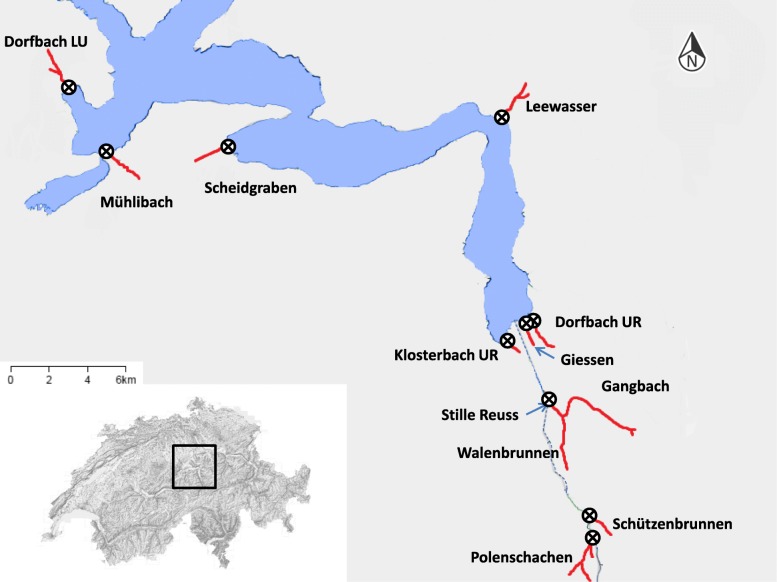
We introduced a model based on size-specific tradeoffs between migration and growth in seasonal environments. We focused on optimal migratory timing for first-time migrants with no knowledge of an alternative habitat, which is a crucial stage in the life history of migratory salmonids. We predicted that optimal timing would occur when individuals move from their natal habitats based on a seasonally variable ratio of predation and growth. When the ratio becomes slightly more favorable in the alternative habitat, migratory movement can occur. As it keeps shifting throughout the season, the threshold for migration is variable, allowing smaller individuals to move at later dates. We compared our model predictions to empirical data on 3 years of migratory movement of more than 800 juvenile trout of varying size from natal to feeding habitat.
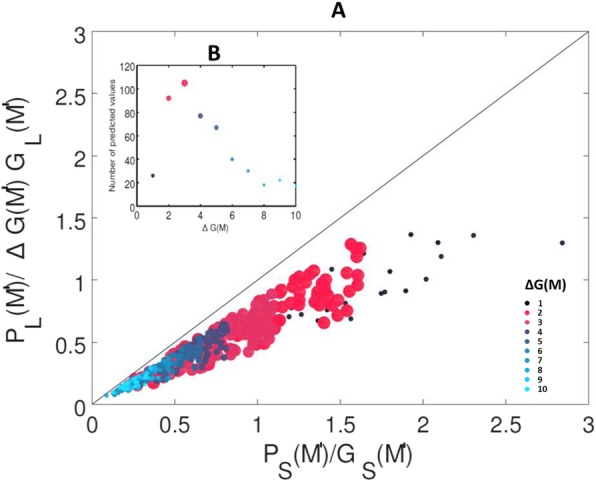
Both our model and empirical data showed that large individuals, which are assumed to have a lower predation risk in the migratory habitat, move earlier in the season than smaller individuals, whose predicted predation-to-growth ratio shifted to being favorable only later in the migratory season. Our model also predicted that the observed difference in migratory timing between large and small migrants occurred most often at low values of growth differential between the two habitats, suggesting that it was not merely high growth potential but rather the tradeoff between predation and growth that shaped differential migration patterns.
We showed the importance of considering condition-specific tradeoffs for understanding temporal population dynamics in spatially structured landscapes. Rather than assuming a fixed threshold, which appears to be absent based on previous work on salmonids, we showed that the body-size threshold for migration changed temporally throughout the season. This allowed increasingly smaller individuals to migrate when growth conditions peaked in the migratory habitat. Our model illuminates an understudied aspect of predation as part of a condition-dependent tradeoff that shapes migratory patterns, and our empirical data back patterns predicted by this model.
栖息地质量和非生物条件的季节性时空变化导致动物在全球不同环境之间迁徙。虽然种群迁徙的平均时间通常相当清楚,但对于种群内迁徙时间变化的解释往往不足。条件依赖的权衡可能是一种研究较少的机制,可以解释这种差异迁徙。虽然在早期关于个体发育生态位转移的研究中已经确定了特定条件的固定阈值,但在差异迁徙中却很少见,这表明此类系统中的阈值可以根据随时间变化的环境条件而变化。
我们引入了一个基于季节性环境中迁徙与生长之间大小特异性权衡的模型。我们关注首次迁徙且不了解替代栖息地的个体的最佳迁徙时间,这是洄游鲑科鱼类生活史中的关键阶段。我们预测,当个体根据捕食与生长的季节性可变比率从其出生栖息地迁移时,最佳时间将会出现。当该比率在替代栖息地变得稍微更有利时,迁徙运动就可能发生。由于它在整个季节不断变化,迁徙阈值是可变的,使得较小的个体能够在较晚的日期迁移。我们将模型预测与来自800多条不同大小的幼年鳟鱼从出生栖息地到觅食栖息地3年迁徙运动的实证数据进行了比较。
我们的模型和实证数据均表明,假定在迁徙栖息地捕食风险较低 的较大个体,会比 较小个体更早地在季节中迁徙,较小个体的预测捕食与生长比率仅在迁徙季节后期才变得有利。我们的模型还预测,大小不同的迁徙者在迁徙时间上观察到的差异最常出现在两个栖息地生长差异值较低时,这表明塑造差异迁徙模式的不仅仅是高生长潜力,而是捕食与生长之间的权衡。
我们展示了考虑特定条件权衡对于理解空间结构化景观中种群时间动态的重要性。我们没有假定一个固定阈值(根据之前对鲑科鱼类的研究似乎不存在这样的阈值),而是表明迁徙的体型阈值在整个季节中随时间变化。这使得越来越小的个体能够在迁徙栖息地生长条件达到峰值时进行迁徙。我们的模型阐明了捕食作为塑造迁徙模式的条件依赖权衡的一部分这一研究较少的方面,并且我们的实证数据支持了该模型预测的模式。