Clark Cari Jo, Shrestha Binita, Ferguson Gemma, Shrestha Prabin Nanicha, Calvert Collin, Gupta Jhumka, Batayeh Brian, Bergenfeld Irina, Oakes J Michael
Hubert Department of Global Health, Rollins School of Public Health, Emory University, 1518 Clifton Road NE, Atlanta, GA, 30322, USA.
Equal Access International, 1001 Connecticut Ave, NW Suite 909, Washington, DC, 20036,, USA.
SSM Popul Health. 2019 Dec 13;10:100530. doi: 10.1016/j.ssmph.2019.100530. eCollection 2020 Apr.
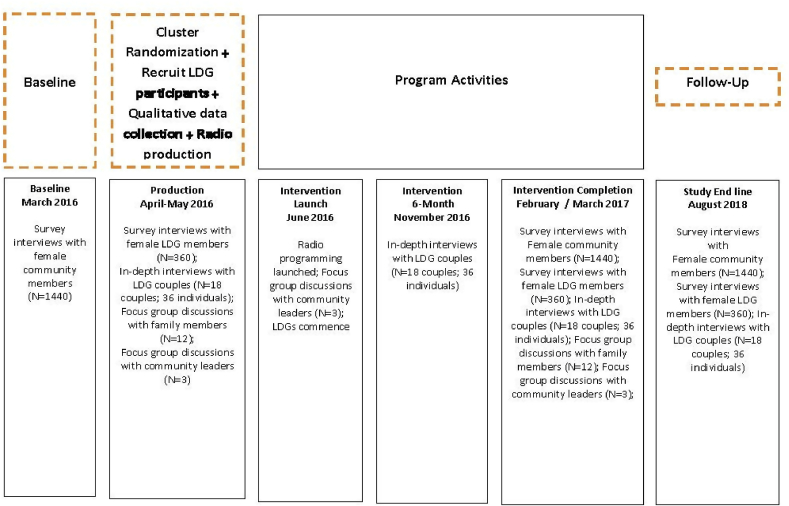
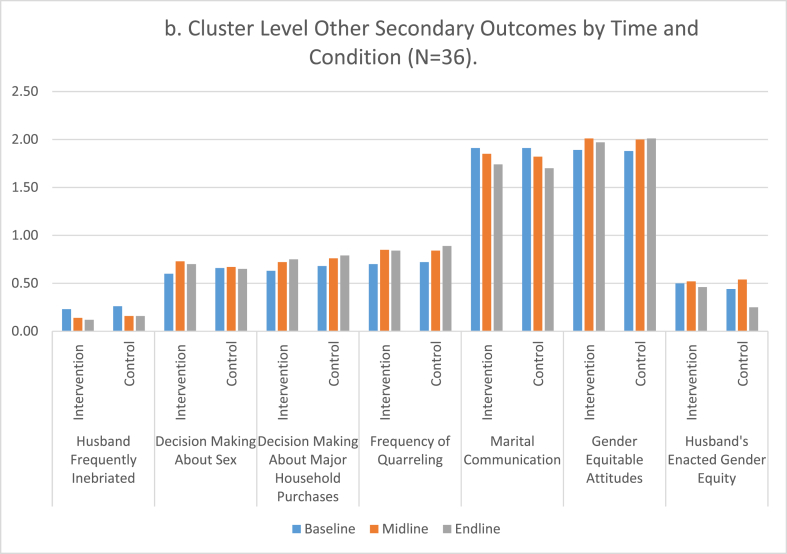
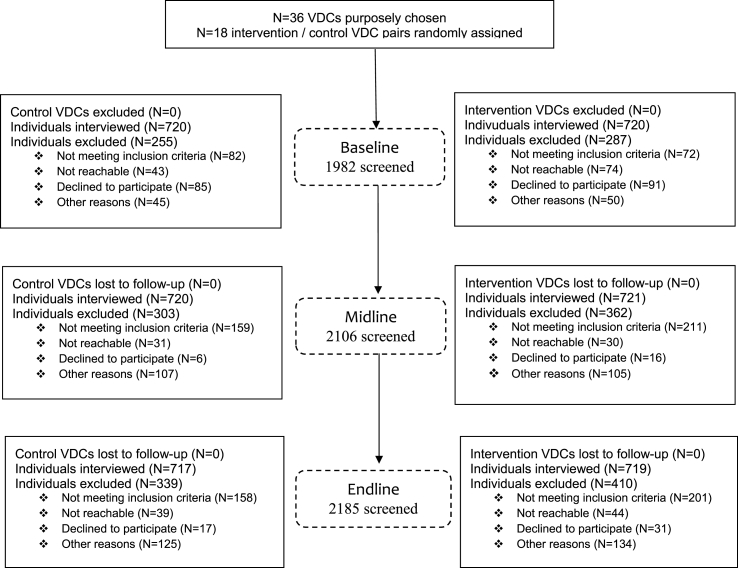
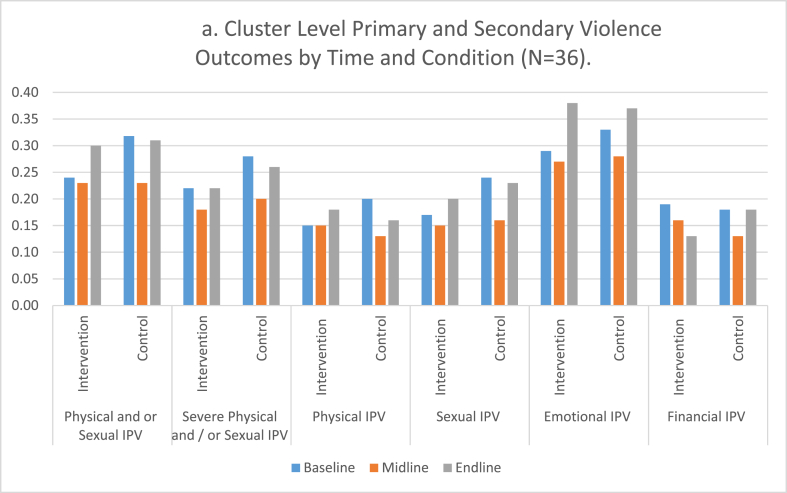
Intimate partner violence (IPV) affects 1 in 3 women worldwide. Research in low- and middle-income countries suggests that multicomponent interventions incorporating media, group work, and community mobilization may be effective at changing social norms that enable such violence. Our study aimed to evaluate the impact of a radio programme plus community engagement versus radio programming alone on the 12-month prevalence of IPV. Using a cluster randomized, repeat cross-sectional, single-blinded approach, thirty-six village communities were pair-matched within three districts in Nepal and randomly assigned to either control or intervention. Both groups were exposed to social behaviour change communication through radio programming. In addition, weekly listening and discussion groups (LDGs) were formed in intervention communities to meet and discuss radio programming over the 40-week intervention period. Participants were also exposed to other community mobilization activities such as street theatre and messaging from local leaders who were engaged in intervention programming. IPV was measured at baseline, 12 months post-baseline at program conclusion, and 28 months post-baseline using a simple random sample of 40 married women per cluster (n = approximately 1440 at each time point) along with 382 women who participated in the LDGs. Although control and intervention groups were demographically similar, baseline rates of IPV were higher in control areas. The trend in IPV for both groups was nonlinear, largely declining at midline (control condition) and rising again at endline (control and intervention conditions), possibly reflecting greater reporting due to awareness-raising activities. Significant differences between the two groups were largely absent at endline. Higher LDG attendance was associated with decreases in several forms of IPV, some of which persisted to endline. These findings suggest that intensive community engagement over longer timespans or social network measurement may be necessary to detect significant changes at the community level (NCT02942433).
亲密伴侣暴力(IPV)影响着全球三分之一的女性。低收入和中等收入国家的研究表明,结合媒体、小组工作和社区动员的多成分干预措施可能有效地改变助长此类暴力的社会规范。我们的研究旨在评估广播节目加社区参与与单独广播节目对IPV 12个月患病率的影响。采用整群随机、重复横断面、单盲方法,在尼泊尔的三个地区内将36个村庄社区进行配对匹配,并随机分配到对照组或干预组。两组都通过广播节目接受社会行为改变宣传。此外,在干预社区中每周组建收听和讨论小组(LDGs),在为期40周的干预期内见面并讨论广播节目。参与者还接触到其他社区动员活动,如街头戏剧以及参与干预计划的当地领导人传达的信息。在基线、基线后12个月(项目结束时)以及基线后28个月,使用每个整群中40名已婚妇女的简单随机样本(每个时间点n = 约1440)以及382名参与LDGs的妇女来测量IPV。虽然对照组和干预组在人口统计学上相似,但对照组地区的IPV基线发生率较高。两组IPV的趋势是非线性的,在中线(对照条件)时大多下降,在终点线(对照和干预条件)时再次上升,这可能反映出由于提高认识活动而导致的报告增加。在终点线时两组之间基本没有显著差异。较高的LDG出勤率与几种形式的IPV减少有关,其中一些持续到终点线。这些发现表明,可能需要在更长的时间跨度内进行密集的社区参与或社会网络测量,以在社区层面检测到显著变化(NCT02942433)。