Promundo-US, Washington, DC, United States of America.
Gender Innovation Lab, World Bank, Washington, DC, United States of America.
PLoS One. 2018 Apr 4;13(4):e0192756. doi: 10.1371/journal.pone.0192756. eCollection 2018.
Rigorous evidence of the effectiveness of male engagement interventions, particularly on how these interventions impact relationship power dynamics and women's decision-making, remains limited. This study assessed the impact of the Bandebereho gender-transformative couples' intervention on impact on multiple behavioral and health-related outcomes influenced by gender norms and power relations.
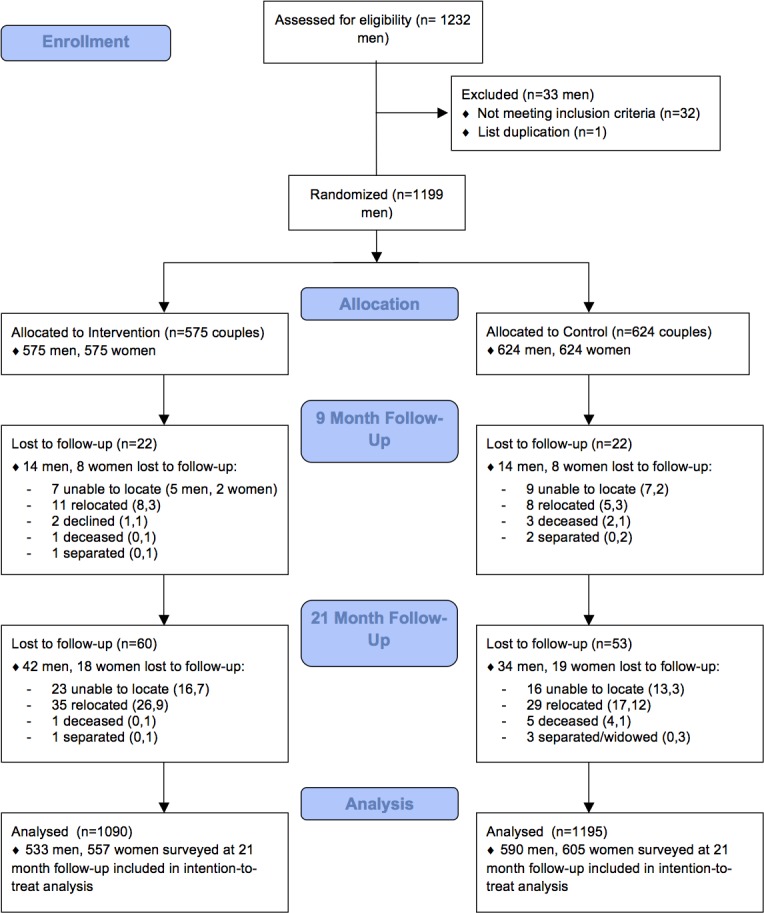
We conducted a multi-site randomised controlled trial in four Rwandan districts with expectant/current fathers and their partners, who were randomised to the intervention (n = 575 couples) or control group (n = 624 couples). Primary outcomes include women's experience of physical and sexual IPV, women's attendance and men's accompaniment at ANC, modern contraceptive use, and partner support during pregnancy. At 21-months post-baseline, 1123 men and 1162 partners were included in intention to treat analysis. Generalized estimating equations with robust standard errors were used to fit the models.
The Bandebereho intervention led to substantial improvements in multiple reported outcomes. Compared to the control group, women in the intervention group reported: less past-year physical (OR 0.37, p<0.001) and sexual IPV (OR 0.34, p<0.001); and greater attendance (IRR 1.09, p<0.001) and male accompaniment at antenatal care (IRR 1.50, p<0.001); and women and men in the intervention group reported: less child physical punishment (women: OR 0.56, p = 0.001; men: OR 0.66, p = 0.005); greater modern contraceptive use (women: OR 1.53, p = 0.004; men: OR 1.65, p = 0.001); higher levels of men's participation in childcare and household tasks (women: beta 0.39, p<0.001; men: beta 0.33, p<0.001); and less dominance of men in decision-making.
Our study strengthens the existing evidence on male engagement approaches; together with earlier studies our findings suggest that culturally adapted gender-transformative interventions with men and couples can be effective at changing deeply entrenched gender inequalities and a range of health-related behavioral outcomes.
ClinicalTrials.gov NCT02694627.
男性参与干预措施有效性的严格证据,特别是这些干预措施如何影响关系权力动态和妇女的决策,仍然有限。本研究评估了班德贝雷霍性别转换夫妇干预对受性别规范和权力关系影响的多种行为和健康相关结果的影响。
我们在卢旺达的四个地区进行了一项多地点随机对照试验,其中包括准父亲/当前父亲及其伴侣,他们被随机分配到干预组(n = 575 对夫妇)或对照组(n = 624 对夫妇)。主要结果包括妇女经历身体和性暴力侵害、妇女参加和男子陪同产前护理、现代避孕药具使用以及怀孕期间伴侣的支持。在基线后 21 个月,1123 名男性和 1162 名伴侣被纳入意向治疗分析。使用稳健标准误差的广义估计方程拟合模型。
与对照组相比,班德贝雷霍干预组在多项报告的结果中取得了实质性的改善。与对照组相比,干预组的女性报告:过去一年的身体暴力(OR 0.37,p<0.001)和性暴力(OR 0.34,p<0.001)较少;更多的产前护理就诊(IRR 1.09,p<0.001)和男性陪同(IRR 1.50,p<0.001);干预组的女性和男性报告:较少的儿童身体惩罚(女性:OR 0.56,p = 0.001;男性:OR 0.66,p = 0.005);更多的现代避孕药具使用(女性:OR 1.53,p = 0.004;男性:OR 1.65,p = 0.001);男性更多地参与儿童保育和家务(女性:β 0.39,p<0.001;男性:β 0.33,p<0.001);以及男性在决策中的主导地位降低。
我们的研究加强了关于男性参与方法的现有证据;结合早期研究,我们的研究结果表明,对男性和夫妇进行文化上适应的性别转换干预措施可以有效地改变根深蒂固的性别不平等和一系列与健康相关的行为结果。
ClinicalTrials.gov NCT02694627。