College of Medicine and Health Sciences, Adigrat University, Tigray, Ethiopia.
Pan African University Institute for Life and Earth Sciences, University of Ibadan, Ibadan, Nigeria.
BMC Pregnancy Childbirth. 2019 Dec 31;20(1):7. doi: 10.1186/s12884-019-2708-6.
The prevalence of pregnancy-induced hypertension in Ethiopia ranges from 2.2 to 18.3%. However, so far little is known about the adverse perinatal outcomes of pregnancy-induced hypertension in Tigray regional state, Ethiopia. Therefore, the objective of this study was to assess the effect of pregnancy-induced hypertension on adverse perinatal outcomes in Tigray Regional State, Ethiopia.
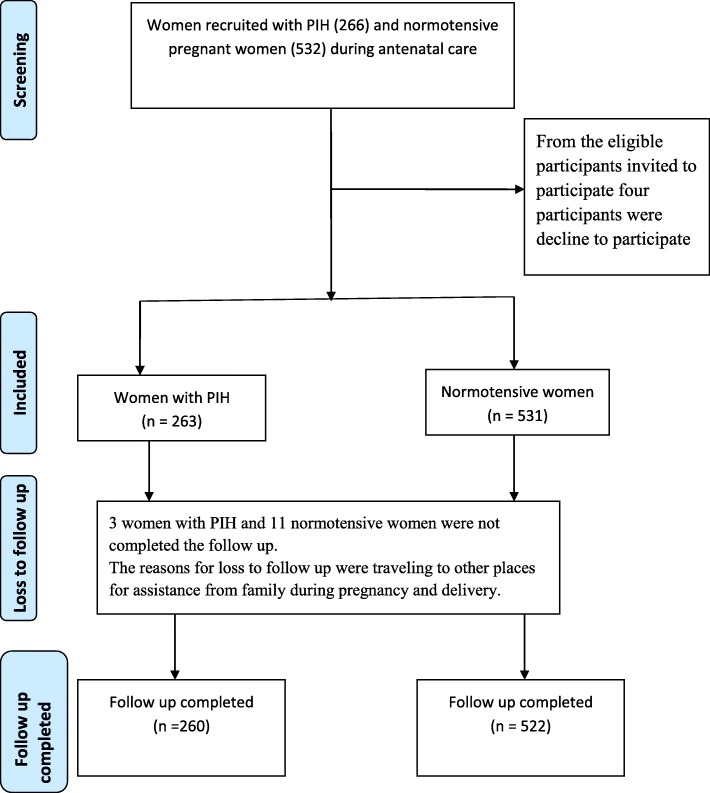
a prospective cohort study was conducted on a total sample of 782 pregnant women attending antenatal care in hospitals of Tigray regional state, Ethiopia. Pregnant mothers diagnosed with PIH during the data collection period in the selected hospitals were included as exposed group and normotensive women were also enrolled as a control group. This study addresses women diagnosed with preeclampsia, eclampsia and gestational hypertension between 28 and 35 weeks of gestation. Data were collected using an interviewer-administered questionnaire and review of their medical records from February 2018, to February 2019. The adverse perinatal outcome event includes low birth weight, birth asphyxia, small for gestational age, preterm delivery, admission to neonatal intensive care unit and perinatal death. A modified Poisson regression model with robust standard errors was used to analyze relative risk.
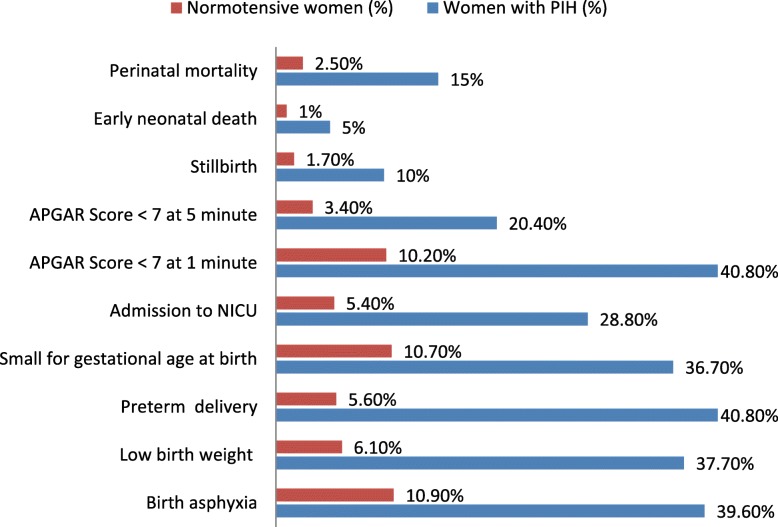
In this study, the overall incidence of adverse perinatal outcome was higher among women with pregnancy-induced hypertension than normotensive women (66.4% vs 22.2%). After adjusted for confounders women with pregnancy-induced hypertension were born babies with a higher risk of low birth weight (adjusted RR (95%CI) = 5.1(3.4,7.8)), birth asphyxia (aRR = 2.6(1.9,3.8)), small for gestational age (aRR = 3.3(2.3,4.6)), preterm delivery (aRR = 5.2(3.4,7.9)), stillbirth (aRR = 3.46(1.40,8.54)), admission to neonatal intensive care unit (aRR = 5.1(3.1,8.4)) and perinatal death (aRR = 3.6(1.8,7.4)) compared to normotensive pregnant women.
Higher incidences of adverse perinatal outcomes occurred among women pregnancy-induced hypertension in Tigray regional state, Ethiopia. Hence, health care providers should strengthen prevention, early diagnosis and prompt management of pregnancy-induced hypertension to reduce adverse perinatal outcomes of pregnancy-induced hypertension.
在埃塞俄比亚,妊娠高血压的患病率在 2.2%至 18.3%之间。然而,迄今为止,人们对提格雷州妊娠高血压对围产期不良结局的影响知之甚少。因此,本研究旨在评估妊娠高血压对提格雷州埃塞俄比亚围产期不良结局的影响。
对在提格雷州医院接受产前护理的 782 名孕妇进行了一项前瞻性队列研究。在选定医院的数据收集期间被诊断为妊娠高血压的孕妇被纳入暴露组,正常血压的孕妇也被纳入对照组。本研究关注的是在 28 至 35 周妊娠期间被诊断为子痫前期、子痫和妊娠期高血压的女性。数据是通过访谈式问卷调查和对 2018 年 2 月至 2019 年 2 月期间的医疗记录进行回顾收集的。围产期不良结局事件包括低出生体重、出生窒息、小于胎龄儿、早产、新生儿重症监护病房入院和围产儿死亡。采用稳健标准误差的修正泊松回归模型进行分析相对风险。
在这项研究中,妊娠高血压孕妇的围产期不良结局发生率高于正常血压孕妇(66.4%比 22.2%)。在调整混杂因素后,妊娠高血压孕妇所生婴儿有更高的低出生体重风险(调整后的 RR(95%CI)=5.1(3.4,7.8))、出生窒息(aRR=2.6(1.9,3.8))、小于胎龄儿(aRR=3.3(2.3,4.6))、早产(aRR=5.2(3.4,7.9))、死产(aRR=3.46(1.40,8.54))、新生儿重症监护病房入院(aRR=5.1(3.1,8.4))和围产儿死亡(aRR=3.6(1.8,7.4))的风险。
在提格雷州,妊娠高血压孕妇的围产期不良结局发生率较高。因此,医疗保健提供者应加强妊娠高血压的预防、早期诊断和及时管理,以降低妊娠高血压的围产期不良结局。