Wang Kai, Yang Shasha, Gao Yishen, Zhang Caihong, Sui Qiangbo
Department of Neurosurgery, Weihai Central Hospital, Weihai, Shandong 264400, P.R. China.
Department of Burns, Weihai Central Hospital, Weihai, Shandong 264400, P.R. China.
Oncol Lett. 2020 Jan;19(1):992-1000. doi: 10.3892/ol.2019.11135. Epub 2019 Nov 21.
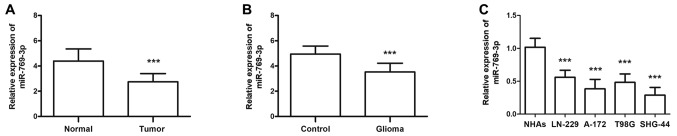
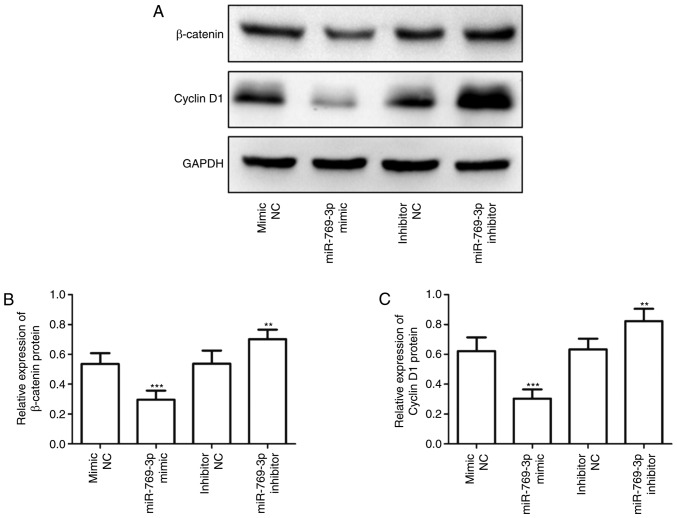
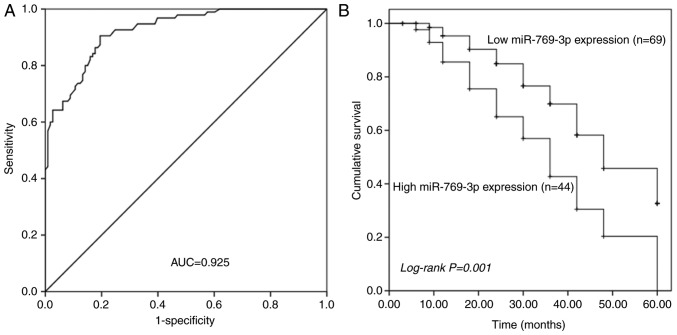
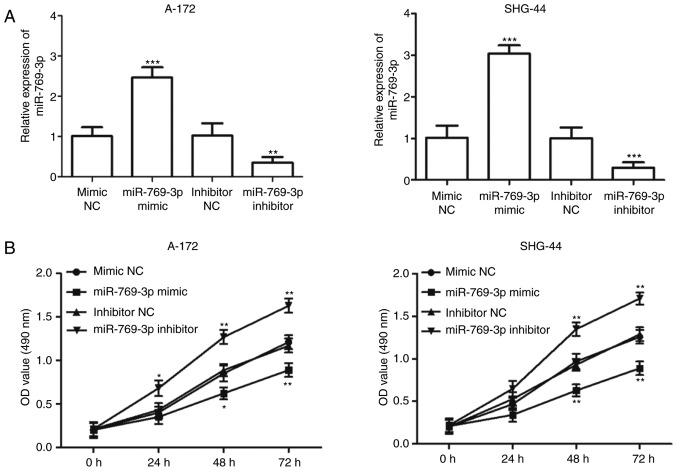
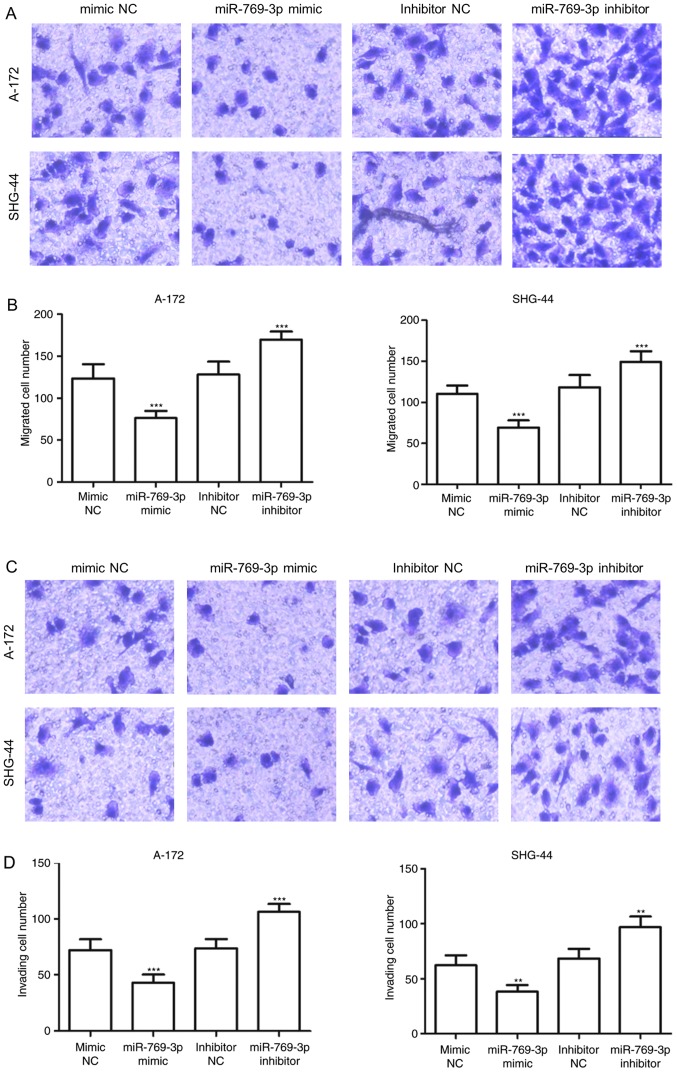
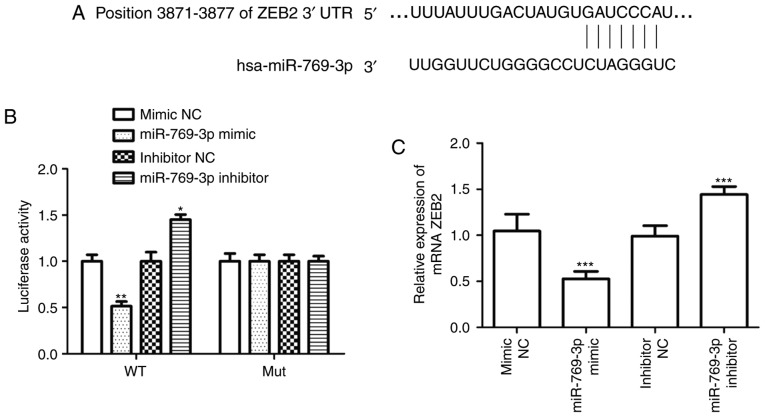
Accumulating evidence suggests the crucial role of microRNAs (miRNAs) in human cancers. The present study aimed to investigate the clinical and functional roles of miR-769-3p in glioma, as well as the underlying molecular mechanisms. Reverse transcription-quantitative polymerase chain reaction (RT-qPCR) was used to determine the expression levels of miR-769-3p in glioma tissues and cells. Receiver operating characteristic (ROC) curve analysis was applied to calculate the diagnostic value of miR-769-3p. The 5-year survival rate of patients was calculated using Kaplan-Meier analysis and Cox regression analysis. Cell experiments were used to investigate the functional role of miR-769-3p in glioma. The gene target of miR-769-3p was predicted by TargetScan. Changes in the levels of Wnt signaling-related proteins were measured by western blotting. miR-769-3p was significantly downregulated in glioma tissues and serum, as well as in glioma cell lines (P<0.001). miR-769-3p expression was significantly associated with the World Health Organization grade and Karnofsky performance score. The ROC curves demonstrated that serum miR-769-3p level reliably distinguished patients with glioma from healthy individuals. High tissue miR-769-3p expression predicted poor overall survival in patients with glioma (log-rank P=0.001) and was identified as an independent prognostic factor. In addition, zinc finger E-box binding homeobox 2 (ZEB2) was demonstrated to be a direct target of miR-769-3p in glioma cells using a luciferase assay. miR-769-3p upregulation suppressed the activity of the Wnt/β-catenin signaling pathway in glioma cells. In conclusion, miR-769-3p may serve as a diagnostic and prognostic biomarker in patients with glioma and target ZEB2 to inhibit tumor progression via the Wnt/β-catenin signaling pathway. miR-769-3p may be a novel therapeutic target for the treatment of glioma.
越来越多的证据表明,微小RNA(miRNA)在人类癌症中起着关键作用。本研究旨在探讨miR-769-3p在胶质瘤中的临床和功能作用,以及潜在的分子机制。采用逆转录定量聚合酶链反应(RT-qPCR)检测miR-769-3p在胶质瘤组织和细胞中的表达水平。应用受试者工作特征(ROC)曲线分析计算miR-769-3p的诊断价值。采用Kaplan-Meier分析和Cox回归分析计算患者的5年生存率。通过细胞实验研究miR-769-3p在胶质瘤中的功能作用。通过TargetScan预测miR-769-3p的基因靶点。采用蛋白质印迹法检测Wnt信号相关蛋白水平的变化。miR-769-3p在胶质瘤组织、血清以及胶质瘤细胞系中均显著下调(P<0.001)。miR-769-3p表达与世界卫生组织分级和卡氏功能状态评分显著相关。ROC曲线表明,血清miR-769-3p水平能够可靠地区分胶质瘤患者与健康个体。高组织miR-769-3p表达预示着胶质瘤患者的总生存期较差(对数秩检验P=0.001),并被确定为独立的预后因素。此外,荧光素酶报告基因实验证明锌指E盒结合同源框2(ZEB2)是胶质瘤细胞中miR-769-3p的直接靶点。miR-769-3p上调抑制了胶质瘤细胞中Wnt/β-连环蛋白信号通路的活性。总之,miR-769-3p可能作为胶质瘤患者的诊断和预后生物标志物,并通过Wnt/β-连环蛋白信号通路靶向ZEB2以抑制肿瘤进展。miR-769-3p可能是治疗胶质瘤的新型治疗靶点。