Linden-Lahti Carita, Holmström Anna-Riia, Pennanen Pirjo, Airaksinen Marja
MSc. Helsinki University Hospital, HUS Pharmacy; & Division of Pharmacology and Pharmacotherapy, Faculty of Pharmacy, University of Helsinki.Finland
PhD. Helsinki University Hospital, HUS Pharmacy; & Division of Pharmacology and Pharmacotherapy, Faculty of Pharmacy, University of Helsinki.Finland.
Pharm Pract (Granada). 2019 Oct-Dec;17(4):1583. doi: 10.18549/PharmPract.2019.4.1583. Epub 2019 Dec 4.
The study was carried out as part of the European Network for Patient Safety (EUNetPas) project in 2008-2010.
To investigate facilitators and barriers in implementation process of selected medication safety practices across hospitals within European Union countries.
This was an implementation study of seven selected medication safety practices in 55 volunteering hospitals of 11 European Union (EU) member states. The selected practices were two different versions of medicine bed dispensation; safety vest; discharge medication list for patients; medication reconciliation at patient discharge; medication reconciliation at patient admission and patient discharge, and sleep card. The participating hospitals submitted an evaluation report describing the implementation process of a chosen practice in their organisation. The reports were analysed with inductive content analysis to identify general and practice-specific facilitators and barriers to the practice implementation.
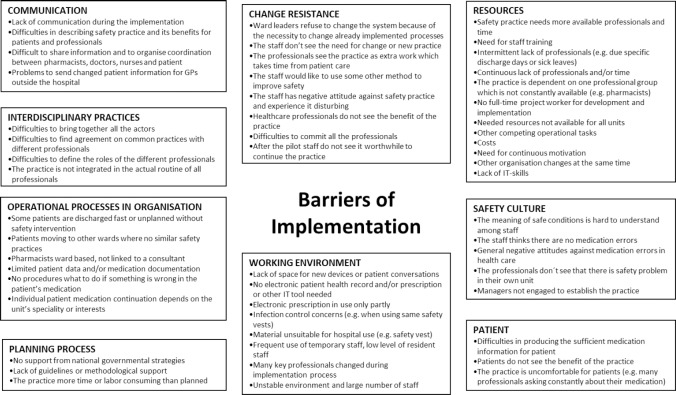
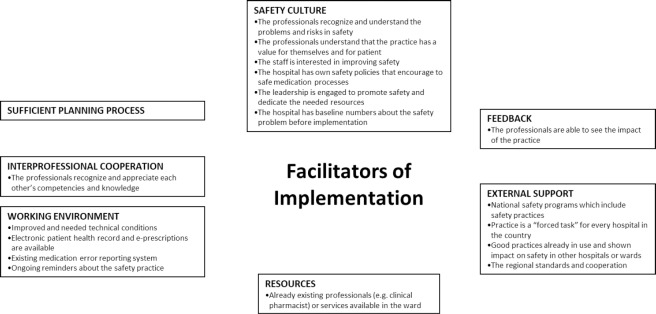
Altogether 75 evaluation reports were submitted from 55 hospitals in 11 EU member states. Implementation of the medication safety practices was challenging and more time consuming than expected. The major reported challenge was to change the work process because of the new practice. General facilitators for successful implementation were existence of safety culture, national guidelines and projects, expert support, sufficient resources, electronic patient records, interdisciplinary cooperation and clinical pharmacy services supporting the practice implementation.
The key for the successful implementation of a medication safety practice is to select the right practice for the right problem, in the right setting and with sufficient resources in an organization with a safety culture.
该研究作为欧洲患者安全网络(EUNetPas)项目的一部分,于2008 - 2010年开展。
调查欧盟国家各医院在选定药物安全实践实施过程中的促进因素和障碍。
这是一项针对11个欧盟成员国55家志愿医院的7项选定药物安全实践的实施研究。选定的实践包括两种不同版本的病床发药;安全背心;患者出院用药清单;患者出院时的用药核对;患者入院和出院时的用药核对,以及睡眠卡。参与医院提交了一份评估报告,描述其组织中选定实践的实施过程。通过归纳性内容分析对报告进行分析,以确定实践实施的一般和特定实践的促进因素和障碍。
来自11个欧盟成员国55家医院共提交了75份评估报告。药物安全实践的实施具有挑战性,且比预期更耗时。报告的主要挑战是由于新实践而改变工作流程。成功实施的一般促进因素包括存在安全文化、国家指南和项目、专家支持、充足资源、电子病历、跨学科合作以及支持实践实施的临床药学服务。
成功实施药物安全实践的关键是在具有安全文化、资源充足的合适环境中,为正确的问题选择正确的实践。