University of Michigan Addiction Center and Department of Psychiatry, University of Michigan School of Medicine, 4250 Plymouth Road, Ann Arbor, MI 48109, United States of America; University of Michigan Injury Prevention Center, University of Michigan School of Medicine, 2800 Plymouth Road, NCRC10-G080, Ann Arbor, MI 48109, United States of America.
University of Michigan Addiction Center and Department of Psychiatry, University of Michigan School of Medicine, 4250 Plymouth Road, Ann Arbor, MI 48109, United States of America.
Prev Med. 2020 Mar;132:105972. doi: 10.1016/j.ypmed.2019.105972. Epub 2020 Jan 3.
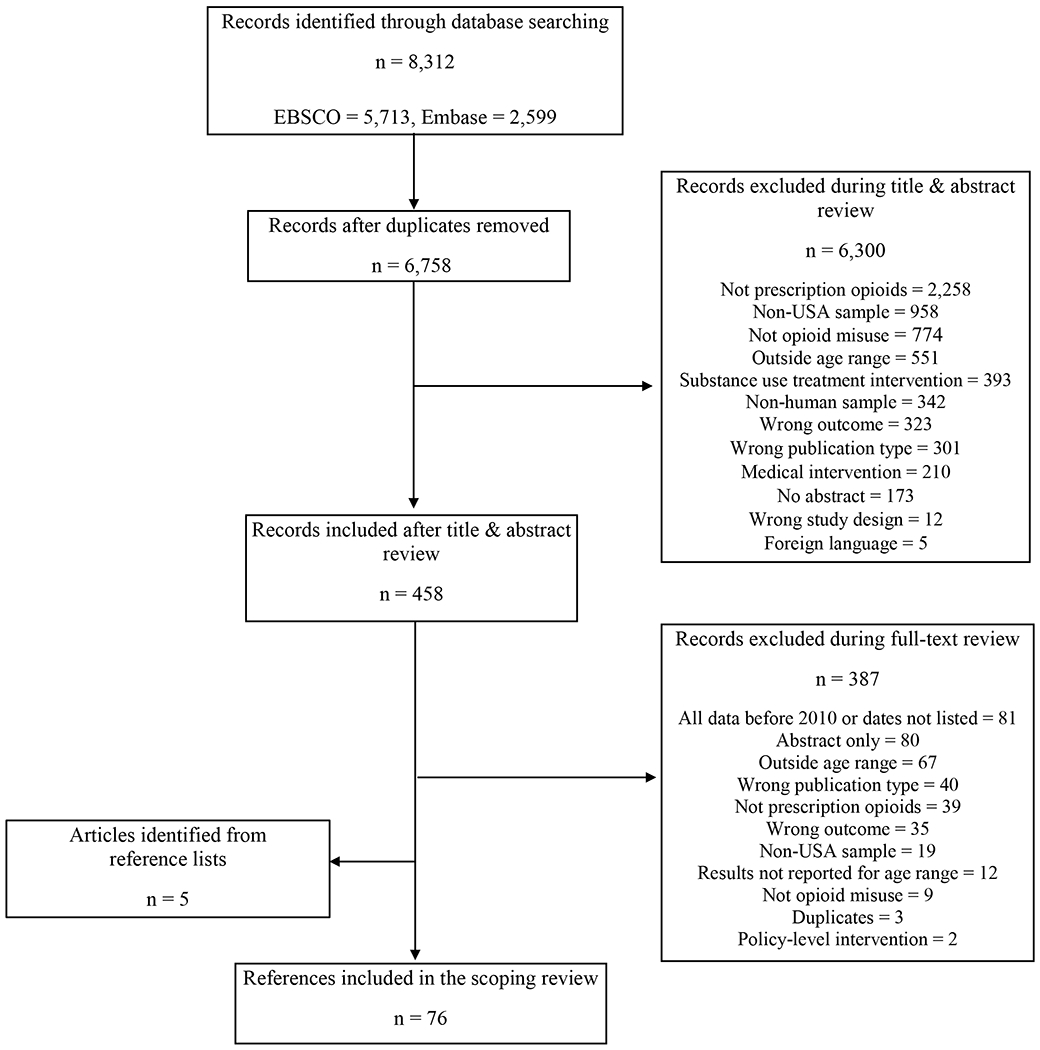
The U.S. opioid epidemic is a critical public health problem. As substance use and misuse typically begin in adolescence and emerging adulthood, there is a critical need for prevention efforts for this key developmental period to disrupt opioid misuse trajectories, reducing morbidity and mortality [e.g., overdose, development of opioid use disorders (OUD)]. This article describes the current state of research focusing on prescription opioid misuse (POM) among adolescents and emerging adults (A/EAs) in the U.S. Given the rapidly changing nature of the opioid epidemic, we applied PRISMA Scoping Review (PRISMA-ScR) guidelines to identify empirical articles published in the past 5 years (January 2013-September 2018) from nine databases examining POM among A/EAs (ages 10-25) in the U.S. Seventy-six articles met our inclusion criteria focusing on POM in the following areas: cross-sectional surveys (n = 60), longitudinal cohort studies (n = 5), objective, non-self-reported data sources (n = 9), and interventions (n = 2). Final charted data elements were organized by methodology and sample, with results tables describing design, sample, interventions (where applicable), outcomes, and limitations. Most studies focused on the epidemiology of POM and risk/protective factors, including demographic (e.g., sex, race), individual (e.g., substance use, mental health), and social (e.g., peer substance use) factors. Despite annual national surveys conducted, longitudinal studies examining markers of initiation and escalation of prescription opioid misuse (e.g., repeated overdoses, time to misuse) are lacking. Importantly, few evidence-based prevention or early intervention programs were identified. Future research should examine longitudinal trajectories of POM, as well as adaptation and implementation of promising prevention approaches.
美国阿片类药物流行是一个严重的公共卫生问题。由于物质使用和滥用通常始于青少年和成年早期,因此需要在这一关键的发展时期开展预防工作,以打破阿片类药物滥用轨迹,降低发病率和死亡率[例如,过量用药、阿片类药物使用障碍(OUD)的发展]。本文描述了目前专注于美国青少年和成年早期(A/EAs)处方类阿片药物滥用(POM)的研究状况。鉴于阿片类药物流行的性质迅速变化,我们应用 PRISMA 范围综述(PRISMA-ScR)指南,从 9 个数据库中确定了过去 5 年(2013 年 1 月至 2018 年 9 月)发表的研究论文,以研究美国 A/EAs(10-25 岁)中的 POM。76 篇文章符合我们的纳入标准,重点研究了以下领域的 POM:横断面调查(n=60)、纵向队列研究(n=5)、客观的非自我报告数据来源(n=9)和干预措施(n=2)。最终图表数据元素按方法和样本进行组织,结果表描述了设计、样本、干预措施(适用时)、结果和局限性。大多数研究都集中在 POM 的流行病学和风险/保护因素上,包括人口统计学因素(例如,性别、种族)、个体因素(例如,物质使用、心理健康)和社会因素(例如,同伴物质使用)。尽管每年都进行全国性调查,但缺乏纵向研究来检查处方类阿片药物滥用开始和升级的标志物(例如,重复过量用药、滥用时间)。重要的是,几乎没有发现基于证据的预防或早期干预计划。未来的研究应研究 POM 的纵向轨迹,以及有希望的预防方法的适应性和实施。