Chandra Roy Miltan, Lee Dongwoon, Kim Yonggyun
Department of Plant Medicals, Andong National University, Andong 36729, Korea.
School of Environmental Ecology and Tourism, Kyungpook National University, Sangju 37224, Korea.
Insects. 2019 Dec 31;11(1):33. doi: 10.3390/insects11010033.
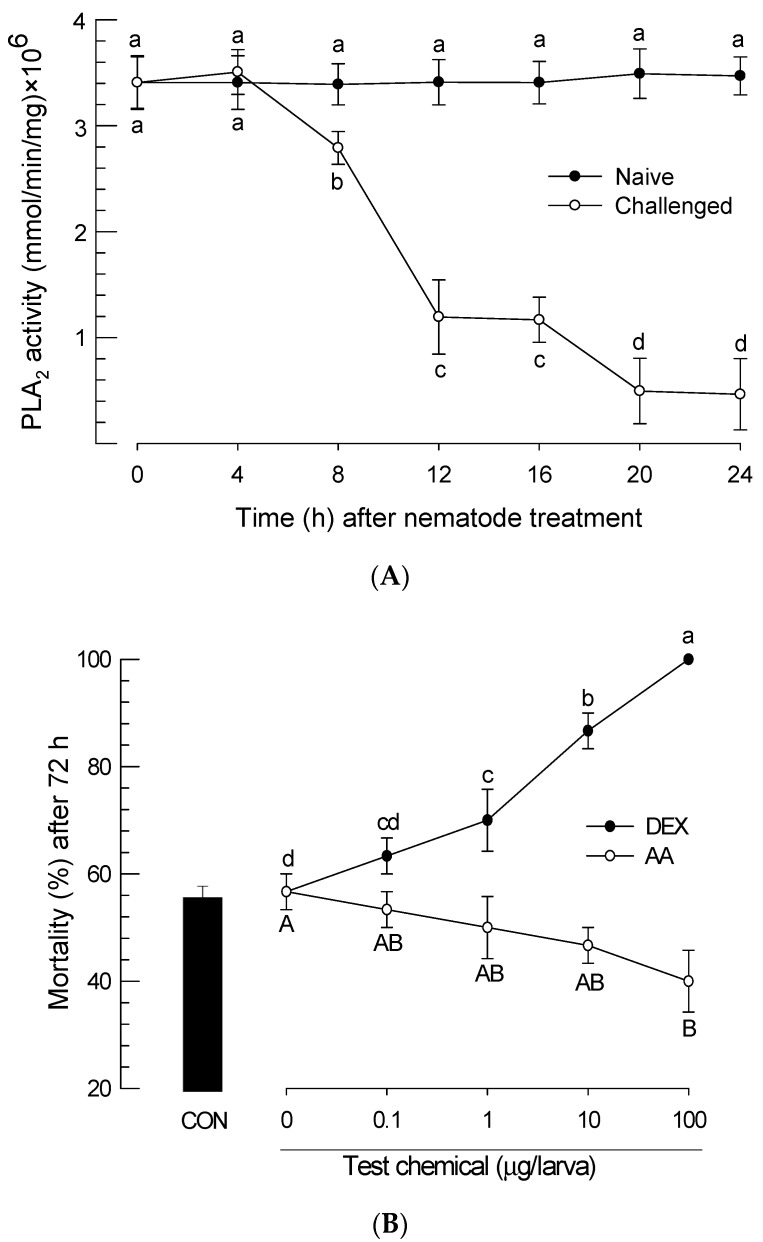
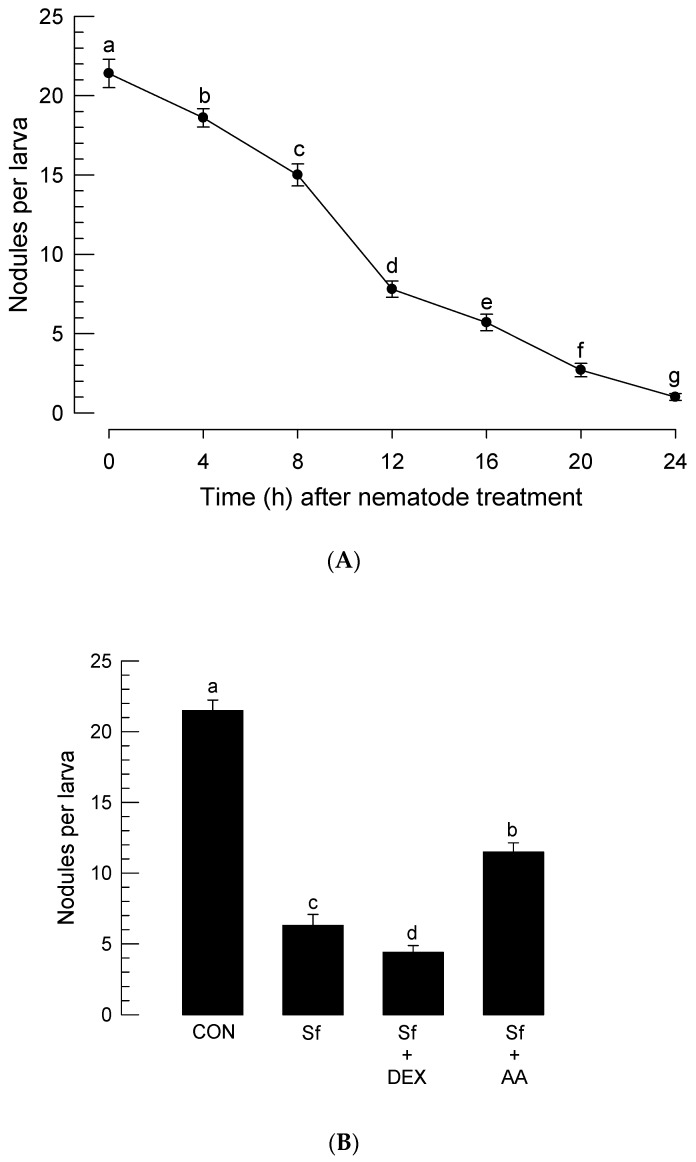
K1 (Filipjev) (Nematode: Steinernematidae), an entomopathogenic nematode, was isolated and identified based on its morphological and molecular diagnostic characteristics. Its infective juveniles (IJs) were highly pathogenic to three lepidopteran (LC = 23.7-25.0 IJs/larva) and one coleopteran (LC = 39.3 IJs/larva) insect species. Infected larvae of the diamondback moth, (L.) (Insecta: Lepidoptera), exhibited significant reduction in phospholipase A (PLA) activity in their plasma. The decrease of PLA activity was followed by significant septicemia of the larvae infected with . Insecticidal activity induced by was explained by significant immunosuppression in cellular immune responses measured by hemocyte nodule formation and total hemocyte count (THC). Although infection suppressed nodule formation and THC in the larvae, an addition of arachidonic acid (AA, a catalytic product of PLA) rescued these larvae from fatal immunosuppression. In contrast, an addition of dexamethasone (a specific PLA inhibitor) enhanced the nematode's pathogenicity in a dose-dependent manner. To discriminate the immunosuppressive activity of a symbiotic bacterium ( (Proteobacteria: Enterobacterales)) from the nematode, kanamycin was applied to after nematode infection. It significantly inhibited the bacterial growth in the hemolymph. Compared to nematode treatment alone, the addition of antibiotics to nematode infection partially rescued the immunosuppression measured by phenol oxidase activity. Consequently, treatment with antibiotics significantly rescued the larvae from the insecticidal activity of . These results suggest that immunosuppression induced by infection of depends on its symbiotic bacteria by inhibiting eicosanoid biosynthesis, resulting in significant insect mortality. However, the addition of antibiotics or AA could not completely rescue the virulence of the nematode, suggesting that the nematode itself also plays a role in its insecticidal activity.
K1(菲利皮耶夫)(线虫纲:斯氏线虫科)是一种昆虫病原线虫,根据其形态学和分子诊断特征进行分离和鉴定。其感染性幼虫(IJs)对三种鳞翅目昆虫(致死浓度=23.7-25.0条IJs/幼虫)和一种鞘翅目昆虫(致死浓度=39.3条IJs/幼虫)具有高度致病性。小菜蛾(L.)(昆虫纲:鳞翅目)的感染幼虫血浆中的磷脂酶A(PLA)活性显著降低。PLA活性降低后,感染K1的幼虫出现明显的败血症。K1诱导的杀虫活性可通过血细胞结节形成和总血细胞计数(THC)所测量的细胞免疫反应中的显著免疫抑制来解释。尽管K1感染抑制了幼虫的结节形成和THC,但添加花生四烯酸(AA,PLA的催化产物)可使这些幼虫免于致命的免疫抑制。相反,添加地塞米松(一种特异性PLA抑制剂)以剂量依赖的方式增强了线虫的致病性。为了区分共生细菌(变形菌门:肠杆菌目)与线虫的免疫抑制活性,在感染线虫后应用卡那霉素。它显著抑制了血淋巴中的细菌生长。与单独的线虫处理相比,在感染线虫时添加抗生素可部分挽救通过酚氧化酶活性测量的免疫抑制。因此,用抗生素处理可显著使幼虫免于K1的杀虫活性。这些结果表明,K1感染诱导的免疫抑制取决于其共生细菌,通过抑制类花生酸生物合成,导致显著的昆虫死亡。然而,添加抗生素或AA不能完全挽救线虫的毒力,这表明线虫本身在其杀虫活性中也起作用。