
LTCC 流量传感器,带 RFID 接口。
LTCC Flow Sensor with RFID Interface.
机构信息
Department of Electronic and Telecommunications Systems, Rzeszów University of Technology, Wincentego Pola 2, 35-959 Rzeszów, Poland.
Faculty of Microsystem Electronics and Photonics, Wrocław University of Technology, Janiszewskiego 11/17, 50-372 Wrocław, Poland.
出版信息
Sensors (Basel). 2020 Jan 2;20(1):268. doi: 10.3390/s20010268.
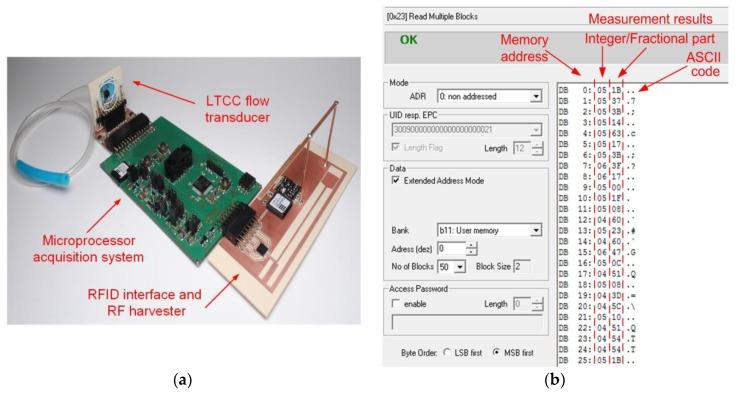
The idea of battery-less flow sensors and their implementation in wireless measurement systems is presented in this research article. The authors take advantage of their latest achievements in the Low Temperature Co-fired Ceramic (LTCC) technology, RadioFrequency Identification (RFID) technique, and increasing availability of low power electronics in order to get rid of the need to use electrochemical cells in a power supply unit of the elaborated device. To reach this assumption, special care has to be put on the energy balance in such an autonomous sensor node. First of all, the new concept of an electromagnetic LTCC turbine transducer with a signal conditioner which only draws a current of around 15 µA, is proposed for measuring a flow rate of fluids. Next, the autonomy of the device is showed; measured data are gathered in a microcontroller memory and sent to a control unit via an RFID interface which enables both information exchange and power transfer. The energy harvested from the electromagnetic field is used to conduct a data transmission, but also its excess can be accumulated, so the proposed sensor operates as a semi-passive transponder. The total autonomy of the device is achieved by implementing a second harvester that continually gathers energy from the environmental electromagnetic field of common active radio systems (e.g., Global System for Mobile Communications (GSM), wireless network Wi-Fi).
本文提出了一种无需电池的流量传感器及其在无线测量系统中的实现方法。作者利用其在低温共烧陶瓷(LTCC)技术、射频识别(RFID)技术以及低功耗电子设备日益普及方面的最新成果,摆脱了在所研制设备的电源单元中使用电化学电池的需要。为了实现这一假设,必须特别注意这种自主式传感器节点中的能量平衡。首先,提出了一种新型的电磁 LTCC 涡轮换能器及其信号调理器,该换能器仅需约 15µA 的电流即可测量流体的流速。其次,展示了设备的自主性;测量数据被收集在微控制器的内存中,并通过 RFID 接口发送到控制单元,该接口既实现了信息交换,也实现了功率传输。从电磁场中采集的能量用于进行数据传输,但也可以将其多余部分积累起来,因此所提出的传感器作为半被动式应答器运行。通过实现第二个采集器,从常见的有源无线电系统(如全球移动通信系统(GSM)、无线局域网 Wi-Fi)的环境电磁场中持续采集能量,从而实现了设备的完全自主性。




 Zotero 插件